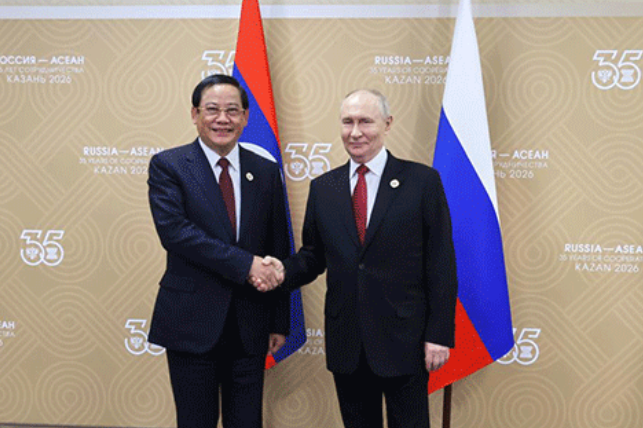
Prime Minister Sonexay Siphandone has concluded his first official visit to Russia since taking office with a significant reaffirmation of bilateral ties, meeting President Vladimir Putin at the Russia-Association of Southeast Asian Nations Summit in Kazan from June 14-17. The encounter underscored the two nations' commitment to broadening cooperation across multiple economic and strategic sectors, positioning Laos as an important partner for Russia's engagement with Southeast Asia at a time when Moscow is strengthening its regional footprint beyond traditional allies.
The timing of Prime Minister Sonexay's visit proved particularly significant, as it coincided with Russia's major regional diplomacy initiative. President Putin's public endorsement of Russia-Laos relations, describing them as rooted in "friendship, mutual respect and a balance of each other's interests," reflects Moscow's broader strategy to consolidate ties with Southeast Asian nations. This comes as Russia seeks to expand its sphere of influence in a region where Western countries maintain traditional dominance, making Laos's consistent alignment with Moscow a valuable asset for Kremlin diplomacy.
Among the concrete outcomes, the two countries signed an intergovernmental agreement on peaceful nuclear energy cooperation, which carries far-reaching implications for Laos's energy security and development trajectory. The agreement establishes the legal framework for constructing a small nuclear power plant utilising Russian technology within Laos—a project that could fundamentally reshape the country's energy infrastructure and reduce reliance on hydroelectric exports. For a nation heavily dependent on revenue from dam construction and power sales to neighbours, diversifying into nuclear energy represents a strategic pivot that warrants close regional attention, particularly given ongoing debates about energy sovereignty and technological dependence in Southeast Asia.
President Putin's acknowledgement of Laotian participation in Russian Victory Day celebrations and the attendance of a Lao People's Army unit at the 80th anniversary parade of Soviet victory in World War II highlights the symbolic dimensions of the relationship. These cultural and historical gestures underscore a deeper narrative that Russia cultivates with Southeast Asian partners, one centred on shared historical memory and non-alignment with Western geopolitical frameworks. For Laos, maintaining these bonds serves multiple purposes: it demonstrates independence in foreign policy, secures continued Russian support, and reinforces the narrative of multipolarity that appeals to the Lao government's strategic positioning.
Cooperation spans a diversifying portfolio of sectors beyond energy. The two governments identified opportunities for collaboration in industrial development, agricultural modernisation, mining operations, digital economy advancement, banking integration, transport infrastructure, tourism promotion, and educational exchange. This comprehensive approach signals Russia's intention to embed itself deeper into Laos's economy and society, moving beyond the traditional framework of resource extraction or military supply relationships that have historically characterised Moscow's engagement with developing nations.
Educational cooperation merits particular scrutiny for Malaysian and Southeast Asian observers. Prime Minister Sonexay specifically commended Russia for providing annual scholarships and training opportunities for Lao nationals, including government officials. This investment in human capital development creates long-term strategic bonds, as officials trained in Russian institutions return home with linguistic capabilities, institutional knowledge, and professional networks that sustain diplomatic alignment. For Laos, which faces capacity constraints in developing skilled workforces, such assistance addresses genuine developmental needs while incrementally shifting institutional orientations toward Russian models and perspectives.
The construction of the Laos-Russia Friendship School in Vientiane, expected to reach completion soon, represents another vehicle for deepening societal-level connections. Educational institutions bearing such nomenclature function as more than schools; they serve as cultural ambassadors and institutional anchors for bilateral relationships, influencing how new generations of Lao citizens perceive Russia and international relations more broadly. This soft power dimension complements Russia's harder strategic objectives in the region.
The gift of two elephants to Kazan Zoo, presented to commemorate the 65th anniversary of Laos-Russia diplomatic relations and Russia Day on June 12, exemplifies the ceremonial dimensions of bilateral statecraft. While seemingly symbolic, such gestures carry diplomatic weight by demonstrating goodwill and shared celebration of historical ties. For Laos, such traditional offerings underscore cultural pride and the continuity of relationship maintenance—important signalling mechanisms in Southeast Asian diplomacy where ceremonial propriety carries substantive weight.
Prime Minister Sonexay's address at the Laos-Russia business forum, focused on promoting trade and investment cooperation, indicates that economic interests drive engagement beyond political and strategic considerations. However, trade between Laos and Russia remains modest compared to the nation's engagement with China, Vietnam, and Thailand. Expanding commercial ties requires more than goodwill declarations; it demands removal of logistical barriers, currency stability, and identification of complementary economic niches where both nations possess competitive advantages. The business forum provides a venue for such discovery, though outcomes remain uncertain.
For Malaysia and other Southeast Asian nations, the deepening Laos-Russia partnership illustrates broader regional dynamics worth monitoring. As Russia pursues strategic penetration of Southeast Asia through bilateral relationships with individual nations, the pattern of engagement with Laos—combining political affirmation, economic incentives, educational investment, and technological cooperation—offers a template that Moscow may replicate across the region. This diversification of great power engagement complicates the region's geopolitical landscape, introducing additional considerations for nations balancing relationships between the United States, China, Russia, and regional powers.
The nuclear energy agreement particularly carries implications for ASEAN coherence on energy policy and technological standards. If Laos proceeds with Russian nuclear technology, it establishes a precedent for other Southeast Asian nations considering similar partnerships, potentially fragmenting the region's approach to energy security and creating technological dependencies with varying geopolitical consequences. Regional consensus-building on nuclear safety standards, technology transfer terms, and security implications becomes more complex when bilateral arrangements proliferate.
Looking forward, the strength of Laos-Russia partnership will depend substantially on implementation capacity. Joint declarations proliferate in international relations; translating them into sustained cooperation, completed infrastructure projects, and mutually beneficial trade relationships requires institutional persistence and adequate resourcing. For Laos, managing this partnership alongside existing commitments to China, Vietnam, and Thailand demands sophisticated diplomatic calibration to prevent relationship overextension or economic vulnerability to any single patron. The coming months will reveal whether the ambitious cooperation agenda articulated during these talks materialises into substantive achievements.