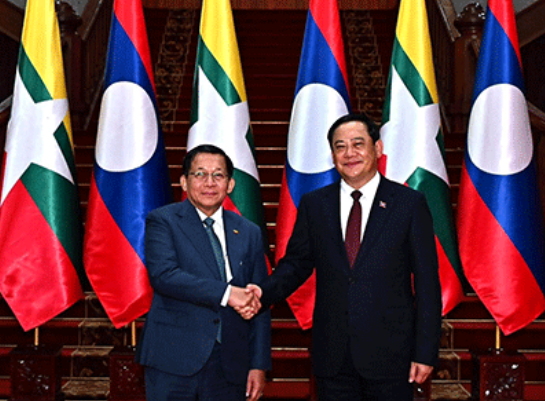
Myanmar's President Min Aung Hlaing arrived in Vientiane on July 3 for a carefully choreographed three-day state visit that underscored the deepening strategic partnership between two of Southeast Asia's closest neighbours. The visit, which concluded on July 5, represented a significant moment in bilateral relations and served as President Min Aung Hlaing's debut foreign engagement since his recent assumption of office. Accompanying him were his wife and a high-level delegation, all received at the Presidential Palace by Lao President Thongloun Sisoulith and First Lady Naly Sisoulith in a ceremony marked by full state honours.
The timing of the visit proved symbolically resonant, coinciding with celebrations marking the 70th anniversary of formal diplomatic relations between Laos and Myanmar. This milestone offered both nations an opportunity to reflect on decades of sustained cooperation and to chart an ambitious course for future engagement. The state visit framework itself conveyed a message of institutional commitment, with engagements spanning the highest echelons of government and touching multiple sectors of national interest. For observers watching the relationship between these two economically challenged Southeast Asian neighbours, the visit demonstrated an unwavering dedication to mutual support despite complex regional dynamics.
During formal bilateral talks, Presidents Thongloun and Min Aung Hlaing conducted a comprehensive review of existing cooperation mechanisms while exploring fresh avenues for collaboration. The discussions ranged across conventional diplomatic territory—regional affairs and international relations—whilst also addressing the substantive mechanics of practical partnership. President Thongloun seized the opportunity to congratulate Myanmar on holding recent general elections and forming a new government, framing this as evidence of democratic progress. This gesture held particular significance given ongoing international scrutiny of Myanmar's political trajectory, with Laos positioning itself as a supportive regional voice at a moment when Myanmar faces considerable diplomatic pressure elsewhere.
The two leaders endorsed cooperation across an expansive portfolio of domains: defence and security considerations, foreign affairs coordination, trade and investment frameworks, transport infrastructure, energy projects, labour mobility, and educational exchanges. More specifically, they committed to intensifying border security arrangements and bolstering intelligence-sharing mechanisms. Both governments pledged deeper involvement in multilateral platforms including the Association of Southeast Asian Nations, United Nations proceedings, and the Mekong-Lancang Cooperation framework—a grouping that has become increasingly central to China-led regional architecture in mainland Southeast Asia.
Prime Minister Sonexay Siphandone extended bilateral engagement further by meeting separately with the Myanmar President. These discussions reinforced commitments already articulated at the presidential level whilst adding emphasis to cross-border issues previously noted only obliquely. The two premiers focused particularly on pollution challenges affecting the shared region, acknowledging that environmental degradation recognises no political boundaries. This attention to transnational air quality concerns reflected evolving sophistication in how Southeast Asian governments frame their partnerships, moving beyond security and economics to encompass environmental stewardship.
The parliamentary dimension of the visit underscored Laos and Myanmar's commitment to institutionalising cooperation across governmental levels. Xaysomphone Phomvihane, President of the National Assembly, engaged directly with President Min Aung Hlaing in discussions centred on strengthening legislative ties. Xaysomphone notably referenced the symbolic importance of Laos receiving the Myanmar President's first official foreign visit since his recent political transition—a detail that conveyed careful diplomatic messaging about regional alignment and mutual confidence. The two parliamentary leaders committed to supporting implementation of bilateral agreements, an undertaking that suggests both nations recognise the gap between signing documents and achieving tangible mutual benefit.
The most concrete outcomes of the visit manifested in ceremonial document signings that reflected evolving cooperation priorities. A memorandum of understanding on tourism cooperation between the Lao Ministry of Culture and Tourism and Myanmar's Ministry of Hotels, Tourism and Culture promised to expand visitor flows between both countries. Tourism collaboration represents an accessible growth area for neighbouring developing economies seeking to diversify revenue streams without requiring the massive infrastructure investments that alternative cooperation sectors demand. A second significant accord established formal friendship city relations between Vientiane and Naypyidaw, the Burmese capital purpose-built to replace Yangon. Such city-level twinning arrangements have proliferated throughout Southeast Asia as nations deploy soft power through cultural and people-to-people connections.
Beyond formal diplomatic business, the visit incorporated ceremonial elements designed to reinforce emotional bonds between populations. President Min Aung Hlaing laid wreaths at the Unknown Soldier Monument, honouring Lao revolutionary fighters and thereby acknowledging shared struggle narratives that both nations emphasise in their official histories. A traditional Baci ceremony and state banquet hosted by President Thongloun provided opportunities for informal interaction among officials, often where genuine relationship-building occurs beyond the constraints of formal dialogue. These social dimensions serve important functions in maintaining the personal relationships that typically underpin sustained cooperation between political elites.
The inclusion of medical assistance in the visit agenda merits closer attention as evidence of humanitarian cooperation. Handover of snake antivenom serum to the Lao Ministry of Health, whilst modest in material terms, addressed concrete public health needs affecting rural populations in particular. Myanmar's capacity in pharmaceutical production and Laos's receptiveness to receiving such aid reflected asymmetries in economic capability between the two nations whilst simultaneously demonstrating willingness to meet real human needs through bilateral channels.
The planned extension of the presidential delegation to Luang Prabang, the ancient royal capital now designated a UNESCO World Heritage site, completed the visit's cultural narrative. Touring temples and cultural landmarks provided visual context for discussions about civilisational commonalities and Buddhist heritage that both nations share. For Myanmar's leadership, such engagements in a destination celebrated globally for cultural preservation offered opportunities to showcase appreciation for Asian heritage at a moment when Myanmar's international reputation requires careful cultivation.
For Malaysian and broader Southeast Asian observers, this visit illustrated how smaller members of ASEAN maintain bilateral relationships outside formal ASEAN frameworks whilst remaining committed to regional solidarity. The emphasis on parliamentary cooperation, tourism expansion, and environmental collaboration reflects broader regional patterns whereby neighbouring developing economies pursue integration strategies that demand minimal capital investment whilst maximising diplomatic alignment. The visit also demonstrated Myanmar's capacity to conduct normalized state diplomacy despite international isolation affecting parts of its foreign relations, with Laos positioned as a reliable partner willing to extend recognition and support.
Looking forward, the visit establishes infrastructure for ongoing engagement through the newly activated Laos-Myanmar Joint Committee on Bilateral Cooperation and associated channels. Both nations now possess expanded institutional mechanisms for translating political goodwill into functional cooperation across multiple sectors. Whether these frameworks produce measurable improvements in trade volumes, tourism arrivals, and security coordination remains to be determined, but the visit itself signals serious commitment to deepening ties that extend well beyond ceremonial pleasantries.

