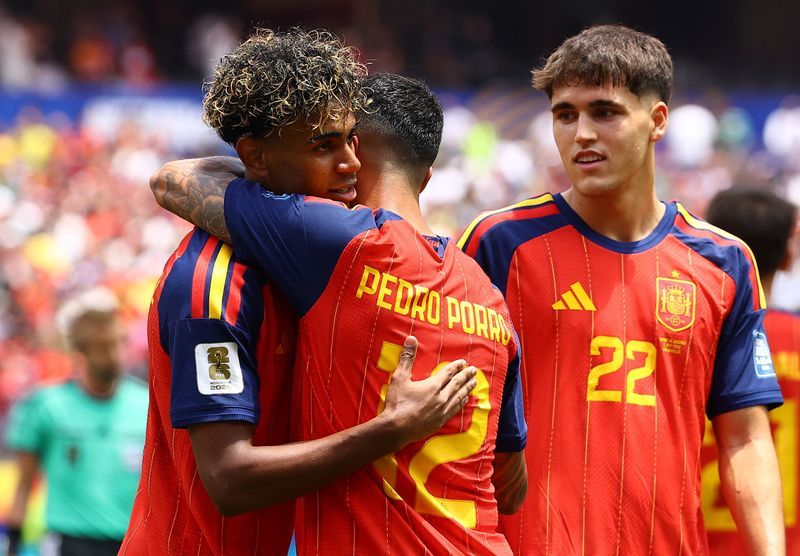
Spain's stuttering start to their World Cup campaign has given way to something far more troubling for their opponents: a side rediscovering its rhythm with perhaps the continent's most electrifying teenage talent hitting his stride. The 3-0 demolition of Austria represents a sharp departure from the listless opening performance against Cape Verde, when the defending European champions looked vulnerable and directionless. The transformation tracks almost perfectly with one factor—the growing sharpness of 18-year-old Lamine Yamal, who arrived at the tournament nursing a hamstring concern that relegated him to the bench initially but has now become the fulcrum around which Luis de la Fuente's side rotates.
The paradox of Spain's football identity has long rested on their commitment to a collective philosophy where the team functions as an interconnected system rather than a collection of individual talents. Yet Yamal presents a fascinating contradiction: he embodies individual brilliance while somehow reinforcing rather than undermining the team's structural integrity. Against Austria, he registered neither goal nor assist, yet earned the player-of-the-match accolade—a testament to how his presence extends far beyond statistics. His gravitational pull on opposing defences creates space and opportunities for teammates, transforming him from a pure finisher into an architect of possibilities.
When Yamal operated on the bench during Spain's goalless stalemate with Cape Verde, the Spanish attack appeared blunt and mechanical. Gavi and Ferran Torres occupied wide positions but generated little of the directness or penetration that characterises a genuinely threatening offensive system. The introduction of Alex Baena on the left flank provided one solution, but the pairing of Baena and Yamal on opposite wings represents something more potent: a dual-threat structure that stretches defences horizontally while maintaining Spain's prized midfield control. Austria simply could not accommodate both threats simultaneously, forced into constant reactive positioning as Spain's fullbacks Marc Cucurella and Pedro Porro pushed forward with confidence.
Yamal's rise from Barcelona's La Masia academy at just 16 years old followed the academy's storied tradition of producing technically supreme footballers who understand pressing systems and positional discipline. Yet he carries a dimension that distinguishes him from many contemporary Spanish midfielders—an explosive athleticism and one-on-one dribbling capability that makes structured football feel spontaneous. When he receives the ball on the right wing, opponents know exactly what is coming, yet the technical execution and creative variability remain difficult to predict. This season, he was instrumental in Spain's European Championship triumph in Germany, where they won every match and set tournament scoring records with expansive, attacking football.
The tournament trajectory in North America has proven more complicated, partly through injury disruptions beyond Yamal's control. Nico Williams, the left-winger who provided critical balance during the European campaign, suffered his own fitness issues that disrupted De la Fuente's preferred tactical shape. Recovering both threats simultaneously presented a puzzle that the early Cape Verde performance failed to solve. However, as tournament minutes accumulated and physical condition improved, the geometric precision of Spain's attacking shape has returned. Midfielders Rodri and Pedri now operate with clearer passing lanes, tempo accelerates in transition phases, and the ball moves with the patient tempo that made Spain's earlier campaigns so destructive.
Spain's construction against Austria revealed tactical sophistication that extended beyond attacking arrangements. Long sequences of play saw Yamal positioned wide while Spain deliberately isolated him in one-on-one situations, testing Austria's full-back stability repeatedly. This direct approach generated sufficient angles to create scoring opportunities, yet Spain's most dangerous moments arrived when Yamal drifted infield, compressing defensive space and activating central midfielders. Rodri particularly impressed after halftime, while Mikel Oyarzabal demonstrated decisiveness in attack. The complementary movement and positional fluidity suggest the tactical machinery is meshing effectively after early doubts.
Defensively, Spain's performance established a new benchmark for tournament resilience. Austria failed to register a single shot on target, marking the first time since Germany's 2014 World Cup final victory against Argentina that an opponent achieved this feat in a knockout match. Spain has now extended their remarkable run to 34 matches without defeat and has conceded zero World Cup goals since their 2022 defeat by Japan. These statistics reveal a squad-wide improvement in organisation and compactness that transcends Yamal's individual contributions. Yet the teenager's recovery accelerates the timeline toward dangerous form.
For Malaysian and Southeast Asian observers following the tournament, Yamal's emergence carries broader significance beyond Spanish football. The teenager represents the latest generation of technically refined European footballers who approach the sport with methodical precision yet individual brilliance—a model increasingly influential across football development worldwide. Southeast Asian academies frequently study European training methodologies, and Yamal's trajectory from academy graduate to world-class performer at 18 demonstrates the value of structured development programs that balance technical instruction with encouragement of individual expression.
Spain's recovery from their sluggish start also underscores how tournament momentum builds unevenly. Early performances can mislead, particularly when injury affects key personnel. De la Fuente's squad possessed the underlying quality from the beginning, yet required match fitness and tactical cohesion to manifest that talent. As Yamal rounds into tournament rhythm, opposing defences face a mounting problem: a player who combines elite technical ability with physical tools and competitive maturity that belies his teenage years. Spain look dangerous again, and the tournament landscape has shifted accordingly.

