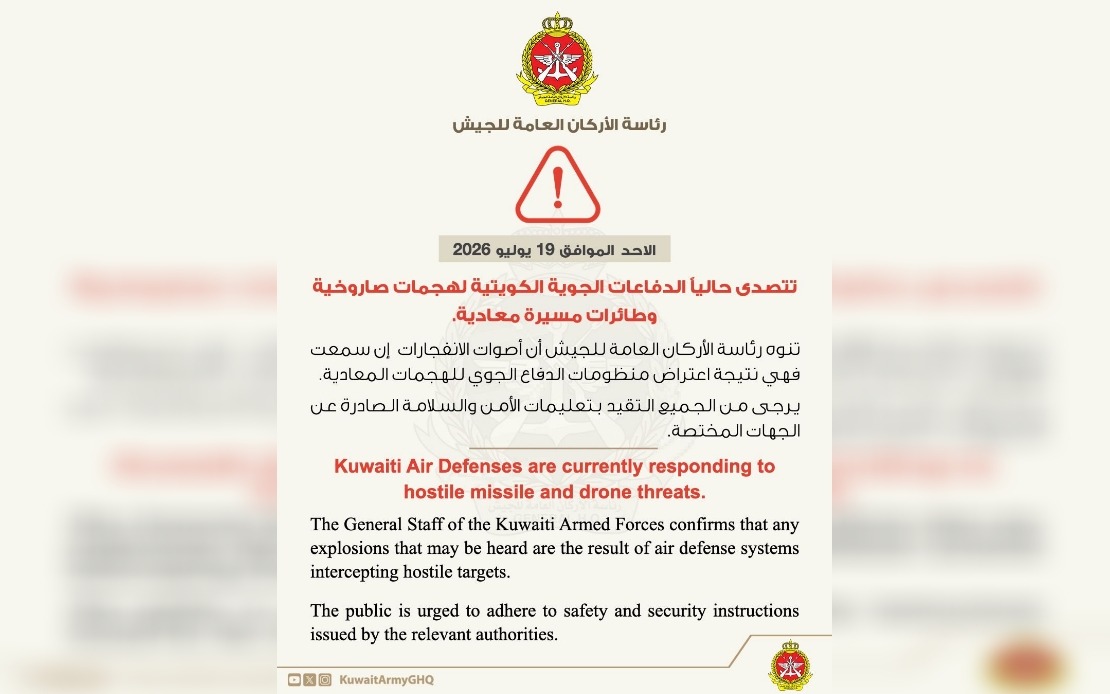
Kuwait's armed forces moved into active defence mode on Sunday, intercepting incoming hostile missiles and drone strikes as the escalating military confrontation between the United States and Iran spilled across the broader Middle East. The Kuwaiti army confirmed through official channels that explosions reported across the country resulted from air defence systems neutralising attacking targets, while simultaneously instructing residents to remain vigilant and adhere to security protocols issued by national authorities.
The situation represents a significant widening of a conflict that had already involved direct exchanges of fire between Washington and Tehran. Over the preceding week, American military operations had targeted sites within Iranian territory through successive bombing campaigns, prompting swift retaliation from Iranian forces who struck back at facilities and military installations they identified as belonging to or supporting US operations across multiple countries in the region. Kuwait, as a longtime American ally hosting substantial US military presence, became a natural flashpoint for this regional proxy struggle.
This deterioration in regional security comes despite diplomatic efforts to contain the crisis. Pakistan had brokered a memorandum of understanding between the rival powers in June, intended to establish a ceasefire framework and create pathways toward sustained peace negotiations. That agreement now appears increasingly fragile as both sides continue military operations, suggesting that the underlying tensions fuelling the US-Iran rivalry remain fundamentally unresolved by diplomatic channels alone.
For Malaysian observers and policymakers, the Kuwait developments carry significant implications. Southeast Asia's energy security remains tightly linked to stability in the Persian Gulf, where a substantial portion of global oil and liquefied natural gas production occurs. Any sustained military conflict in the region directly threatens the supply chains and pricing mechanisms that Malaysian businesses, manufacturers, and consumers depend upon. The prospect of extended hostilities introduces volatility into commodity markets that regional economies cannot easily insulate themselves from.
The involvement of Kuwait, a nation with deep historical ties to both Western powers and regional Arab states, underscores the comprehensive nature of the current standoff. Kuwait's geographic proximity to Iran and its significant strategic importance as a hub for American military operations in the Gulf make it particularly vulnerable to becoming a theatre for proxy warfare. The fact that defensive systems were engaged suggests that threats were sufficiently credible and imminent to warrant active military response, indicating an intensity of conflict that extends beyond symbolic gesturing.
Regional stability concerns extend beyond immediate military exchanges. The pattern of escalation—with each side responding to the other's strikes with further attacks—creates a dangerous cycle that historical precedent suggests becomes difficult to interrupt once established. Maritime navigation through the Strait of Hormuz, through which approximately one-fifth of global oil passes, remains perpetually at risk when regional military tensions peak. Disruptions to shipping lanes would immediately ripple through global supply networks that Malaysian companies and consumers depend upon.
The broader Middle Eastern security architecture faces strain as this US-Iran competition intensifies. Gulf Cooperation Council members, of which Kuwait is a founding member, must balance their traditional Western security partnerships against the reality of living in closer proximity to Iran. Malaysia, as a Muslim-majority nation with interests across multiple regions, typically seeks to maintain balanced diplomatic relationships. However, events in the Gulf increasingly force regional actors to confront the limits of strategic neutrality when major power competition directly threatens territorial interests and economic wellbeing.
Iranian decision-making appears driven partly by domestic political considerations and strategic calculations about deterrence signalling. Tehran views its strikes against American interests as proportional responses to American military operations on its territory, a framing intended to restore credibility with regional allies and domestic audiences. The fact that Pakistan's diplomatic intervention has thus far proved insufficient suggests that both sides view the stakes as high enough to justify continued military action despite international mediation efforts.
For Kuwait specifically, the activation of air defence systems represents a difficult position between competing interests. The nation hosts significant American military facilities and personnel while sharing a long border with Iran. This geographic reality means Kuwait cannot simply choose sides without substantial consequences. The need to protect civilian populations from incoming fire while maintaining delicate balance in regional relationships creates complex operational and political pressures on Kuwaiti leadership.
The sustainability of current escalation patterns remains uncertain. Both the United States and Iran possess capabilities for extended campaigns, but the cycle of strikes and counter-strikes cannot continue indefinitely without either side achieving strategic objectives or exhaustion forcing negotiation. The June memorandum of understanding, despite current strains, does provide a diplomatic framework that parties might return to if military operations fail to produce desired outcomes.
Malaysia's approach to these developments should involve careful monitoring of supply chain implications while maintaining diplomatic channels that could contribute to de-escalation. As a nation with economic interests across the region and cultural connections to both Arab and broader Asian communities, Malaysia has potential leverage in regional conversations. The current trajectory, however, suggests that military competition rather than diplomatic solution will likely dominate the near term, with consequences that extend well beyond the Gulf itself.

