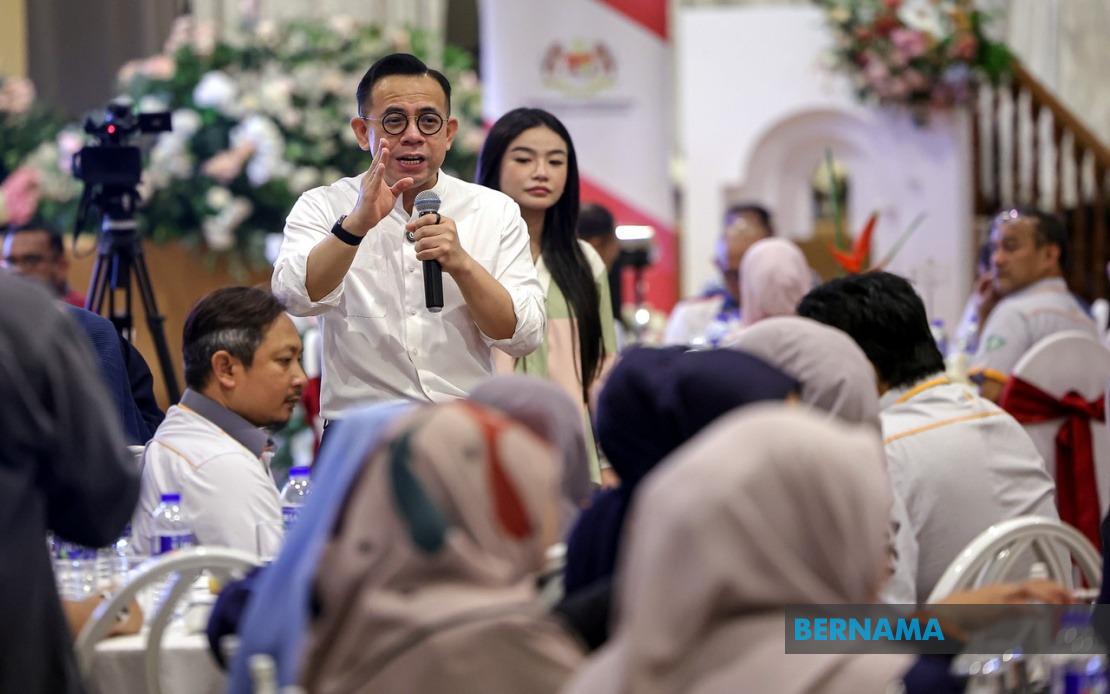
The Ministry of Entrepreneur Development and Cooperatives has accelerated its financial support for Malaysia's business community, channelling nearly RM7 billion to more than 213,000 micro, small and medium enterprises nationwide during the opening half of 2026. This substantial injection of capital represents a critical component of the government's broader economic strategy to ensure local businesses remain competitive amid persistent global economic headwinds. Minister Steven Sim disclosed these figures while addressing the Negeri Sembilan KUSKOP staff assembly, highlighting the tangible progress made under the Power Up 10K initiative, which operates as a comprehensive financing and support framework designed to fortify entrepreneurship across the country.
The Power Up 10K initiative represents an ambitious intervention by the government to address funding gaps that traditionally hinder small business expansion and operational sustainability. With the first six months producing nearly half of the annual target, the ministry is tracking towards a total disbursement of RM15 billion by year's end. This trajectory demonstrates both the robustness of application pipelines and the effectiveness of delivery mechanisms that have been refined over successive years. For Malaysian entrepreneurs operating in increasingly volatile global markets characterised by supply chain disruptions and shifting trade dynamics, such government backing provides essential liquidity and working capital that might otherwise prove elusive through conventional banking channels.
Negeri Sembilan exemplifies the programme's regional penetration, with RM345 million allocated to more than 6,600 local entrepreneurs during the same period. This distribution underscores a critical policy objective: ensuring that government resources reach grassroots business operators rather than concentrating benefits among larger or better-connected enterprises. The geographic spread of funding reflects KUSKOP's deliberate focus on decentralisation and ensuring that rural and smaller urban centres do not fall behind in accessing development capital. For states like Negeri Sembilan with relatively diversified economies spanning manufacturing, services, and agriculture, such disbursements support job creation and economic activity across multiple sectors.
Minister Sim's articulation of KUSKOP's evolving operational direction reveals a shift towards greater proactivity in service delivery. Rather than adopting a passive posture where entrepreneurs must navigate bureaucratic procedures to locate available support, the ministry is repositioning its constituent agencies as dynamic facilitators actively promoting available schemes. This reorientation addresses a persistent challenge in government support programmes: information asymmetry. Many eligible entrepreneurs remain unaware of financing opportunities or remain intimidated by complex application requirements, resulting in substantial unutilised government funding capacity.
The emphasis on reducing compliance costs represents a pragmatic acknowledgement of real constraints facing the MSME sector. While global factors such as oil price volatility remain beyond domestic policy influence, government has considerable leverage in streamlining regulatory requirements and reducing the administrative burden imposed by multiple layers of compliance. By lowering documentation requirements, simplifying reporting obligations, and harmonising standards across agencies, authorities can meaningfully reduce the effective cost of business operations. This approach particularly benefits smaller enterprises with limited administrative capacity and no dedicated compliance personnel.
The ministry's strategic pivot towards expanded business resource accessibility addresses fundamental competitive disadvantages that Malaysian MSMEs face relative to their regional counterparts. Access to capital remains only one dimension; equally critical are business development services, technology adoption support, market linkage programmes, and capacity building initiatives. KUSKOP's determination to position its network of agencies as comprehensive support hubs rather than mere lending bodies reflects sophisticated understanding that entrepreneurial success depends on multi-dimensional assistance. For Malaysian businesses seeking to penetrate export markets or upgrade production capabilities, such integrated support proves invaluable.
State-level agencies are receiving explicit encouragement to intensify their entrepreneurship outreach, with Sim's direction to move beyond passive office-based service provision. Roadshows, social media campaigns, and direct engagement strategies represent proven methods for building awareness among dispersed micro-entrepreneur populations who may lack formal business registration or structured decision-making processes. This grassroots engagement approach recognises that many informal and semi-formal business operators rely on personal networks and community information channels rather than official government communications. Digital outreach proves particularly important given Malaysia's internet penetration and active social media usage across demographic groups.
The competitive dynamic introduced between state agencies carries implications for administrative efficiency and programme delivery quality. By encouraging jurisdictions to pursue fund disbursement targets proactively, the ministry creates implicit performance metrics that reward responsive and entrepreneurial agency management. This approach contrasts with traditional government bureaucracy where activity levels remain relatively constant regardless of external demand. Such internal competition, when properly channelled, can catalyse organisational improvements and staff motivation without requiring additional resource allocation.
For Malaysian entrepreneurs navigating an uncertain global environment marked by trade tensions and macroeconomic volatility, government support mechanisms provide countercyclical stabilisation. During periods when private sector credit tightens or when investor confidence falters, the availability of reasonably-priced government financing becomes crucial for business continuity and growth. The RM7 billion distributed in the first half of 2026 represents concrete evidence that the government recognises this stabilising role and is maintaining financial commitments despite competing budget pressures.
The broader context for these funding flows includes Malaysia's evolving position within regional value chains and the structural transformation of the economy towards higher value-added activities. MSME support programmes increasingly target sectors such as digital commerce, green technology, advanced manufacturing, and professional services where Malaysia seeks competitive advantage. The nature of available financing and support increasingly reflects these strategic sectoral priorities, subtly incentivising entrepreneurs towards activities aligned with national development objectives.
Minister Sim's remarks implicitly acknowledge that government support, however generous, constitutes just one element of a comprehensive ecosystem required for entrepreneurial flourishing. Access to physical infrastructure, reliable utility services, skilled labour availability, and predictable regulatory environments also prove essential. While KUSKOP directly influences only the financing dimension, the ministry's outreach efforts serve educative functions, building awareness among entrepreneurs regarding diverse success factors and encouraging them to address constraints beyond capital acquisition alone.
The achievement of channelling RM7 billion in six months requires functional delivery systems capable of processing large volumes of applications while maintaining appropriate due diligence standards. This operational capacity reflects investments made across previous fiscal years in digitalisation of application procedures, staff training, and quality management systems. For other developing economies considering similar large-scale support programmes, Malaysia's experience demonstrates that substantial disbursement targets become achievable when supporting systems receive adequate preparation and resource allocation.
Looking forward, the trajectory established in the first half of 2026 will prove critical in determining whether the full RM15 billion annual target becomes realised. Any shortfall would suggest either insufficient eligible demand, application processing bottlenecks, or disbursement constraints requiring administrative remediation. Conversely, exceeding the target would validate both the effectiveness of programme design and the genuine capital requirements within Malaysia's MSME sector. For regional observers and policymakers in comparable developing economies, these outcomes will inform assessments regarding optimal scale and targeting for government entrepreneurship support initiatives.

