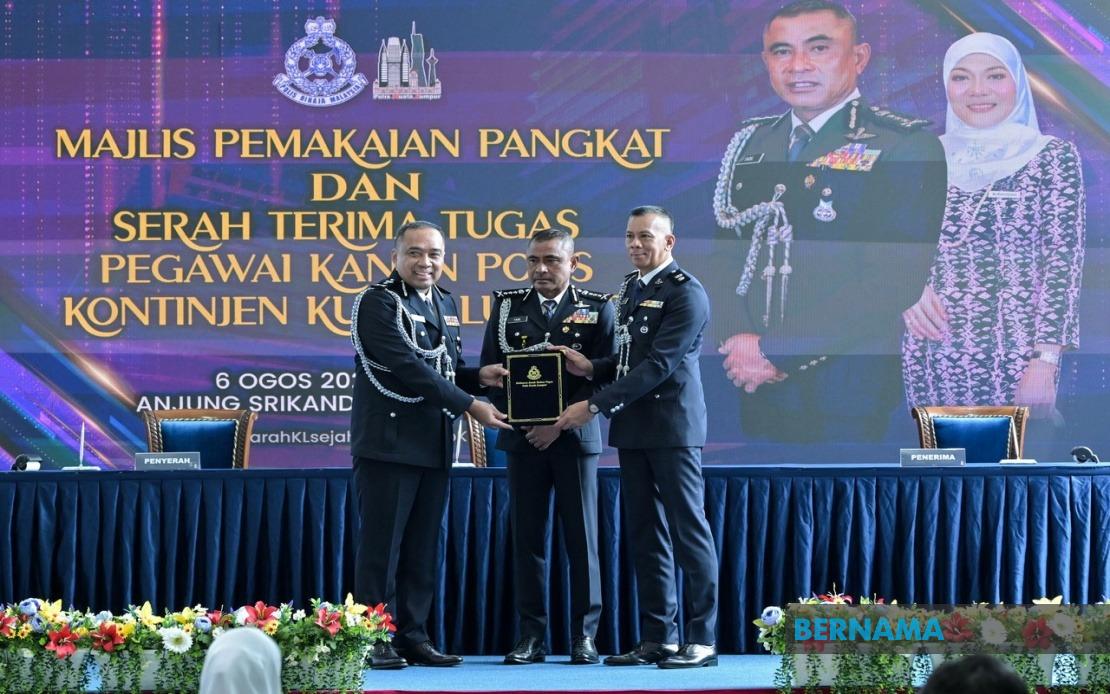
The Kuala Lumpur police force has undertaken a significant restructuring of its leadership ranks, with Kuala Lumpur police chief Datuk Fadil Marsus presiding over a formal handover ceremony on August 6 that transferred responsibility across six critical senior positions within the contingent. The reshuffle, conducted at the Kuala Lumpur police contingent headquarters, touches the very backbone of the city's law enforcement apparatus, signalling a deliberate recalibration of investigative and operational command at a time when urban policing demands remain intense.
Among the most consequential moves, SAC Zulkarnain Samsudin has relinquished his position as head of the Criminal Investigation Department to SAC Sazlee Adam, a transition that carries particular weight given the CID's centrality to solving serious crimes across the federal territory. Simultaneously, the Narcotics Crime Investigation Department has seen SAC Haslah Bachok step aside in favour of ACP Kee Hang Kee, a change reflecting the police force's ongoing commitment to combating drug trafficking—a persistent challenge in the Klang Valley region and throughout Malaysia's urban centres.
The reshuffle extends to district-level command, where two of Kuala Lumpur's busiest and most complex police jurisdictions have acquired new leadership. Supt Nuzulan Mohd Din has assumed command of Dang Wangi district police from SAC Sazlee Adam, while Supt Jasni Zolpa now leads Sentul district operations, taking over from SAC Basri Sagoni. These two districts encompass some of the capital's most dynamic commercial zones and densely populated residential areas, making their police chiefs pivotal figures in maintaining public order and public safety.
The support structure underlying operational success has similarly been reorganised. SAC Kamaruzaman Md Alib has transferred his duties as Special Branch deputy chief for Intelligence and Operations to ACP Saefuddin @ Mohd Fitri Abdul Rahman, a move that affects how intelligence is gathered and deployed across the contingent. Additionally, Supt Ong Seng Keong has assumed the CID deputy chief role in the Intelligence and Operations portfolio from SAC Zulkarnain Samsudin, creating a ripple effect through the investigative hierarchy.
Datuk Mohd Azani Omar, the Kuala Lumpur deputy police chief, was present at the ceremony, underscoring the significance the police leadership attaches to this transition. In his remarks, Fadil framed the appointments not merely as administrative changes but as affirmations of professional merit and institutional confidence. He emphasised that promotions and new postings represent acknowledgment of demonstrated competence and dedication, while simultaneously imposing heightened expectations for integrity, professionalism, and commitment to duty.
The police chief articulated a vision of continuity combined with renewal, describing the handover process as essential to the Royal Malaysia Police's long-term institutional health. He argued that periodic rotations of personnel through different commands inject fresh perspectives, encourage the cross-pollination of best practices, and prevent organisational stagnation—all critical factors in a police force serving a metropolis as complex and diverse as Kuala Lumpur. By moving experienced officers between the CID, district commands, and intelligence functions, the force appears designed to broaden leadership capabilities and improve knowledge transfer across divisions.
In the context of Malaysia's broader security environment, these changes arrive at a moment when the Kuala Lumpur police contingent confronts mounting operational pressures. Urban crime, ranging from burglary and street robbery to organised crime and white-collar offences, demands investigative excellence. The narcotics trade continues to flourish despite enforcement efforts, with drugs remaining a driver of secondary crime and social instability. Public expectations for rapid case resolution and visible law enforcement presence remain high, placing considerable responsibility on the commanding officers who now assume these positions.
The reshuffle also reflects internal police management philosophy regarding how investigations should be structured and supervised. By cycling officers through CID and NCID postings, the force likely aims to ensure that no single individual or faction becomes too entrenched in any division, thereby maintaining institutional impartiality and preventing the kind of operational silos that can compromise investigative integrity. This approach mirrors best practices in mature police services, where rotation policies are designed to strengthen accountability and professional standards.
For the broader Malaysian public, these administrative changes may seem distant from daily life, yet they shape the efficiency and effectiveness of law enforcement they experience. A well-led CID directly affects case clearance rates; a capable narcotics division impacts drug availability on streets; alert district commanders translate into visible policing and community confidence. The individuals now stepping into these roles carry the practical and ethical weight of these expectations. Fadil's call for the contingent to intensify efforts against crime, drug abuse, and the various vectors of criminal activity serves as both directive and challenge to both the promoted officers and the wider force beneath them.
The ceremony itself—formal, public, and documented—reinforces professional standards and creates institutional memory of these transitions. It signals to the police rank and file, to government, and to the public that the Kuala Lumpur contingent takes leadership succession seriously and operates according to deliberate protocols rather than ad hoc decision-making. As these newly appointed officers settle into their roles, the coming months will reveal whether this reshuffle delivers on its implicit promise of renewed operational vigour and enhanced investigative capacity in Malaysia's most demanding policing environment.

