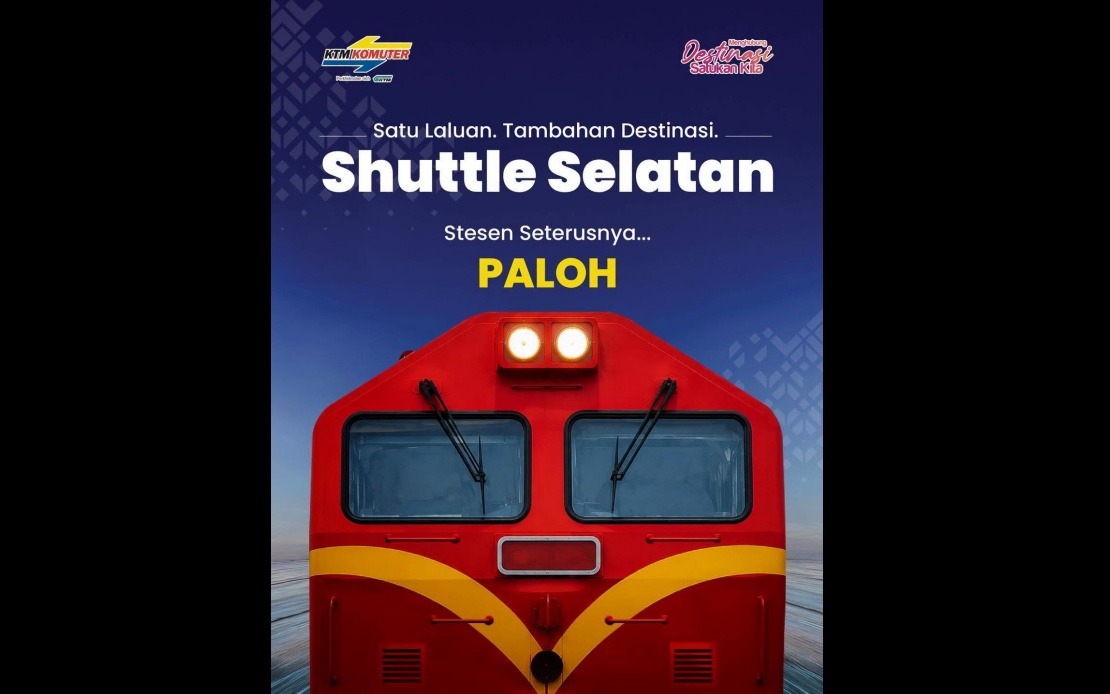
Keretapi Tanah Melayu Berhad (KTMB) is launching an expanded phase of its Southern Shuttle rail service beginning August 8, extending operations to encompass the Paloh-JB Sentral corridor in what represents an accelerated rollout of the Transport Ministry's public transport enhancement programme for Johor. The newly extended network will serve seven stations spanning the central Johor region, strategically positioned to unlock economic potential while improving commuter accessibility across a critical commercial and residential corridor.
The extended route will connect Paloh, Kluang, Renggam, Layang-Layang, Kulai, Kempas Baru and JB Sentral, with the flagship journey between Paloh and JB Sentral scheduled to take approximately 120 minutes. This geographic spread reflects careful planning to service both established urban centres and emerging suburban areas, positioning the shuttle service as a backbone for regional mobility rather than merely a point-to-point connection. The selection of these stations underscores deliberate effort to knit together communities that have historically relied on private vehicles or long-distance bus networks for inter-town movement.
This initiative emerged less than three months after KTMB introduced the service's initial phase, demonstrating confidence in the concept and responsiveness to documented demand. The expansion utilises sections of the Gemas-Johor Bahru Electrified Double-Track Project (PLBEGJB) infrastructure, leveraging existing assets and technological investment to deliver public value. By tapping into this modern electrified alignment, the service operates on contemporary standards rather than legacy rail infrastructure, offering passengers reliability and comfort expected from contemporary transit systems.
Operational capacity has been configured to handle substantial passenger volumes, with each train accommodating up to 400 travellers across 10 daily services—five departures in each direction. The scheduling strategy addresses distinct commuter demographics: the earliest service departs Paloh at 3:55 am, reaching JB Sentral by 5:52 am, while the final evening departure from JB Sentral at 8:30 pm arrives in Paloh at 10:27 pm. This timetable structure explicitly targets shift workers and cross-border commuters, particularly those transiting through the Johor Bahru border crossing to Singapore, revealing how the service has been engineered around actual mobility patterns rather than abstract scheduling convenience.
The economic logic underlying this expansion extends beyond simple commuter convenience. By strengthening rail connectivity between Paloh, Kluang, Kulai and Johor Bahru, the service directly supports the Johor-Singapore Special Economic Zone (JS-SEZ)—a cornerstone initiative in Malaysia's efforts to compete for regional investment and talent. Workers employed across this economic zone gain reliable transport alternatives to private vehicles, potentially reducing congestion while enhancing workforce mobility. The connection to Pasir Gudang industrial area via a transfer point at Kempas Baru further broadens the service's economic footprint, linking manufacturers and logistics operators to wider labour and supply networks.
Pricing strategy reveals deliberate policy intent to establish rail as the preferred commuting option. The Paloh-JB Sentral promotional fare of RM7.70 represents a 50 percent reduction from the standard RM15.30 price point, and this subsidised pricing will persist until new electric trains arrive in Malaysia's fleet. The message implicit in this pricing structure is clear: KTMB is building ridership patterns and fostering modal shift away from private vehicles, with the understanding that patronage habits, once established, typically prove durable. This represents a form of temporary demand stimulus designed to overcome initial hesitation among commuters accustomed to vehicular travel.
Concurrent social policy measures expand the service's accessibility. The MyRailLife Pass programme, extended to cover the Southern Shuttle from August 8 through December 31, offers zero-cost travel for children aged four to six, students from Year One through Form Six, and persons with disabilities. This inclusive approach signals that public transport enhancement serves not merely commercial objectives but social equity goals, ensuring that economic participation and educational access do not depend upon family vehicle ownership. The distinction between paying and non-paying passengers reflects sophisticated understanding of transport's role as infrastructure for social mobility.
Early performance indicators suggest receptiveness to this service model. Since introduction, the Southern Shuttle recorded 3,209 passengers across its initial route phases, validating the premise that well-designed rail service can attract commuters away from established private vehicle patterns. While this figure may appear modest in absolute terms, the velocity of adoption—taking place within weeks—demonstrates that service quality and pricing accessibility can overcome the considerable inertia of existing commuting behaviour. These founding passengers function as ambassadors whose experiences will shape broader community perceptions of the service.
The expansion strategy reflects deeper strategic thinking within Malaysia's transport policy framework. Rather than pursuing expensive greenfield rail construction, KTMB is extracting maximum value from existing infrastructure investments through innovative service design and scheduling. The decision to introduce suburban shuttle services on electrified trunk lines represents efficient asset utilisation, spreading infrastructure costs across multiple service types while maintaining operational coherence. This approach offers important lessons for other Malaysian states and regions seeking to enhance public transport without undertaking massive capital expenditure.
For Singapore-bound commuters, the service introduces new operational efficiencies. Rather than driving private vehicles to Johor Bahru or waiting for long-distance bus services, workers can now access a frequent, predictable rail option that deposits them at JB Sentral—positioned as a gateway to Singapore's public transport system and border crossing points. This connectivity dimension explains why promotional pricing and extended operating hours specifically accommodate cross-border movement patterns, recognising that Johor's economic geography cannot be understood in purely Malaysian terms.
The service expansion also addresses environmental and congestion objectives central to Malaysia's sustainable urban development agenda. By providing attractive alternatives to private vehicle use across the Johor corridor, the shuttle service contributes to reducing vehicular emissions and traffic congestion on key roads serving the region. This environmental dimension, while less prominent in the official announcements, aligns with Malaysia's commitments under international climate frameworks and regional sustainability agreements.
Implementation of this expansion within 90 days of initial launch demonstrates KTMB's operational capability to execute transport improvements at meaningful pace. For a state-owned enterprise often criticised for sluggish responses to service demands, this accelerated timeline suggests organisational adaptation toward stakeholder responsiveness. The success of this particular initiative may establish templates applicable to other railway corridors, particularly in Selangor and Perak, where similar suburban connectivity challenges exist.
Looking forward, the service's trajectory will depend upon sustaining ridership growth, managing crowding during peak periods, and eventually delivering the new electric trains that will replace current promotional pricing with permanent commercial fares. The commitment to introduce new rolling stock suggests KTMB anticipates operational scaling beyond current 400-passenger train capacities. If execution remains on track and ridership continues climbing, the Paloh-JB Sentral shuttle may evolve into a template for how Malaysia's rail operators can rejuvenate existing infrastructure to serve contemporary commuter needs and regional economic development objectives.

