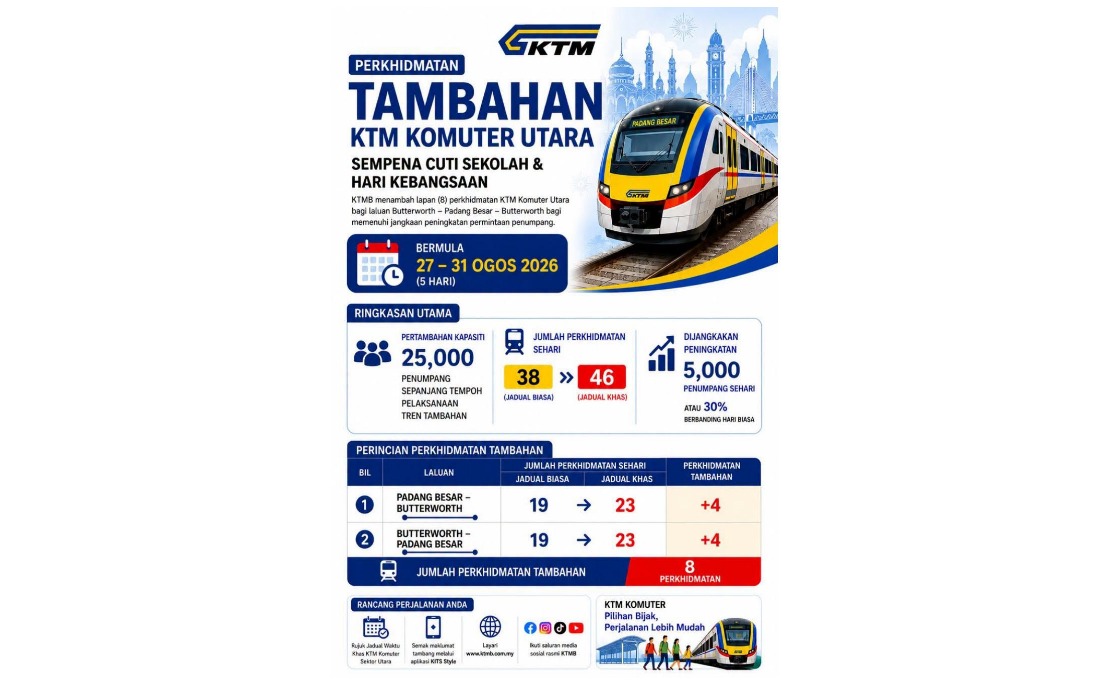
Keretapi Tanah Melayu Berhad (KTMB) is ramping up commuter rail capacity across the northern corridor, introducing eight supplementary KTM Komuter Utara services beginning Thursday, August 27, through Monday, August 31, in response to the convergence of school holidays and National Day celebrations. The decision reflects the operator's commitment to manage anticipated travel surges when thousands of families simultaneously venture across Penang, Kedah, and Perlis for holiday activities and commemorative festivities.
The expansion forms part of KTMB's Northern Sector Special Timetable initiative, a tactical scheduling adjustment designed specifically to absorb expected ridership peaks during high-demand periods. Rather than operating at capacity constraints during this critical window, the enhanced service framework distributes passenger flow across additional departure slots, reducing crowding and improving the overall commuting experience. This approach recognizes that infrastructure modernization takes time; in the interim, operational flexibility offers meaningful relief to time-sensitive travellers.
The mathematical impact is substantial. Under the enhanced schedule, the Butterworth-Padang Besar-Butterworth route will accommodate 46 daily services, climbing from the standard 38 services that normally characterize the timetable. This 21 percent increase in frequency translates directly into greater accessibility for commuters attempting to coordinate holiday plans. The breakdown allocates four additional northbound services to the Padang Besar-Butterworth direction, lifting that segment from 19 to 23 daily departures, while four southbound services similarly enhance the Butterworth-Padang Besar leg to the same 23-service level.
Capacity projections underscore the scale of anticipated demand. KTMB estimates that the supplementary services can accommodate an additional 5,000 passengers daily throughout the five-day implementation window, aggregating to 25,000 extra passenger journeys across the period. The operator forecasts a 30 percent surge in overall ridership relative to ordinary operating days, suggesting that baseline weekday volumes will expand by approximately one-third as holiday travellers activate the network. For a public transport system already serving commuters with limited alternatives, these increments represent meaningful additions to available seating and standing capacity.
The timing of this initiative carries particular significance within Malaysia's transport context. The northern corridor connecting Penang, Kedah, and Perlis represents a crucial economic and social corridor linking major urban centres with smaller towns and rural communities. During school holidays, this connectivity becomes essential infrastructure for family visits, tourism-related travel, and holiday activities spanning the region. National Day celebrations on August 31 compound demand as Malaysians organize patriotic events and gatherings, many of which draw participants across state boundaries. Transport planners understand that inadequate capacity during these windows creates bottlenecks that frustrate passengers and potentially suppress public transport patronage as drivers opt for private vehicles.
The broader policy context reveals KTMB's strategic priority of positioning rail as a viable alternative to road-based transport. Successive Malaysian governments have promoted public transit as a solution to urban congestion and environmental sustainability, yet such ambitions remain dependent on consistent service quality and reliability. When commuters experience packed trains or missed connections during peak periods, confidence in the system erodes, pushing travellers back toward motorcycles and cars regardless of traffic conditions. By demonstrating responsiveness to foreseeable demand spikes, KTMB signals to the public that rail operators take passenger needs seriously and possess the operational agility to accommodate legitimate travel patterns.
Information accessibility becomes critical in campaigns of this nature. KTMB has committed to disseminating details through multiple channels, including the KITS Style mobile application, the operator's official website, and official social media accounts. This multi-platform approach acknowledges that modern commuters access information through diverse digital pathways, and relying on single communication channels risks reaching only segments of the travelling population. The public advisory recommending advance journey planning reflects sound crowding management principles; when passengers coordinate around the enhanced timetable rather than simply boarding the first available train, the system distributes loadings more evenly and prevents platform congestion.
The eight-service enhancement, while operationally noteworthy, also highlights ongoing challenges within Malaysia's rail infrastructure ecosystem. That supplementary services are presented as a notable development underscores the reality that baseline capacity remains constrained relative to demand, particularly during predictable peak windows. Urban transport experts observe that mature, efficient commuter rail systems operate with sufficient spare capacity to absorb ordinary demand fluctuations without requiring special timetable implementations. The Malaysian context differs; KTMB must employ tactical measures to manage periodic surges that wealthier transport systems accommodate through routine operations.
For regional observers, this initiative reflects broader patterns within Southeast Asian public transport. Many nations across the region grapple with insufficient commuter rail capacity as urbanization and economic growth generate travel demand exceeding infrastructure supply. KTMB's approach of targeted service enhancements during predictable high-demand periods represents a pragmatic interim strategy. However, sustained improvements would require capital investments in rolling stock acquisition, track capacity expansion, and signalling upgrades—projects typically proceeding more slowly than operational adjustments.
The summer holiday-National Day nexus also illustrates how social and civic calendars shape transport demand patterns. School holidays across Malaysia cluster during specific windows, and National Day concentrates patriotic activities on a single date. Unlike random demand variations, these patterns prove entirely predictable, enabling operators to plan supplementary resources well in advance. KTMB's decision to implement the special timetable reflects this foreknowledge and demonstrates that competent transport planning can mitigate congestion without requiring emergency measures during the actual peak period.
For commuters in the Penang-Kedah-Perlis triangle, the initiative offers practical relief during what might otherwise prove frustrating travel conditions. Holiday periods traditionally impose stress on transport networks; rail operators adding capacity acknowledge their responsibility to facilitate family connections and regional mobility. Whether this strategic intervention sufficiently meets actual demand remains to be seen, but the effort itself signals recognition that public transport infrastructure must demonstrate flexibility in responding to the legitimate travel patterns of Malaysian communities.

