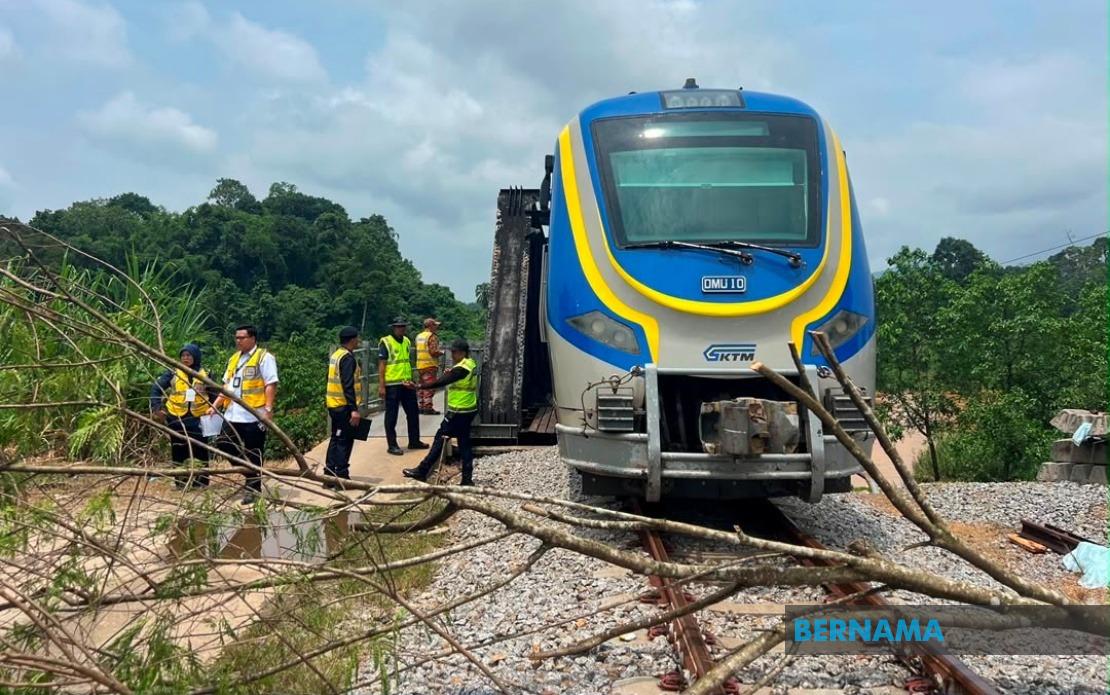
Keretapi Tanah Melayu Berhad (KTMB) has conducted a comprehensive emergency response exercise on the EX-Kemubu railway route in Kuala Krai, designed to stress-test the railway operator's ability to coordinate with multiple government agencies during a crisis. The drills, involving nearly 350 personnel across 11 different government bodies, represent a critical assessment of how quickly rescue teams can reach remote railway corridors and how efficiently information flows from the initial incident report to coordinated multi-agency response.
The training programme focused on three interconnected challenges that railway operators and emergency responders face in Malaysia's rural rail network. Khairul Naim Johdi, KTMB's Occupational Safety, Health and Environment general manager, explained that access to the EX-Kemubu route presents the most significant operational difficulty, as the railway line's remote location far from major roads creates a substantial time lag between incident notification and rescue team arrival. This geographic isolation, common across many Malaysian railway segments, fundamentally changes how emergency protocols must be structured and executed.
The choice of the EX-Kemubu corridor as the training ground was deliberate and strategic. The route encompasses multiple hazard characteristics that make it representative of Malaysia's most challenging railway environments: sections run adjacent to rivers, the terrain is mountainous and densely forested, and the entire corridor remains geographically isolated from urban centres and primary road networks. These combined factors create a scenario where traditional rapid-response emergency protocols may prove inadequate, requiring railways and rescue agencies to develop alternative strategies suited to the specific operational constraints of rural rail infrastructure.
The evaluation methodology adopted by KTMB reflects international best practices in emergency management training. Rather than simply conducting the exercise and moving forward, organisers implemented a structured post-exercise review process that examines not only whether objectives were met but also identifies systemic gaps in inter-agency coordination. This assessment framework specifically examines response delays, evaluates the effectiveness of first responder actions, measures access difficulties encountered, and critically reviews how information disseminated between KTMB's operations centre and responding agencies. Such detailed analysis transforms a training exercise into a diagnostic tool for identifying and subsequently addressing weaknesses in the broader emergency preparedness system.
The participating agencies reflect the complexity of railway emergency response in Malaysia. The Royal Malaysia Police provide traffic control and scene security, the Malaysian Fire and Rescue Department handles technical rescue operations, the Ministry of Health coordinates medical response, the Malaysian Civil Defense Force may assist with mass evacuation scenarios, and the Department of Social Welfare manages displaced persons and crisis counselling. Coordinating these 11 separate agencies, each with distinct procedures and command structures, represents one of the most demanding aspects of real emergency management, making their participation in structured training exercises invaluable.
KTMB's approach to emergency preparedness extends beyond these annual large-scale drills. The railway operator conducts smaller-scale exercises throughout the calendar year across all four of its operational regions, with large-scale exercises conducted annually in rotation. This layered training strategy ensures that personnel maintain proficiency during intervals between major exercises while systematically rotating comprehensive drills across different network segments. Such planning acknowledges that railway emergencies can occur anywhere within the system, and all operational regions must maintain equivalent readiness levels.
Internal coordination between KTMB departments emerged as a critical focus area. The protocol requires that any incident first triggers notification to KTMB's central operations control centre, which serves as the information hub for all emergency communications. From this control centre, information flows outward to external agencies including police, fire and rescue, and health authorities. This centralised notification approach aims to ensure that information reaches all relevant parties simultaneously and consistently, reducing communication delays and preventing gaps where critical agencies remain unaware of an ongoing incident. Khairul Naim particularly emphasised that improving the speed and accuracy of this initial notification phase remains essential for rural railway operations where geographical distance already imposes substantial constraints on response times.
The training programme included practical passenger evacuation scenarios, recognising that in many potential railway emergencies, rapidly and safely removing passengers from trains or stations represents the most time-critical operational priority. KTMB staff participated in exercises demonstrating evacuation procedures, communication protocols during evacuation, and coordination with external rescue agencies who may need to assist in removing injured or immobilised passengers from damaged train cars. These practical components complement theoretical knowledge, ensuring that KTMB personnel can execute procedures under stress conditions resembling actual emergency environments.
For Malaysian passengers and broader public safety considerations, these systematic training programmes represent a commitment to minimising fatalities and injuries should railway emergencies occur. While Malaysia has experienced relatively low incident rates on KTMB services compared to other regional railways, the exercise acknowledges that statistical rarity does not eliminate the necessity for comprehensive preparedness. The remote nature of the EX-Kemubu route means that if an incident occurs, the response environment will differ dramatically from urban rail operations where hospitals, fire stations, and police facilities exist within minutes of the railway corridor.
The implications of these training exercises extend beyond KTMB's immediate operations. As Malaysia's railway network expands and new routes open in previously less accessible areas, the protocols and operational frameworks developed through these exercises become templates for training programmes on newer corridors. Additionally, the coordinated training approach involving 11 government agencies provides a practical framework that could inform emergency response protocols across other transportation sectors, including road and aviation, where similar challenges of geographic isolation and inter-agency coordination arise.
Looking forward, KTMB indicated that systematic analysis of this exercise's findings will generate recommendations for protocol refinements and infrastructure improvements. The feedback collection process from participating agencies will likely identify specific bottlenecks in the current system, whether related to communication equipment capabilities in remote areas, the availability of access routes for emergency vehicles, or gaps in inter-agency understanding of respective responsibilities during multi-casualty incidents. These findings will inform adjustments to training content, procedural modifications, and potentially infrastructure investments designed to enhance emergency response capabilities across Malaysia's railway network.

