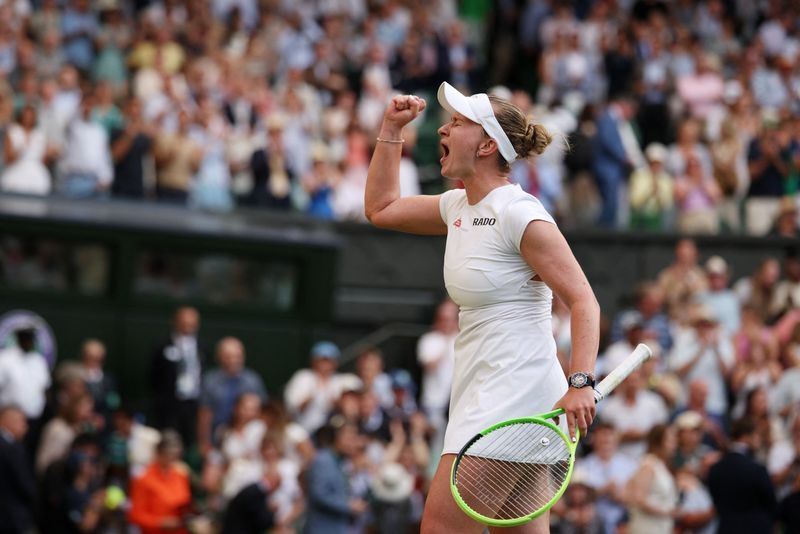
Barbora Krejcikova demonstrated the resilience that defines her storied career by mounting a dramatic turnaround against fifth-seeded Mirra Andreeva on Centre Court at Wimbledon on Wednesday, ultimately progressing to the third round with a 4-6 7-5 6-4 victory. The Czech player's comeback from a set deficit showcased her ability to sustain focus and adjust tactics under pressure, delivering a performance that underscored why she remains a formidable contender despite her advancing years in professional tennis.
The match unfolded as a tale of two contrasting phases. Krejcikova began with considerable aggression against the 19-year-old Russian sensation, racing to a 3-0 lead in the opening set. However, her concentration visibly wavered during a critical juncture, allowing Andreeva to claw back into the contest. The young challenger, buoyed by her maiden Grand Slam triumph at the French Open merely weeks earlier, seized the momentum and claimed the first set 6-4, suggesting that experience might prove secondary to youthful exuberance on this particular afternoon.
The momentum shift appeared to galvanise Krejcikova rather than discourage her. Having captured both the Wimbledon and French Open titles in 2024, the Czech veteran understood the demands of high-pressure tennis on grass. She recalibrated her approach in the second set, focusing on consistency and forcing Andreeva into difficult positions. The set developed into a tightly contested affair, with neither player surrendering easily, yet Krejcikova's superior court sense and experience gradually prevailed as she edged ahead 7-5, forcing the encounter into a decisive third frame.
The deciding set emerged as the most dramatic portion of their encounter. Andreeva, despite her youth and recent success on clay, appeared to struggle with the mounting pressure and the rhythm of Krejcikova's play. The Russian salvaged six match points in extraordinary fashion, demonstrating considerable fighting spirit and technical capability. However, Krejcikova's unwavering precision ultimately proved insurmountable, and she clinched victory 6-4 in the decider, securing what she described as only her second triumph over the talented youngster.
The nature of this victory holds particular significance within the broader narrative of women's professional tennis. Krejcikova's success against a player of Andreeva's obvious talent challenges assumptions about generational advantage in the sport. While Andreeva's French Open victory announced her arrival among the world's elite, this Wimbledon loss illustrates that establishing consistent excellence at the majors requires sustained mental fortitude and adaptability across different playing surfaces and opponents.
In her post-match comments, Krejcikova reflected warmly on the quality of opposition she faced. She acknowledged that their fifth encounter together had maintained the competitive intensity characteristic of their previous meetings, suggesting a rivalry of genuine substance rather than mere competitive routine. Her recognition of Andreeva's exceptional potential spoke to the Russian's standing as one of the sport's most promising emerging talents, even as Krejcikova's victory reaffirmed the enduring value of experience and tactical acumen in championship tennis.
Krejcikova's praise for Centre Court underscored the emotional and psychological dimension that the venue carries for elite players. Her satisfaction in securing victory on grass's most hallowed ground reflected the prestige attached to performing successfully at Wimbledon, a tournament that remains the sport's most tradition-laden event. For Malaysian and Southeast Asian tennis enthusiasts, Krejcikova's persistence offers an instructive lesson in how established champions navigate challenges from emerging rivals through tactical intelligence rather than relying solely on experience.
The Czech player's path forward leads to a third-round encounter against compatriot Nikola Bartunkova, presenting a fascinating all-Czech matchup within the main draw. This fixture adds another layer to the interesting narrative surrounding Central European tennis dominance at the senior levels of the sport, where players from this region continue to demonstrate exceptional technical and mental capabilities across various surfaces.
For Andreeva, the defeat represents a meaningful setback in her trajectory toward consistent Grand Slam contention. Her inability to convert six match points highlighted the difference between winning tournaments and maintaining that form under sustained pressure from the world's most accomplished players. The experience gained from this encounter, nevertheless, should prove invaluable as she develops the mental and tactical sophistication required to convert promising performances into consistent major championship results.
The broader implications of this match extend beyond the immediate tournament context. Krejcikova's victory suggests that age and experience retain considerable currency in women's tennis when combined with intelligent match management. For regional audiences following the sport's development, this contest exemplified how professional tennis rewards not merely explosive talent but also the capacity to read opponents, adapt strategies, and maintain composure across extended matches against different challenges.

