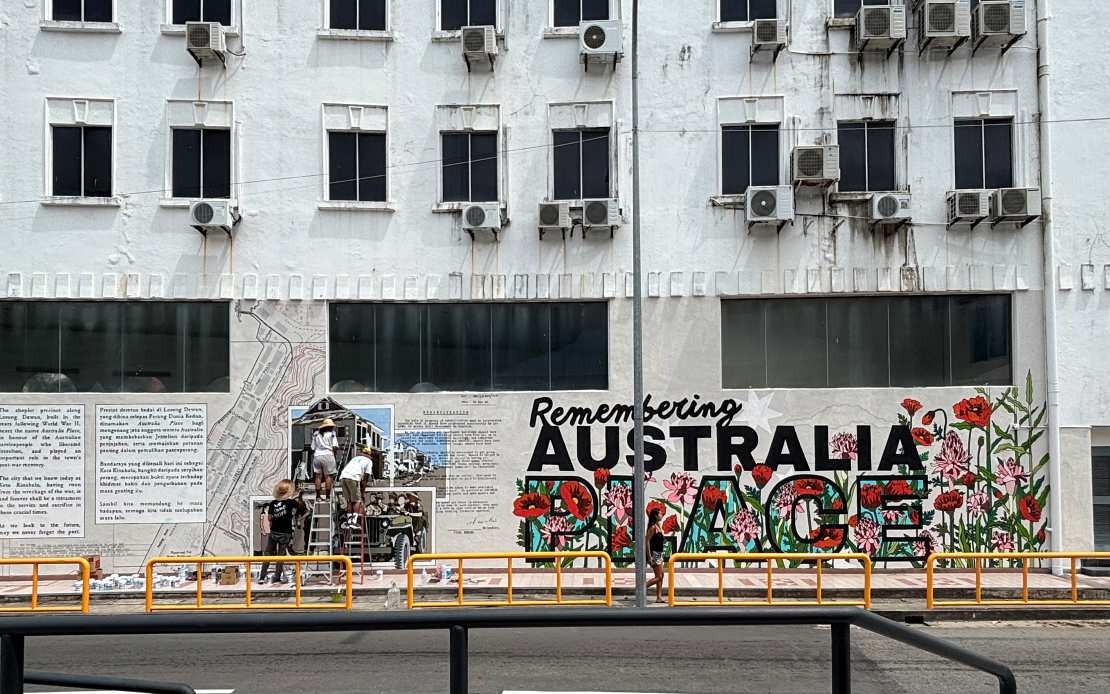
A new public mural has been unveiled in Kota Kinabalu, marking a significant moment in the cultural commemoration of Australian-Malaysian relations. The artwork, installed at the Wisma Intiutama building in the locality long colloquially known as 'Australia Place', was formally launched on Friday in a ceremony that underscored the enduring partnership between Sabah and Australia. The mural's unveiling comes as the region approaches Sandakan Day, a solemn occasion that honours the shared wartime experiences of both nations and the profound sacrifices made during World War II.
Titled 'Remembering Australia Place', the mural represents more than merely decorative public art; it functions as a visual narrative chronicling the multifaceted connections that have bound Australians and Sabahans across generations. The artwork was conceived and executed by Pillars of Sabah, a local community-driven arts organisation committed to preserving and celebrating regional heritage through creative expression. By transforming a building facade into an artistic statement, the project reinforces the notion that public spaces can serve as repositories of collective memory and cultural identity, particularly relevant in Malaysia where community cohesion remains a central policy objective.
Australian High Commissioner to Malaysia Danielle Heinecke attended the launch alongside Kota Kinabalu Mayor Datuk Seri Sabin Samitah, with the gathering drawing parliamentarians, community leaders, and alumni of Australian educational institutions. In her remarks, Heinecke articulated how the mural encapsulates the foundational elements undergirding the Australia-Malaysia relationship: sustained friendship, reciprocal cultural exchange, institutional partnerships, and the human connections that transcend formal diplomatic channels. She characterised the artwork as capturing stories of individuals whose lives have traversed both nations, creating bridges that continue to shape contemporary bilateral cooperation. This emphasis on people-to-people connections reflects a strategic priority in Australian foreign policy towards Southeast Asia, where grassroots engagement increasingly complements state-level diplomatic initiatives.
The creative process itself carries symbolic weight. Jared Abdul Rahman, co-founder of Pillars of Sabah, brought personal investment to the project grounded in his own biographical narrative. Born to a Sabahan father and a Tasmanian mother who met during his father's studies in Australia under the Colombo Plan scholarship scheme, Rahman embodies the very cross-cultural union the mural celebrates. His involvement transformed the commission from a commissioned art project into an intimate exploration of hybrid identity and transnational family histories. The Colombo Plan reference is particularly significant for Southeast Asian audiences, as the scholarship initiative represented a transformative vehicle for regional mobility and educational advancement during the post-colonial period, facilitating the kind of personal encounters that subsequently deepened bilateral relations.
The mural's artistic vocabulary deliberately emphasises universal themes that resonate across cultural boundaries. Through visual storytelling, the work depicts shared values including friendship, resilience, cooperation, and the organic connections forged between communities rather than imposed through governmental structures. This thematic approach acknowledges that sustained bilateral relationships depend fundamentally on mutual understanding and voluntary engagement rather than mere diplomatic formality. For Malaysian viewers, the emphasis on resilience carries particular resonance, echoing national narratives about perseverance and collective strength that feature prominently in Malaysian civic discourse.
The inclusion of younger generations in the mural's creation process extends its significance beyond the immediate artistic product. Rahman's collaboration with students and educators from Sekolah Menengah Kebangsaan Sanzac represented an intergenerational knowledge transfer, ensuring that younger Malaysians develop awareness of historical ties with Australia before these connections fade from living memory. Educational institutions throughout Malaysia have similarly benefited from Australian university partnerships, scholarship programmes, and academic exchanges that remain largely underappreciated in public discourse. By embedding these contemporary educational linkages within a mural celebrating historical friendship, the project implicitly argues for the continuity of bilateral engagement across multiple domains.
Sandakan Day provides the immediate historical context animating this cultural commemoration. The observance honours the 2,434 prisoners of war who perished during the Sandakan Death Marches, one of World War II's most devastating campaigns of forced displacement and attrition. Beyond the tragic toll on Allied servicemen, the occasion recognises the extraordinary courage demonstrated by Sabahan civilians who jeopardised their own safety to assist prisoners and facilitate escape attempts. This aspect of the historical narrative proves particularly important for contemporary Sabah, as it anchors regional identity within a framework of humanitarian action and moral courage. The mural's unveiling on the eve of this commemorative day reinforces the notion that bilateral memory-making remains emotionally and historically significant, not mere archival exercise.
The geographical and cultural specificity of locating this mural in Kota Kinabalu rather than Kuala Lumpur underscores the decentralised nature of Australian-Malaysian relations. While federal-level diplomacy occurs primarily in the capital, the substantive engagement between communities, universities, and regional governments increasingly occurs in secondary cities like Sabah's capital. This pattern reflects broader Southeast Asian realities, where economic dynamism and demographic concentration increasingly favour cities beyond traditional political centres. By installing a significant public artwork in Kota Kinabalu, both governments signal recognition of the state's importance within Malaysia's broader federation and Sabah's role as an anchor point for Australia's bilateral and regional engagement strategies.
The mural's prominence within the built environment carries practical implications for tourism and cultural diplomacy. Public art installations increasingly function as waypoints within heritage tourism circuits, potentially drawing visitors interested in Australian-Malaysian history and generating conversations about bilateral relations among casual observers. For Malaysian tourists and expatriate communities, the artwork provides accessible entry points for understanding historical complexity without requiring specialised knowledge. For Australian visitors to Kota Kinabalu, the mural offers validation of their nation's cultural presence in Southeast Asia while encouraging deeper reflection on shared histories often underemphasised in Australian domestic narratives.
Looking forward, the mural's existence may catalyse additional commemoration and partnership initiatives. Public art projects frequently generate momentum for broader cultural programming, archival preservation efforts, and educational curriculum development. The involvement of the Australian High Commission suggests institutional commitment to sustaining and expanding cultural engagement beyond the immediate ceremonial moment. For Malaysian policymakers and cultural institutions, the project demonstrates how strategic deployment of public art can advance diplomatic objectives while simultaneously enhancing community pride and intergenerational cultural transmission. As both nations navigate evolving regional dynamics and bilateral priorities, maintaining visibility of historical friendships and contemporary partnerships becomes increasingly important for sustaining mutual commitment and public support for ongoing cooperation across defence, education, trade, and humanitarian domains.

