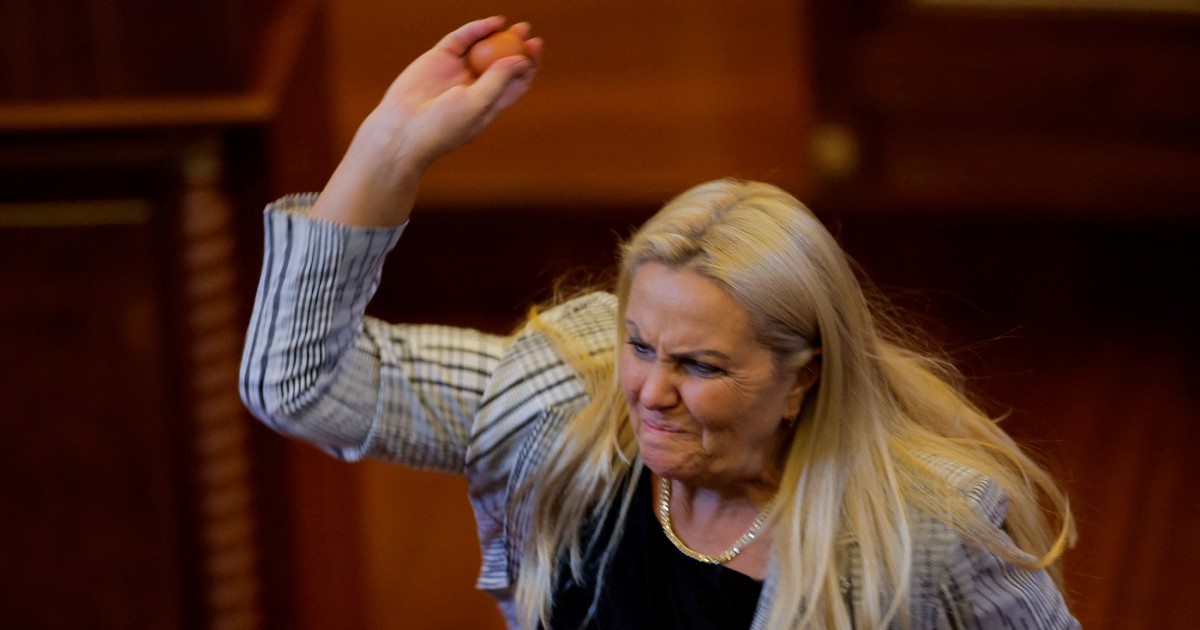
The deteriorating political climate in Kosovo reached a breaking point on Saturday when parliamentary proceedings ground to a halt following a physical confrontation between an opposition member and caretaker Prime Minister Albin Kurti. The incident, in which eggs were thrown at the premier during a legislative session in Pristina, underscores the degree of animosity and dysfunction plaguing the country's governing institutions at a critical moment.
The egg-throwing episode serves as a vivid manifestation of deeper fault lines fracturing Kosovo's political establishment. The caretaker administration of Kurti has struggled to maintain parliamentary consensus as opposition factions grow increasingly hostile to his governance, raising fundamental questions about the stability of the current interim arrangements and the viability of sustaining a functioning government under present circumstances.
The immediate backdrop to this parliamentary breakdown involves a succession of political standoffs that have prevented Kosovo from establishing a stable governing coalition since recent electoral contests. Rather than consolidating power around a coherent legislative majority, the country's political actors have become entrenched in zero-sum confrontations that prioritise factional advantage over institutional functionality. This adversarial environment has made routine parliamentary business contentious and has transformed ordinary legislative debates into forums for territorial posturing.
The caretaker status of Kurti's administration carries particular significance in Kosovo's institutional architecture. Temporary governments typically operate with constrained authority and limited mandate, yet face mounting pressure to address urgent policy challenges. When parliamentary hostility prevents even basic legislative operations from proceeding, the caretaker framework becomes untenable, creating cascading pressures that can only be resolved through electoral intervention or major political realignment.
For Malaysia and other Southeast Asian democracies observing regional developments, Kosovo's parliamentary dysfunction offers cautionary insights into how polarised political environments can undermine institutional stability even in young democracies attempting to consolidate democratic norms. The normalisation of confrontational conduct within legislative chambers represents a dangerous regression that threatens the very institutions designed to channel political disagreement through peaceful mechanisms. When parliamentarians resort to physical provocations rather than rhetorical debate, democratic institutions lose their capacity to legitimate governance outcomes and manage competing claims.
The threat of snap elections looms as a potential consequence of this parliamentary breakdown, reflecting the absence of political mechanisms capable of resolving substantive disagreements through negotiation and compromise. Rather than engineering settlements that accommodate multiple constituencies, Kosovo's political leadership appears locked in patterns of escalation where each side seeks electoral advantage over stability. This dynamic creates persistent uncertainty that hampers long-term policy planning and investor confidence in the country's governance capacity.
Regional stakeholders, particularly the European Union and neighbouring Balkan states, face mounting concern about Kosovo's institutional trajectory. The territory's status remains contested internationally, and internal governance failures provide openings for external powers to challenge Kosovo's sovereignty and territorial integrity. Political instability undermines diplomatic positioning precisely when Kosovo requires unified institutional authority to navigate complex regional geopolitical questions and implement the reforms necessary for potential EU integration pathways.
The symbolic power of the parliamentary suspension cannot be overlooked. That legislative business must be halted to manage a physical altercation demonstrates how thoroughly personalised and acrimonious Kosovo's political environment has become. When institutions cannot function because of conduct that would be considered extraordinary in stable democracies, this itself becomes a statement about the breakdown of political norms and shared expectations about acceptable parliamentary behaviour. The incident reflects not merely tactical disagreement but a deeper erosion of institutional consensus and democratic culture.
Kurti's position as caretaker prime minister places him in an exceptionally difficult political position. Governing without a stable legislative majority while navigating both domestic opposition hostility and international pressure creates pressures that few leaders can navigate successfully. The physical attack on his person escalates beyond standard parliamentary opposition into territory that risks normalising violence as a political tool. This escalation carries particular dangers in a region with recent memories of ethnic conflict and state fragmentation.
The egg-throwing incident exemplifies how political frustration, when channelled into parliament rather than resolved through other mechanisms, translates into institutional breakdown rather than problem-solving. Opposition lawmakers apparently viewed parliamentary disruption and physical provocation as more effective political strategies than legislative persuasion or coalition-building. This judgment reflects profound loss of confidence in the parliamentary process itself as a mechanism capable of delivering political outcomes or protecting minority interests.
The prospect of snap elections presents both risks and potential opportunities for Kosovo's political trajectory. Fresh elections might produce a clearer mandate and consolidated legislative support enabling functional governance, or they might entrench fragmentation further if no faction can assemble decisive parliamentary majorities. The outcome depends substantially on whether the intervening period allows political actors to recalibrate strategies and rebuild institutional consensus, or whether accelerating polarisation renders compromise increasingly impossible.
International observers monitoring Kosovo's institutional health must consider whether this parliamentary crisis represents an isolated incident or symptomatic of deeper democratic backsliding. The European Union and major Western powers invested substantial diplomatic resources in shepherding Kosovo's state-building process and supporting institutional development. Governing dysfunction at this scale threatens to undermine confidence in Kosovo's capacity for stable democratic governance and raises uncomfortable questions about the sustainability of the independence project that international actors championed. Regional stability and Kosovo's international standing increasingly depend on rapid restoration of functional parliamentary procedures and political compromise.

