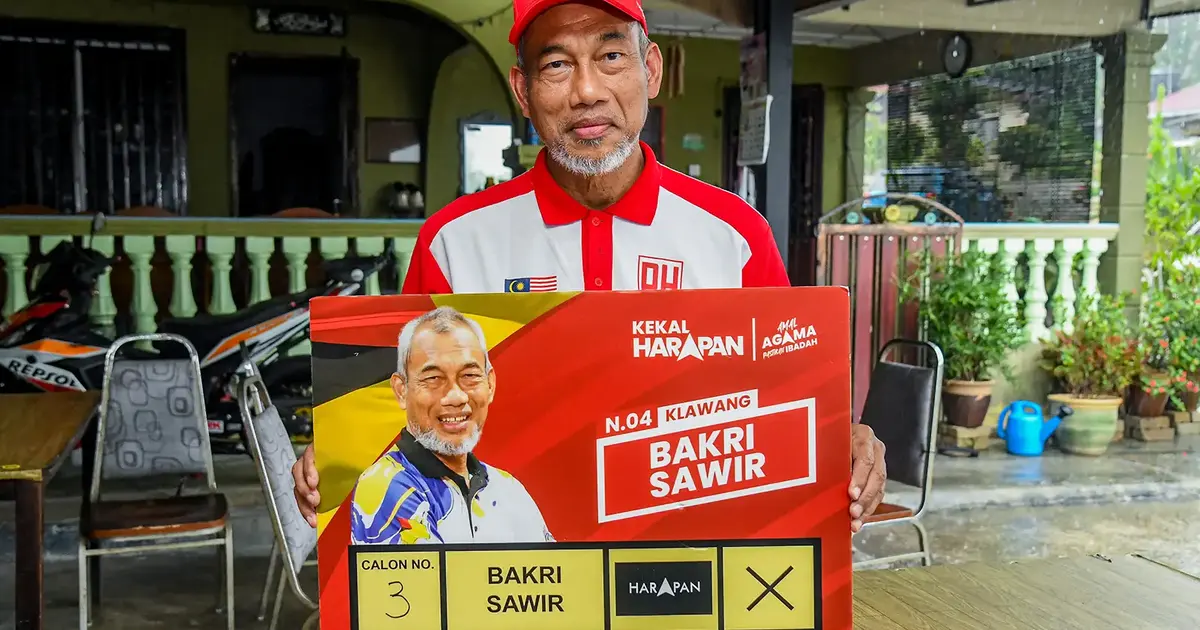
Klawang assemblyman Bakri Sawir has dismissed concerns about the Barisan Nasional-Perikatan Nasional coalition's impact on his re-election bid, pointing to his track record of winning representation for the constituency without relying on Umno's machinery. The two-term incumbent from Pakatan Harapan remains resolute in his determination to retain the Selangor state seat, having previously navigated electoral challenges that he attributes to what he characterises as abandonment by his former party allies.
Bakri's confidence stems partly from his experience during the 2023 state elections, when he secured victory despite what he views as inadequate or deliberate lack of support from Umno. This history appears to have steeled his resolve rather than weakened it, suggesting a political operator who has learned to build independent bases of community support that transcend traditional coalition mechanics. For Malaysian voters accustomed to seeing state assemblies function as extensions of larger political machines, Bakri's assertion represents a different operating model—one centred on localised constituency relationships rather than top-down party directives.
The announcement of a formal BN-PN alliance has triggered speculation across multiple state constituencies about shifting electoral dynamics. In Selangor, where Pakatan Harapan currently commands a significant majority, such coalitions could potentially fragment the opposition vote or consolidate it in ways that reshape political calculations. Bakri's dismissal of this threat carries particular weight in Klawang, a constituency that has demonstrated its own political temperament and preferences in recent electoral cycles. His willingness to contest without explicitly invoking party machinery suggests either extraordinary confidence in grassroots consolidation or a calculated assessment that local factors matter more than national coalition alignments in determining outcomes.
The experience Bakri references from 2023 reveals interesting fault lines within Malaysia's political establishment. That Umno did not fully mobilise behind him during state elections—despite Pakatan Harapan and BN being in ostensible cooperation at that time—indicates the complexities of managing multi-party coalitions where national and state-level interests diverge. For Klawang residents, such internal party disputes may have little salience; what registers instead is whether their assemblyman delivers tangible constituency services and maintains responsive communication channels with constituents.
Pakatan Harapan's approach to candidate selection in constituencies like Klawang will prove decisive. Should the coalition decide to field Bakri again, they signal confidence in his personal standing and local consolidation. If they replace him, the incumbent's assertion about winning without party apparatus gains credibility as a prediction of independent performance. Either way, Bakri has already positioned himself as someone capable of transcending coalition politics, a narrative that resonates with voters fatigued by the frequent realignments that have characterised Malaysian politics over the past decade.
The BN-PN pact itself represents a significant strategic recalibration in Malaysian opposition politics, with implications beyond individual constituencies. These two coalitions have competed fiercely at national level, yet at state level they have pragmatically collaborated or consolidated in various configurations. For Selangor specifically, the state has functioned as a Pakatan Harapan stronghold, though individual seats have remained competitive and sensitive to local factors. The new BN-PN arrangement may prompt more aggressive campaigning in seats like Klawang, but it does not automatically transform electoral outcomes in constituencies where incumbents possess established support networks.
Bakri's political biography matters here. As a two-term assemblyman, he has accumulated approximately a decade of on-ground relationships, constituent grievances addressed or pending, and recognisability that money and coalition backing alone cannot instantly manufacture. Voters in state elections often prioritise local representation quality over national political alignments, particularly when their assemblyman has been attentive and accessible. Bakri's previous victory without perceived Umno support suggests he has built such a personal political economy in Klawang, one that can survive external coalition shifts.
The broader significance of his statement lies in what it reveals about Malaysian electoral politics' growing fragmentation and localisation. Once monolithic coalition machines have fractured into more fluid, issue-specific, and personality-driven political formations. Candidates increasingly win on individual merit and local standing rather than purely on coalition coattails. This trend undermines the traditional gatekeeping power of party machines and empowers capable constituency-level operators. For a politician like Bakri to openly declare independence from coalition machinery reflects and reinforces this structural shift.
Yet Bakri's confidence, however well-founded in his previous success, faces new tests. The BN-PN alliance represents consolidated opposition resources that did not exist in its current form during 2023. Campaign spending, volunteer mobilisation, and messaging coordination may prove more formidable this cycle. Whether his personal standing can withstand such concentrated opposition pressure remains the genuine strategic question underlying his bullish public statements. His assertion serves partly as political messaging, partly as a genuine assessment of his constituency's political personality, and partly as pressure on Pakatan Harapan to commit resources to defending a seat whose incumbent has demonstrated independent viability.

