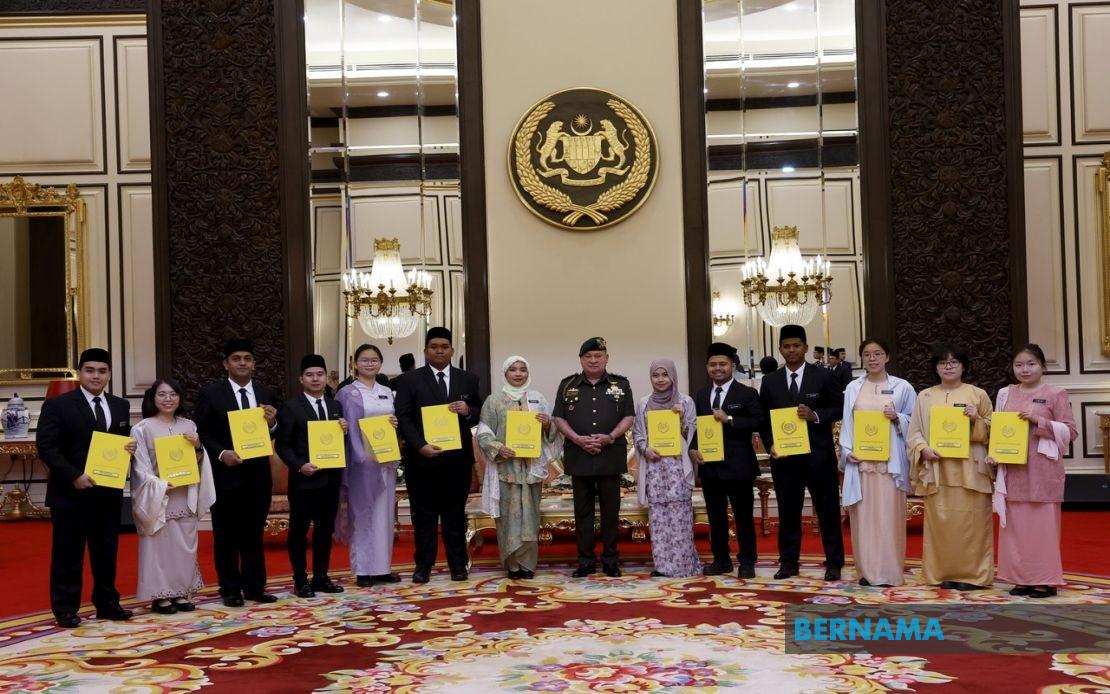
His Majesty Sultan Ibrahim, King of Malaysia, formally conferred the 2026 Yang di-Pertuan Agong Scholarships upon 14 deserving recipients during an official ceremony held at Istana Negara in Kuala Lumpur on June 24. The distinction marks a significant recognition of academic excellence and potential within Malaysia's pool of aspiring researchers and scholars who are poised to contribute meaningfully to the nation's knowledge economy and development trajectory.
The cohort of scholarship recipients was split evenly in terms of academic pursuit. Seven scholars received funding to undertake doctoral studies at the highest level of academic attainment, while the remaining seven were granted support for Master's (Research) level programmes. This balanced distribution reflects the government's commitment to nurturing talent across multiple tiers of postgraduate research, recognising that advanced research capacity spans both the doctoral and master's phases of academic development.
Geographically, the distribution of placements underscores Malaysia's dual strategy of developing research infrastructure domestically whilst maintaining international academic connections. Ten of the 14 recipients will pursue their studies at premier research universities within Malaysia, anchoring their scholarly work and expertise development within the nation's institutional framework. Meanwhile, four scholars have secured placements at leading universities abroad, positioning them to gain exposure to cutting-edge research methodologies and global academic networks whilst maintaining ties to their home country's research ambitions.
The BYDPA scholarship programme stands as one of the most distinguished and generously funded government scholarship initiatives in Malaysia. Tan Sri Wan Ahmad Dahlan Abdul Aziz, Director-General of the Public Service, emphasised this standing when speaking with reporters following the ceremony, noting that the scholarship represents the pinnacle of government-sponsored educational support in terms of funding allocation. This designation reflects the Malaysian government's strategic investment in developing high-calibre researchers and academics who can eventually assume leadership roles in academia, research institutions, and knowledge-intensive sectors.
The presence of senior officials at the ceremony underscored the significance accorded to the event within the government apparatus. Alongside Tan Sri Wan Ahmad Dahlan, the Comptroller of the Royal Household at Istana Negara, Tan Sri Dr Azmi Rohani, attended the presentation. Their participation signalled the importance the monarchy and senior public administration place upon supporting excellence in education and research as pillars of national development.
From a Malaysian perspective, the BYDPA scholarship scheme operates within a broader context of regional competition for academic talent. Southeast Asian nations increasingly vie to retain and develop their brightest minds, recognising that human capital and research capacity directly correlate with economic innovation and competitiveness. By providing generous support for postgraduate study, Malaysia positions itself as a nation invested in nurturing intellectual capital that can address pressing regional and global challenges through research-driven solutions.
The scholarship's emphasis on both domestic placements and international exposure reflects a nuanced understanding of knowledge development in the contemporary era. Scholars studying locally gain immediate benefit from contributing to Malaysia's research ecosystem whilst building networks within the nation's academic institutions. Those studying internationally gain exposure to different research traditions, technological infrastructure, and collaborative frameworks, experience that typically enhances their capacity to advance research upon return to Malaysia.
The distinction between PhD and Master's (Research) tracks within the BYDPA framework acknowledges that postgraduate research talent develops across a spectrum. Not all exceptional researchers immediately leap to doctoral levels; some require the intermediate scaffolding that a research-focused master's programme provides. This tiered approach ensures that the scholarship programme captures a broader range of potential contributors to Malaysia's research landscape rather than restricting support to a single pathway.
For Malaysian readers, the implications of such scholarship investments extend beyond the immediate 14 recipients. These funded scholars will eventually populate universities, research institutes, government laboratories, and industry research divisions throughout the country. Their training, networks, and scholarly productivity will constitute foundational elements of Malaysia's capacity to innovate, address societal challenges through evidence-based approaches, and participate meaningfully in global intellectual discourse. The BYDPA programme thus functions as a strategic tool for building long-term institutional and intellectual capacity.
Looking forward, the consistent annual conferral of these scholarships indicates a sustained government commitment to postgraduate research development. The Malaysian government's willingness to allocate what Tan Sri Wan Ahmad Dahlan characterised as the highest funding levels among government scholarship programmes demonstrates that policymakers recognise research capacity as essential infrastructure for national advancement. For aspiring researchers across Malaysia and the broader Southeast Asian region observing these developments, such investment signals that academic excellence remains valued and supported within the Malaysian context.