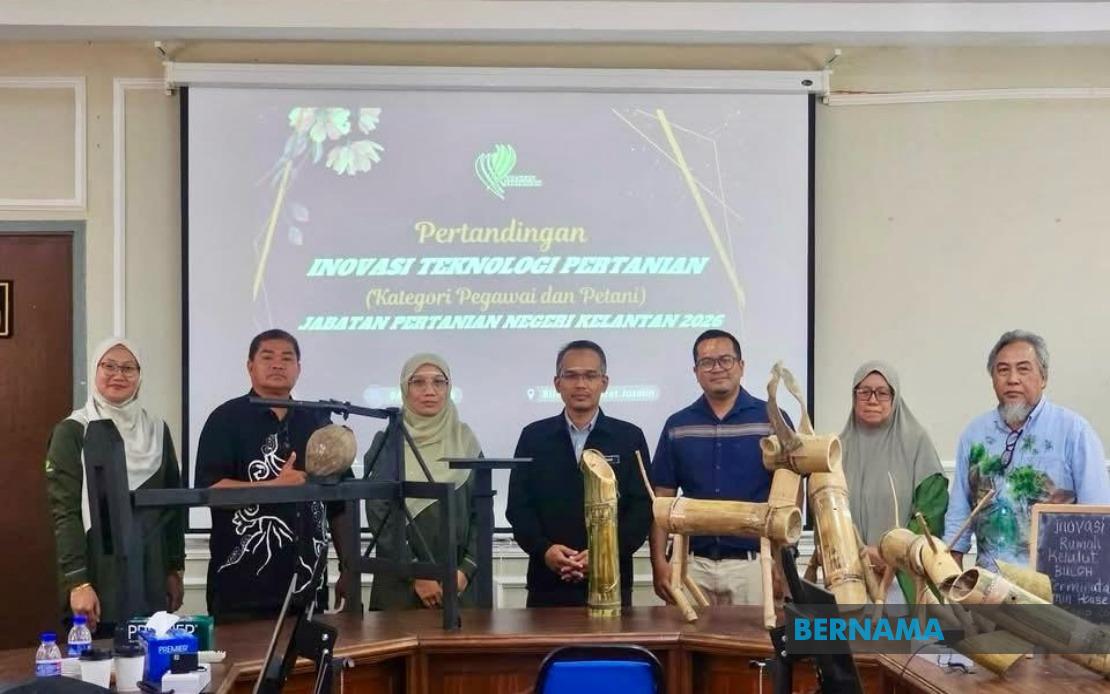
Plantation entrepreneur Che Adnan Che Kadir, 56, has engineered an innovative coconut dehusking machine that judges at Kelantan's 2026 Agricultural Technology Innovation Competition believe holds significant crossover potential for other specialty crops, particularly durians. The device earned a four-star rating in the farmer category, positioning Che Adnan to potentially represent Kelantan at the national innovation showcase in Putrajaya in late September during National Innovation Week. The development represents a tangible example of how local agricultural entrepreneurs are addressing practical challenges through mechanical innovation, a particularly relevant model for Malaysian agriculture as the sector grapples with labour shortages and the need for safer working practices.
The judging panel, comprising specialists from the Kelantan Department of Agriculture, the Malaysian Agricultural Research and Development Institute (MARDI), and representatives from local polytechnics, explicitly recommended exploring adaptation of the technology beyond coconuts. Durians emerged as the primary candidate for further development, recognising that the durian industry faces persistent challenges around processing safety and efficiency. Opening durians requires considerable manual dexterity and carries inherent injury risks, particularly when workers handle the sharp, spiky exterior. A mechanised solution addressing these pain points could meaningfully improve working conditions across Malaysia's durian-growing regions, where seasonal labour intensification has historically contributed to workplace incidents.
Che Adnan initially conceived and built the dehusking device in 2024 to streamline operations on his six-hectare farm in Kampung Chetok, Pasir Mas, where traditional hand-dehusking methods proved labour-intensive and posed occupational hazards. The lightweight portable unit, weighing just 3.5 kilograms, dramatically compresses processing time. Where conventional hand-dehusking typically requires two to three minutes per coconut, the device reduces this to approximately one minute, with experienced operators achieving completion in 40 to 45 seconds. This efficiency gain translates directly into measurable productivity improvements that appeal to both smallholder farmers managing limited acreage and larger commercial operations seeking to optimise labour deployment.
The entrepreneur emphasised that his success stemmed partly from institutional support provided by the Kelantan Department of Agriculture, which facilitated his participation at the state competition level. This agricultural ministry backing underscores growing government recognition that farmer-led innovation deserves systematic encouragement and evaluation. The judging framework itself—drawing expertise from multiple agricultural and technical institutions—ensures that assessments consider commercial viability, technical soundness, and scalability potential, rather than purely novelty value. For Malaysian readers, this institutional infrastructure signals that innovation pathways exist beyond large corporate research laboratories, potentially encouraging other smallholders to formalise their own practical solutions.
Che Adnan's vision for scaling beyond coconuts addresses a critical gap in Malaysia's agricultural mechanisation landscape. Durians constitute a high-value commodity crop central to Malaysia's international agricultural brand and domestic rural prosperity. Yet the industry remains remarkably labour-dependent during processing stages, creating bottlenecks during peak harvest seasons and exposing workers to repetitive strain injuries. A machine adaptable to durian processing could simultaneously enhance safety, reduce seasonal labour requirements, and improve throughput capacity. The entrepreneur noted that durians were explicitly identified as the priority fruit for adaptation precisely because skilled handling remains fundamentally important to product quality and worker protection.
The award included recognition of Che Adnan's potential selection to represent Kelantan at the national innovation competition, an opportunity that carries significant implications for both his invention's trajectory and broader agricultural sector visibility. National-level exposure through innovation competitions creates networking opportunities with government agencies, research institutions, and potential commercial partners. More importantly, it situates farmer-generated solutions within Malaysia's broader innovation ecosystem, helping policymakers understand emerging technologies from the ground level rather than imposing top-down technological solutions that may not align with practical farm realities.
Progress toward commercialisation hinges on securing development funding. Che Adnan identified the national innovation grant—accompanied by a RM10,000 cash prize—as instrumental for refining the design and preparing the device for production scaling. He acknowledged that competitive participation at the national level requires implementing judging panel recommendations, suggesting that state-level feedback identified specific technical or design improvements necessary before broader market introduction. This iterative refinement process, though demanding additional investment and effort, ultimately strengthens the final product and increases its commercial viability. For Malaysian entrepreneurs operating in agricultural technology, this pathway illustrates how government-supported innovation competitions serve not merely as award ceremonies but as structured feedback mechanisms connecting inventors with expert guidance.
The potential adaptation of the technology to durians warrants particular attention given the crop's economic significance. Malaysia ranks among global durian production leaders, with the fruit commanding premium prices domestically and internationally. Processing efficiency directly influences profitability and competitive positioning. A domestically developed mechanisation solution would offer advantages over imported equipment: local adaptation to Malaysian durian varieties, cost accessibility for smallholder operations, and maintenance support through domestic networks. Furthermore, a home-grown innovation in this domain could establish a technology export opportunity if the adapted device performs effectively, allowing Malaysian agricultural equipment manufacturers to position themselves in Southeast Asian durian-producing regions.
Che Adnan's realistic assessment of remaining work required before national competition demonstrates appropriate entrepreneurial maturity. He acknowledged that securing an innovation grant would facilitate design refinement aligned with production capabilities and industry requirements, suggesting he understands the distinction between successful prototype operation and market-ready manufacturing. This perspective contrasts favourably with inventors who prematurely pursue commercialisation without adequately addressing scalability or production consistency challenges. For Malaysian agricultural policymakers interested in translating farmer innovations into commercially viable products, Che Adnan's approach—accepting expert feedback, planning methodical improvement cycles, and seeking targeted financial support—provides a replicable model.
The device's portability represents an often-overlooked advantage. Agricultural equipment designed for farms must balance functionality with practical deployment constraints. A 3.5-kilogram unit that can be easily transported and operated on-farm or in centralised processing facilities offers operational flexibility unavailable with heavier, stationary equipment. This flexibility particularly benefits Malaysia's smallholder-dominated agricultural sector, where farm sizes and infrastructure vary considerably. Farmers could potentially use the device individually or share ownership within farmer cooperative structures, spreading capital costs while addressing processing bottlenecks.
Looking forward, the competition success and expert panel recommendations position durian mechanisation as an emerging innovation frontier within Malaysian agriculture. As labour costs escalate and younger generations seek employment outside farming, mechanising labour-intensive processing steps becomes economically and socially imperative. Che Adnan's device, if successfully adapted and commercialised, could catalyse broader industry interest in durian processing mechanisation. Other inventors might be inspired to address complementary processing challenges, collectively shifting the durian industry toward greater mechanisation and improved working conditions. Furthermore, successful commercialisation would validate the government's agricultural innovation support framework, potentially encouraging expanded funding and institutional support for farmer-led technological development across other crop sectors.
The road to national competition and eventual commercialisation remains demanding, requiring Che Adnan to implement judging recommendations, secure development funding, and navigate the commercialisation pathway. However, the state-level recognition and expert panel endorsement signal that his innovation merits these investments. For Malaysian agricultural stakeholders—whether smallholder farmers, equipment manufacturers, or policymakers—Che Adnan's progression from farm-level problem-solving to state recognition to national competition represents precisely the kind of domestically-driven innovation that could reshape how Malaysia's agricultural sector addresses long-standing processing and labour challenges.

