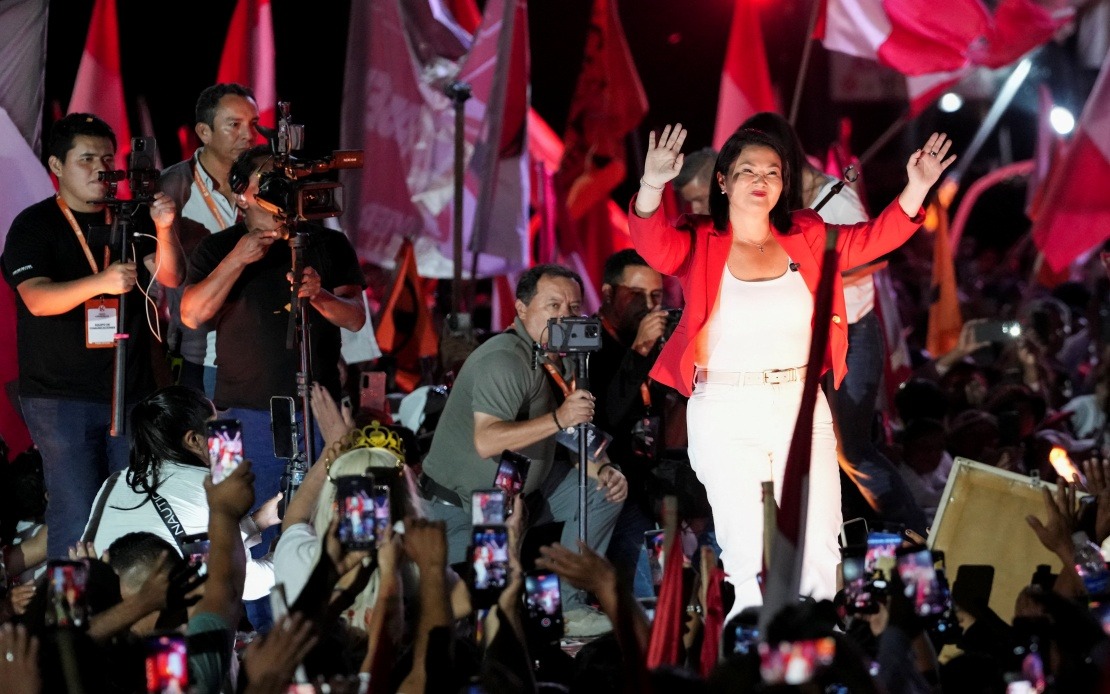
Keiko Fujimori has secured Peru's presidency in one of the closest electoral contests in the country's recent history, capturing 50.135 per cent of valid votes according to the complete official tally released Monday by the National Office of Electoral Processes (ONPE). The Popular Force candidate's narrow triumph over Together for Peru's Roberto Sanchez represents a watershed moment for Peruvian politics, delivering victory to a political dynasty while simultaneously exposing the country's deep ideological divisions at a moment of institutional fragility.
The final count, which processed all 92,766 tally sheets from the June 7 election, awarded Fujimori 9,223,396 votes against Sanchez's 9,173,755 votes. This margin of just 49,641 votes—less than one-half of one per cent of the total—underscores the extraordinary polarization characterizing Peruvian society as the nation grapples with persistent economic challenges, political instability, and widespread public mistrust of traditional institutions. The ONPE's real-time vote-counting platform recorded Sanchez's share at 49.865 per cent, demonstrating how evenly the electorate split between competing visions for the country's future.
Fujimori's victory culminates a remarkable political comeback for the daughter of former President Alberto Fujimori, who led Peru from 1990 to 2000 during a period marked by both economic stabilization and serious allegations of human rights violations. After three previous unsuccessful presidential campaigns, she has finally breached the threshold of electoral victory, though the slender margin offers her little mandate for sweeping policy changes. Her ascent to the presidency carries symbolic weight across the region, as Peru joins other Latin American nations experiencing renewed interest in more conservative or authoritarian-leaning political figures amid widespread dissatisfaction with progressive governance.
Her opponent, Roberto Sanchez, represented continuity with the administration of Pedro Castillo, who served as president from 2021 to 2022 before being removed from office amid political turmoil. Sanchez's near-victory, despite the tumultuous record of the government in which he served as a minister, suggests that significant segments of the Peruvian electorate retained hope for left-leaning approaches to addressing the nation's socioeconomic grievances. The extremely close result reflects voter anxiety about which path would better address persistent inflation, unemployment, and inequality that have plagued Peru's working and middle classes.
The electoral commission's announcement comes at a moment when Peru's democratic institutions face considerable strain. The country has experienced multiple changes of government in recent years, frequent street protests, and deep institutional mistrust that manifests in both ballot-box choices and social mobilization. Fujimori's narrow win, rather than providing decisive clarity, may intensify these tensions by delivering power to a candidate favored by less than one-fifth of all registered voters when accounting for abstention and spoiled ballots. This legitimacy question will shape her ability to govern effectively during what promises to be an exceptionally challenging term.
For observers across Southeast Asia monitoring Peru's political trajectory, this election illuminates broader regional trends in Latin American politics. Like movements in Indonesia, the Philippines, and Thailand, Fujimori's comeback reflects voter frustration with incumbent governments and openness to figures promising institutional renewal or security enhancement, even when those figures carry controversial historical associations. The extremely competitive nature of the contest also demonstrates how economic hardship and social fragmentation have made electoral predictions unreliable across diverse national contexts.
The ONPE's completion of the official count marks the conclusion of one phase of Peru's electoral process. Roberto Burneo, president of the National Jury of Elections, indicated that the electoral authority would officially proclaim the results on Friday, providing the formal constitutional basis for Fujimori's assumption of presidential office. This procedural step, while routine in normal circumstances, carries heightened significance given Peru's history of contested election results and political conflict surrounding electoral outcomes.
Fujimori's path to victory followed an intensely competitive two-person runoff, reflecting Peru's electoral system that requires candidates to advance through multiple rounds of voting when no candidate achieves an outright first-round majority. The June 7 balloting and subsequent tabulation process occurred amid heightened security concerns and international attention to Peru's democratic resilience. Her ultimate success, secured by a margin that could reasonably be described as a statistical tie, raises important questions about the strength of her mandate and the durability of political consensus around her policy platform.
The incoming administration inherits a nation confronting multiple overlapping crises. Peru's economy has struggled with inflation rates that have eroded household purchasing power significantly, while gang violence and drug trafficking organizations continue destabilizing portions of the country. Currency instability has compounded these challenges, making basic goods increasingly expensive for ordinary Peruvians and generating the economic anxiety that doubtless influenced voting patterns. Fujimori's campaign promises will face immediate stress testing against these harsh realities of governance.
As Fujimori prepares to assume office following the formal proclamation, attention now turns toward coalition-building in Peru's Congress, where no single party commands a legislative majority. Effective governance will require negotiating with rival political groupings that may harbor reservations about the new president's agenda or ideological orientation. The Congress's fragmentation mirrors the broader electoral fragmentation evident in the near-tie presidential result, suggesting that Peru's political challenges extend far beyond the question of which individual assumes the presidency.
The election's extremely narrow outcome also raises questions about Peru's longer-term political stability and the nature of democratic competition in an environment where institutional trust has deteriorated significantly. Fujimori enters office without clear public enthusiasm for her agenda and facing skepticism from nearly half the electorate who voted for her competitor. Her ability to govern effectively, command congressional cooperation, and address Peru's mounting social and economic difficulties will determine whether this electoral moment represents a genuine reset of Peruvian politics or merely another episode in the nation's ongoing institutional dysfunction.

