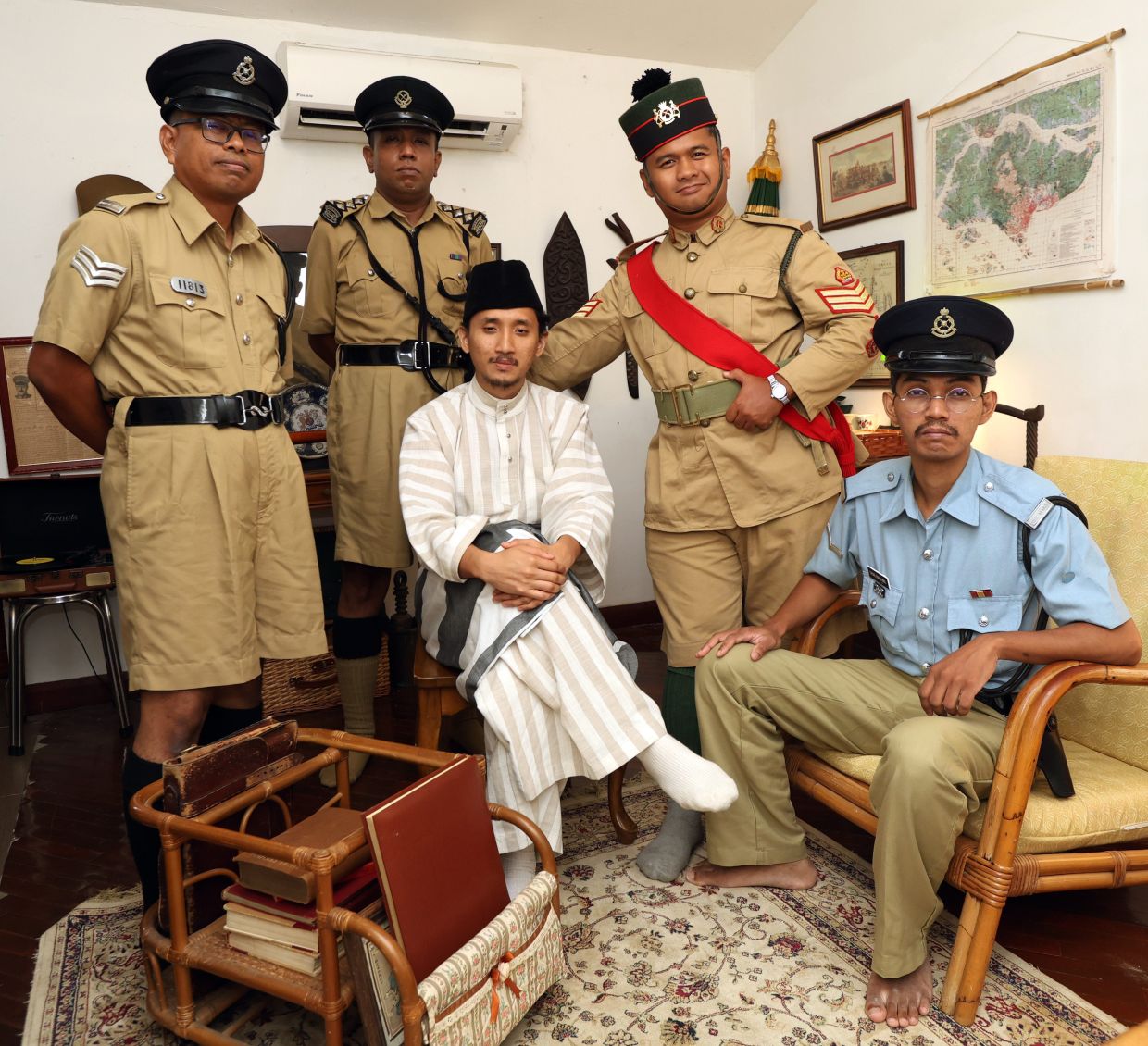
When the Persatuan Reka Ulang Sejarah (PRUS) gathers on weekends, the scene resembles something between a history seminar and a living museum exhibition. Members dressed in meticulously maintained historical military uniforms settle into casual discussion, but their purpose extends far beyond costume appreciation. These enthusiasts have evolved from a loose collective of vintage uniform collectors into a formally registered society dedicated to making Malaysian history tangible and accessible—particularly for younger generations who increasingly encounter the nation's past only through textbooks and digital screens.
The origins of PRUS trace back to the early 2010s, when history buffs with shared interests in military paraphernalia began congregating at events organised by institutions such as the Port Dickson Army Museum at the former Royal Malaysian Air Force Base in Sungai Besi, Kuala Lumpur. What started as informal gatherings under the banner "We Are Re-enactors" eventually crystallised into something more substantial. The group's official registration as PRUS in 2023 marked a turning point, transforming what might easily have remained a niche hobby into a structured educational initiative with genuine institutional credibility and capacity to partner with schools and museums.
Chairman Abdul Hakim Abdul Rani, who works professionally as a tour guide, articulates the core motivation behind the society's formation. He observed widespread confusion regarding historical uniforms, particularly from eras when black-and-white photography dominated and different military branches appeared superficially similar. This knowledge gap troubled him sufficiently to pursue a systematic approach to public education. The society's official registration opened doors that informal gatherings could never access, enabling PRUS to conduct structured exhibitions, deliver school presentations, and position themselves as reliable consultants on matters of historical accuracy. Abdul Hakim emphasises that their educational mission fundamentally separates them from casual costume enthusiasts: they operate under a principle of rigorous historical fidelity rather than entertainment value.
What distinguishes PRUS members from conventional costume roleplayers lies in their obsessive attention to period-appropriate detail. Beyond acquiring authentic uniforms, members invest considerable effort in studying how soldiers of different eras actually behaved—their marching techniques, body language, speaking patterns, and etiquette. A uniform represents only the visual surface; genuine historical understanding requires embodying the complete social and physical context of a particular period. This commitment manifested vividly during a two-day jamboree in July, where PRUS members underwent structured training in marching formations, map reading, navigation techniques, and basic combat manoeuvres based on original pre-Independence military manuals. Abdul Hakim, drawing on his own background with the Territorial Army (Askar Wataniah), personally led these sessions. Crucially, combat re-enactments employed sticks rather than functional weapons, complying with contemporary regulations while maintaining the educational purpose of understanding authentic soldier movements and tactical thinking.
The society's engagement extends into Malaysia's film and television industry, where producers increasingly consult PRUS members for authenticity guidance. Vice chairman Mohd Fadzreeq Mokti explains that their contributions transcend mere extra work; they function as historical consultants ensuring visual and behavioural accuracy. This film industry involvement creates broader public exposure for their work, as viewers unconsciously absorb accurate historical information through entertainment media rather than formal educational channels. Such partnerships also provide platforms for PRUS to demonstrate that historical re-enactment represents serious scholarly work rather than frivolous dressing up.
PRUS maintains particular visibility during Malaysia's peak patriotic seasons, with August and September seeing intensified activity coinciding with National Month and Malaysia Day celebrations. During these periods, members transport their meticulously curated collections to public exhibitions, strategically targeting youth audiences. Abdul Hakim has observed alarming gaps in young people's historical knowledge—unfamiliarity with pivotal national figures and events that previous generations considered foundational. He views this erosion of historical consciousness as deeply concerning, motivating his conviction that schools represent the most crucial venue for early historical engagement. By bringing tangible, visually engaging representations of the past directly into educational settings, PRUS attempts to address what textbooks and conventional teaching methods often fail to achieve.
Mohd Fadzreeq, who combines his PRUS vice chairmanship with a full-time teaching career, has witnessed this educational impact firsthand. When he arrives at school wearing historical military uniform—an arrangement approved by his headmaster—students respond with palpable excitement and curiosity. They repeatedly ask when he will wear the uniform again, revealing genuine fascination that traditional classroom instruction apparently fails to spark. Young children, Fadzreeq observes, demonstrate exceptional curiosity and learn most effectively through hands-on, visual engagement rather than abstract information. Many students lack easy access to museums or opportunities to physically examine historical artefacts; PRUS members effectively become mobile repositories of tangible heritage, bringing history directly to communities that might otherwise remain disconnected from it.
The society's members conceptualise themselves as "walking museums," a phrase that captures their educational philosophy succinctly. They don't merely display uniforms; they embody historical periods through authentic representation and detailed knowledge. When the public encounters PRUS members in full historical dress, curiosity naturally emerges, prompting questions about uniforms, customs, and military practices. Members actively cultivate their capacity to answer these inquiries comprehensively, investing substantial personal time studying historical books and military manuals. This preparation transforms casual encounters into genuine teaching moments, extending historical education beyond formal institutional settings into public spaces where spontaneous learning can occur.
The implications of PRUS's work extend beyond simple heritage preservation into questions about collective memory and national identity. Malaysia's pre-Independence military history remains somewhat distant for younger generations, increasingly removed from living memory as founding generation veterans pass away. By maintaining meticulous representations of this period, PRUS creates experiential touchstones for understanding national formation. The society's insistence on accuracy reflects a deeper conviction: that historical understanding requires respecting the complexity and specificity of past contexts rather than imposing contemporary sensibilities retroactively. This methodological rigor distinguishes scholarly historical engagement from mere nostalgia or fantasy.
For Southeast Asia more broadly, PRUS's model offers relevant lessons about heritage engagement in rapidly modernising societies. As urbanisation, digitalisation, and educational curriculum pressures marginalise traditional historical education, creative institutional responses become increasingly valuable. The society demonstrates how niche enthusiast communities can evolve into legitimate educational actors through proper organisation and institutional partnerships. Their success also highlights an underutilised resource: passionate amateurs with deep subject knowledge can significantly augment formal educational capacity when appropriately channeled and supported.
Looking forward, PRUS faces the challenge of scaling its impact while maintaining the scholarly rigour that distinguishes it from entertainment-focused re-enactment. The society's growth depends partly on recruiting new members with sufficient commitment to historical accuracy and educational purpose, rather than merely enthusiasts seeking costume-based social engagement. Additionally, securing stable institutional partnerships with schools and museums requires ongoing demonstration of educational value and historical credibility. As Malaysia continues grappling with questions about national identity and historical consciousness, organisations like PRUS occupy increasingly important cultural positions—mediating between formal academic expertise and public engagement, translating historical knowledge into visceral, memorable experiences.
Ultimately, PRUS exemplifies how historical consciousness persists and adapts in contemporary Malaysia. By transforming history from passive textbook consumption into active, embodied learning, the society addresses genuine educational gaps while respecting the complexity of the nation's military and political past. Their weekend gatherings, film industry consultations, and school exhibitions collectively constitute a quiet but significant movement toward making Malaysian history accessible, engaging, and intellectually serious for audiences who might otherwise encounter it only as abstraction or obligation.

