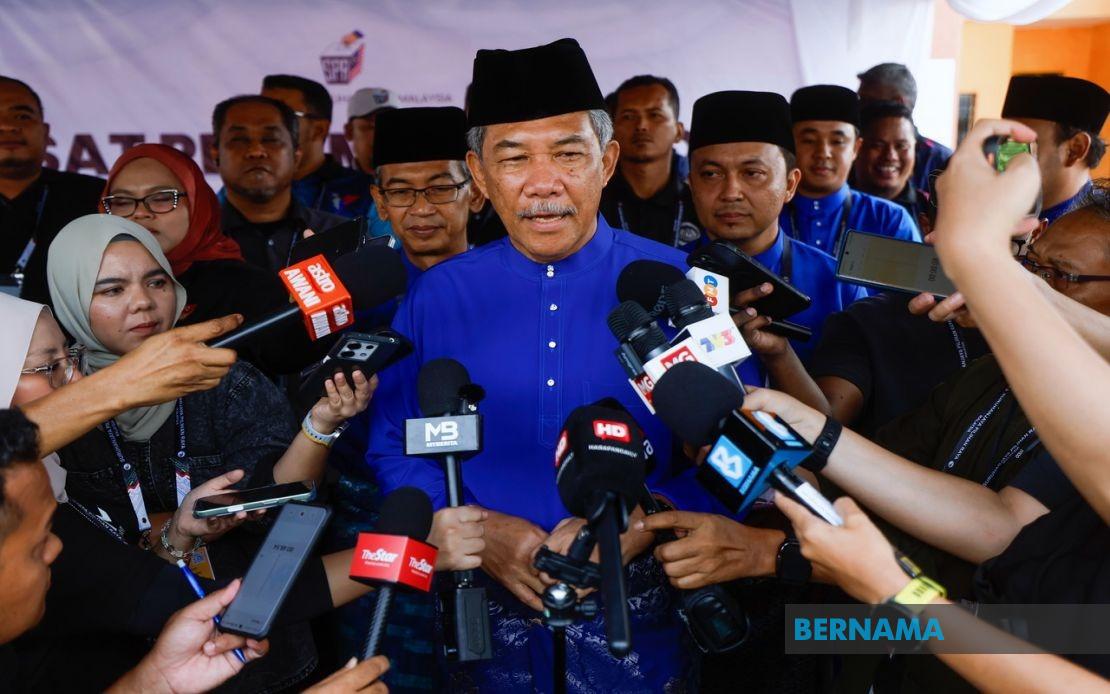
Barisan Nasional's second-in-command has issued a forceful directive to party operatives not to exploit Negeri Sembilan's traditional customs during the upcoming state election, seeking to ring-fence sensitive cultural and institutional matters from the rough-and-tumble of electoral competition. Datuk Seri Mohamad Hasan, who holds parallel authority as UMNO deputy president, made his position clear at the nomination proceedings in Rembau on July 18, underscoring that respect for the state's adat framework must supersede partisan advantage if the democratic contest is to unfold without corrosive discord.
The intervention by Mohamad addresses a structural vulnerability in Malaysian state politics: the intersection between traditional governance structures and modern electoral systems. Negeri Sembilan possesses a distinctive constitutional arrangement centred on its Council of Rulers and customary institutions, arrangements that command deep legitimacy among the state's populace and form part of its constitutional bedrock. When political actors attempt to mobilise adat concerns for campaign purposes, they risk weaponising institutions that derive their authority from consensus and tradition rather than competitive politics, potentially eroding public confidence in those institutions themselves.
Mohamad's reasoning reflects pragmatic politics as much as institutional respect. By instructing party machinery to steer clear of adat matters, BN seeks to prevent an escalation spiral whereby rival campaigns compete to champion traditional interests, ultimately polarising constituencies along lines that transcend conventional left-right political divides. The state's 36 assembly seats will be contested on August 1, following early voting on July 28, meaning the campaign window is already tightening and message discipline becomes increasingly valuable to front-running coalitions.
The warning carries particular weight given Mohamad's standing as UMNO's number two and his role in coordinating BN's overall electoral strategy. His public admonition signals that party headquarters is monitoring campaign conduct at the grassroots level, where enthusiasm sometimes outpaces tactical judgment. In Malaysian state elections, locally-prominent candidates and grassroots organisers occasionally push boundaries by invoking sensitive cultural or religious themes, calculating that such appeals mobilise core constituencies. Mohamad's intervention from the apex of party hierarchy serves as a corrective mechanism, establishing red lines that subordinate units are expected to respect.
On the broader electoral architecture, Mohamad confirmed that BN and Perikatan Nasional maintain an electoral understanding rather than a formal coalition in Negeri Sembilan. This arrangement mirrors deals struck in other states where the two coalitions agree to apportion constituencies and avoid direct competition, thereby dividing the opposition vote across multiple candidates and maximising combined representation. Unlike Johor, where BN and PN formed a full merger, the Negeri Sembilan arrangement preserves both coalitions' organisational independence while securing mutual electoral benefit through voluntary vote-splitting agreements.
Such understandings have become increasingly common in Malaysian state politics as traditional two-bloc competition (BN versus opposition) has fragmented into a more complex multi-polar field. The mechanism allows parties to consolidate support behind single candidates in agreed constituencies while standing aside elsewhere, effectively creating a de facto cartel that enhances the chances of both signatories relative to scattered opposition forces. For voters, this reduces choice in specific constituencies but increases the likelihood of clear majorities that facilitate stable government formation.
The timing of the Negeri Sembilan election follows the dissolution of the state assembly on June 5, itself a consequence of political jostling within and between coalitions. The state had been governed by an unstable arrangement that left both traditional power structures and contemporary electoral politics in uncertain equilibrium. Mohamad's emphasis on institutional respect and campaign propriety can thus be read as an attempt to establish a reset point where stability in the state's governance architecture takes priority over aggressive partisan positioning.
For Malaysian observers, the episode illustrates the ongoing tension between modernised democratic processes and traditional constitutional structures. States with distinctive adat frameworks—particularly Negeri Sembilan, with its Council of Rulers system—must navigate the challenge of preserving institutional legitimacy while accommodating popular democratic participation. When politicians subordinate adat concerns to electoral calculation, they risk delegitimising the very institutions that provide constitutional stability and cultural coherence. Mohamad's directive, by contrast, attempts to maintain a buffer between electoral competition and institutional respect, safeguarding the long-term viability of the state's governance model.
The constraint on campaign rhetoric also reflects lessons from other Malaysian elections where identity-focused messaging—whether cultural, religious, or ethnic—has exacerbated social tensions beyond the immediate electoral cycle. BN, as the coalition currently best-positioned to secure a substantial Negeri Sembilan majority, has strategic incentive to conduct a campaign that leaves the state's social fabric intact for subsequent governance. By preempting divisive adat rhetoric now, Mohamad signals that BN anticipates formation of the next government and seeks to avoid inheriting a polarised electorate.
The electoral understanding between BN and PN extends this logic: rather than compete fiercely across all 36 constituencies and leave voters fractured and exhausted, the two coalitions offer voters in their respective strongholds clear choices while minimising head-to-head competition. This arrangement, though sometimes criticised as antidemocratic, reflects the practical reality that excessive fragmentation can produce ungovernable legislatures or governments lacking clear mandates. In Negeri Sembilan's context, where adat institutions already constrain executive power, the need for coherent coalitional support becomes even more pronounced.
Moving forward, attention will focus on whether grassroots operatives from both BN and PN honour Mohamad's injunction or whether campaign pressures and competitive zeal lead some candidates to venture into adat-adjacent messaging. The nomination period and first weeks of campaigning will test whether the directive holds, particularly if opposition parties attempt to gain advantage by raising institutional concerns that less disciplined elements of BN machinery might feel compelled to counter. Mohamad's preemptive strike aims to prevent such escalation, establishing institutional norms that transcend individual races or seats.

