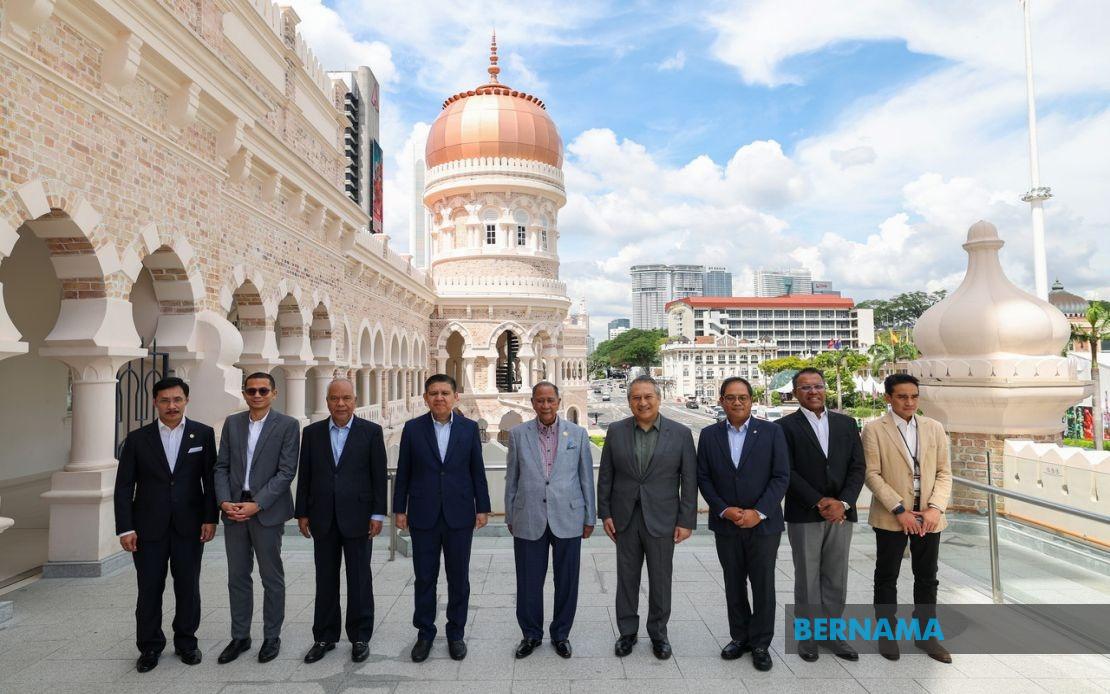
The Sultan of Kedah, Al Aminul Karim Sultan Sallehuddin Sultan Badlishah, made a significant visit to the Sultan Abdul Samad Building on June 24, underscoring the continued importance of Malaysia's most iconic administrative heritage site. His arrival at the building, which commenced at 10.30 am, was marked by formal reception from senior officials of Khazanah Nasional, the state investment arm responsible for the landmark's conservation and public programming.
The Sultan Abdul Samad Building stands as perhaps Malaysia's most recognisable colonial-era structure, commanding the skyline of central Kuala Lumpur with its distinctive Moorish-influenced architecture and copper domes. Historically, the edifice served as the administrative nerve centre of the nation, witnessing pivotal moments in Malaysia's journey from colonial territory to independent federation. The building holds particular resonance in the national memory as the site where the Union Jack was lowered and the Federation of Malaya flag raised for the first time in 1957, marking the formal commencement of Malaysian independence.
During the royal visit, His Royal Highness was guided through the Confluence Hall, a newly established gallery designed to chronicle Kuala Lumpur's origins and developmental trajectory. Mariana Isa, senior manager at Think City, briefed the Sultan on the exhibits displayed within this space, contextualising the capital city's transformation across centuries. The gallery functions as both educational institution and cultural repository, allowing visitors to understand how Kuala Lumpur evolved from a tin-mining settlement into Southeast Asia's most significant economic and administrative hub.
The itinerary subsequently extended to the Visionary Hall, which employs contemporary multimedia technology and scale models to illustrate the capital's future development prospects and urban planning initiatives. This gallery represents a forward-looking complement to the Confluence Hall's historical focus, enabling visitors to appreciate both where Kuala Lumpur has travelled and where it may be headed. The juxtaposition of historical and futuristic elements within the building creates a comprehensive narrative arc spanning past, present, and aspirational futures.
Following the gallery tours, His Royal Highness proceeded to the balcony positioned above the Porte Cochere, the grand carriage entrance of the building. This vantage point provides panoramic views across Merdeka Square and surrounding governmental precincts, offering perspective on the spatial and symbolic relationships between key national landmarks. The Sultan subsequently visited the School of Hard Knocks, a social enterprise initiative operated by Royal Selangor, which functions within the building as both training centre and demonstration of heritage site activation for community benefit.
Khazanah Nasional's managing director, Datuk Amirul Feisal Wan Zahir, emphasised the profound significance of the royal visitation. In his statement, Amirul Feisal articulated how the Sultan's presence represented meaningful validation of Khazanah Nasional's multifaceted conservation philosophy, which transcends mere structural preservation to encompass the telling of Malaysia's broader historical narrative. He stressed that the building's restoration and reopening serve purposes extending well beyond architectural conservation into the realms of national memory preservation and institutional recognition.
Since its public reopening on February 2, the Sultan Abdul Samad Building has demonstrated substantial visitor appeal, attracting approximately 200,000 people across the first four months of operation. This attendance figure suggests strong public interest in heritage tourism and cultural education within Malaysia's urban centres, particularly in Kuala Lumpur where such sites function as tourist attractions, educational resources, and symbols of national identity simultaneously. The building's capacity to draw such numbers indicates successful repositioning from administrative facility to vibrant public cultural institution.
The restoration initiative itself represents a significant investment in heritage preservation. In January, His Majesty Sultan Ibrahim, King of Malaysia, officially inaugurated the completion of Phase One restoration works, culminating eleven months of intensive conservation work conducted under the aegis of the Khazanah Heritage Fund programme. This phase-based approach suggests longer-term plans for comprehensive restoration, with additional conservation work likely envisioned for subsequent phases. The scale and scope of restoration efforts underscore governmental commitment to maintaining these structures as anchors of national heritage and institutional continuity.
For Malaysian and Southeast Asian observers, the Sultan's visit carries particular resonance given the increasingly high profile of heritage tourism and adaptive reuse of colonial-era buildings across the region. Many nations within ASEAN have similarly embarked upon ambitious conservation programmes to transform administrative relics into dynamic public spaces. The Sultan Abdul Samad Building exemplifies this trend, demonstrating how historical buildings can serve contemporary society through education, tourism, and community engagement while remaining rooted in their symbolic significance.
The choice of royal patronage for the site reflects institutional recognition that heritage preservation functions not merely as academic or aesthetic concern but as matter of state importance. When senior members of the royal institution dedicate time to visiting such sites, they signal to the public and international audiences alike that historical continuity and cultural memory merit sustained attention and resources. This pattern of high-level engagement with heritage sites has strengthened public consciousness around conservation efforts across Malaysia.
Looking forward, the building's trajectory as public institution will likely influence approaches to heritage conservation elsewhere in Malaysia. Successful activation of such spaces through galleries, social enterprises, and visitor programming demonstrates viable alternatives to letting heritage buildings become obsolete. The integration of the School of Hard Knocks within the building exemplifies how heritage sites can host contemporary social initiatives, creating symbiotic relationships wherein historical spaces gain programmatic vitality while social enterprises access iconic venues that enhance their mission's visibility and accessibility.
The Sultan of Kedah's visit thus represents more than ceremonial occasion; it constitutes endorsement of heritage preservation as legitimate governmental priority and validation of public-facing cultural institutions as appropriate custodians of national memory. As Malaysia's heritage sector continues developing capacity for tourism, education, and community programming, the Sultan Abdul Samad Building stands as compelling model of adaptive reuse aligned with national priorities.

