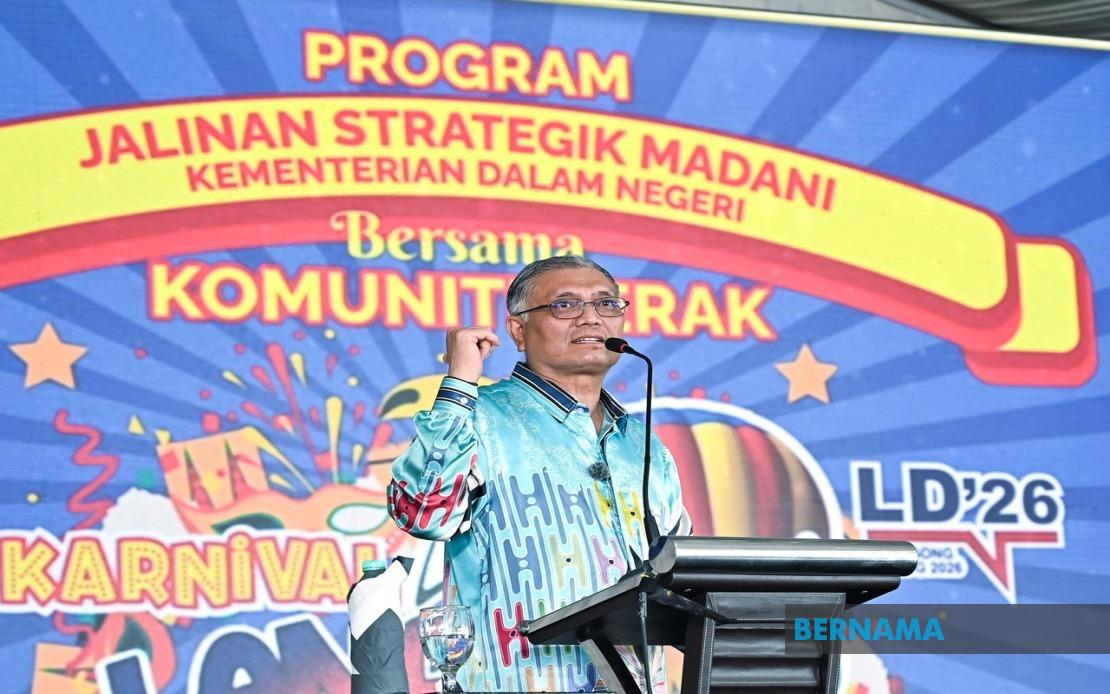
The Home Ministry has taken a hands-on approach to closing the distance between government agencies and ordinary Malaysians through its MADANI Strategic Partnership Programme, a two-day community activation that unfolded at Dataran Lenggong in Perak this week. The initiative represents an evolving model of public administration in Malaysia, where rather than citizens navigating bureaucratic pathways to access services, the apparatus of government itself moves into neighbourhoods to meet residents where they live. This shift in approach reflects a broader recognition that sustained public confidence in institutions depends on tangible accessibility and transparent communication.
Deputy Home Minister Datuk Seri Dr Shamsul Anuar Nasarah, who represents Lenggong in Parliament, positioned the event as far more than a ceremonial exercise or mere public relations effort. Speaking during the official launch, he articulated the programme's foundational logic: that security and social cohesion depend on institutional relationships with grassroots communities, not top-down mandates alone. The Deputy Minister framed the MADANI initiative as a deliberate mechanism for two-way dialogue, enabling residents to raise concerns about crime, narcotics abuse, and neighbourhood security while simultaneously allowing agencies to educate and listen. This reciprocal engagement model acknowledges that effective governance requires understanding local contexts and priorities rather than imposing standardised solutions.
Operationally, the programme materialised through a series of service touchpoints staffed by multiple KDN agencies. Citizens encountered direct access to counters managed by the Royal Malaysia Police (PDRM), the Immigration Department of Malaysia (JIM), and the National Anti-Drugs Agency (AADK). Rather than requiring separate visits to dispersed offices across Perak, residents could consolidate administrative tasks—updating records, seeking formal advice, or filing complaints—within a single location. The enthusiastic turnout at these service counters suggests latent demand for such convenience, particularly in semi-urban and rural areas where transport costs and time away from work create genuine barriers to bureaucratic interaction.
The event's accompanying programme illustrates how security agencies increasingly embed themselves within community wellbeing rather than positioning themselves as external enforcers. Approximately 1,190 participants joined a Fun Ride and Fun Run organised jointly by the People's Volunteer Corps (RELA) and AADK, traversing villages surrounding Lenggong and revealing the region's natural attractions. This fitness-oriented component served dual purposes: it promoted healthy lifestyle messaging while simultaneously normalising the presence and accessibility of security personnel. By associating anti-drugs and police agencies with recreational wellness rather than enforcement trauma, the initiative may reshape public perception, particularly among younger demographics increasingly sceptical of traditional authority structures.
Lenggong's designation as a UNESCO World Heritage Site added symbolic weight to the programme. The Valley's geological significance and tourism potential provided natural backdrop and framing device, connecting government service provision to community pride and regional development. This linkage—between security, public health, and heritage preservation—underscores how contemporary governance initiatives increasingly frame multiple policy domains as interconnected. A community confident in policing and secure from narcotics trafficking is positioned to develop its tourism economy more effectively, creating virtuous cycles between security, prosperity, and civic engagement.
The programme's cultural and recreational components—religious talks, children's creative performances, and colouring competitions—reflect recognition that government engagement, particularly in conservative communities, functions most effectively when rooted in shared cultural values and family participation. Rather than approaching citizens as atomised individuals requiring specific bureaucratic transactions, the MADANI model treats communities as social wholes, creating environments where extended families, youth, and religious leaders encounter government services simultaneously. This holistic approach may prove particularly resonant in Perak, where communal traditions remain strong and religious institutions retain significant social influence.
For Malaysian and regional observers, the MADANI programme illustrates broader shifts in how ASEAN governments navigate public legitimacy in an era of declining trust in institutions. The initiative recognises that enforcement-centred approaches to security prove insufficient without corresponding investments in public accessibility and perceived institutional responsiveness. Countries across Southeast Asia confront rising scepticism toward government effectiveness, amplified by social media's magnification of service failures and corruption narratives. Localised programmes like MADANI represent attempts to rebuild institutional credibility through demonstrable service delivery and authentic community consultation rather than relying on formal authority alone.
The two-way engagement framework articulated by the Deputy Minister carries particular significance given Malaysia's complex security landscape. Drug trafficking, cybercrime, and cross-border organised crime demand community cooperation to generate intelligence and prevent recruitment into illicit networks. Communities that perceive police and anti-narcotics agencies as accessible, responsive, and culturally sensitive prove more willing to report suspicious activity and protect vulnerable household members from addiction. Conversely, communities experiencing alienation from security forces often retreat into insularity, creating information vacuums that criminal networks readily exploit. The MADANI initiative thus functions as preventive security infrastructure as much as immediate service delivery.
Expanding this model across Malaysia's diverse geography and demographic composition presents obvious challenges. Rural Sabah and Sarawak, urban centres like Kuala Lumpur, and highly conservative areas like Kelantan operate within distinct social contexts that would require customised programme design. Resource constraints likely limit how frequently such initiatives can occur and how many locations they can reach annually. Yet the Lenggong event demonstrates proof of concept: that bringing government services to communities, embedding them within cultural and recreational contexts, and explicitly positioning agencies as listening partners rather than enforcement authorities can generate genuine public enthusiasm and participation.
The long-term impact of MADANI will depend on whether the initiative represents sustained policy evolution or a discrete promotional exercise. If subsequent years witness similar programmes rolling out systematically to underserved communities across Peninsular Malaysia and the Borneo states, the model may meaningfully reshape citizen-state relations. If, conversely, the Lenggong activation remains isolated or sporadic, it risks becoming merely a well-intentioned but marginal counterpoint to citizens' primary experience of government as bureaucratically distant and enforcement-focused. Measuring success requires tracking not merely attendance metrics but substantive changes in public trust metrics, crime reporting rates, and community assessment of police and immigration responsiveness.

