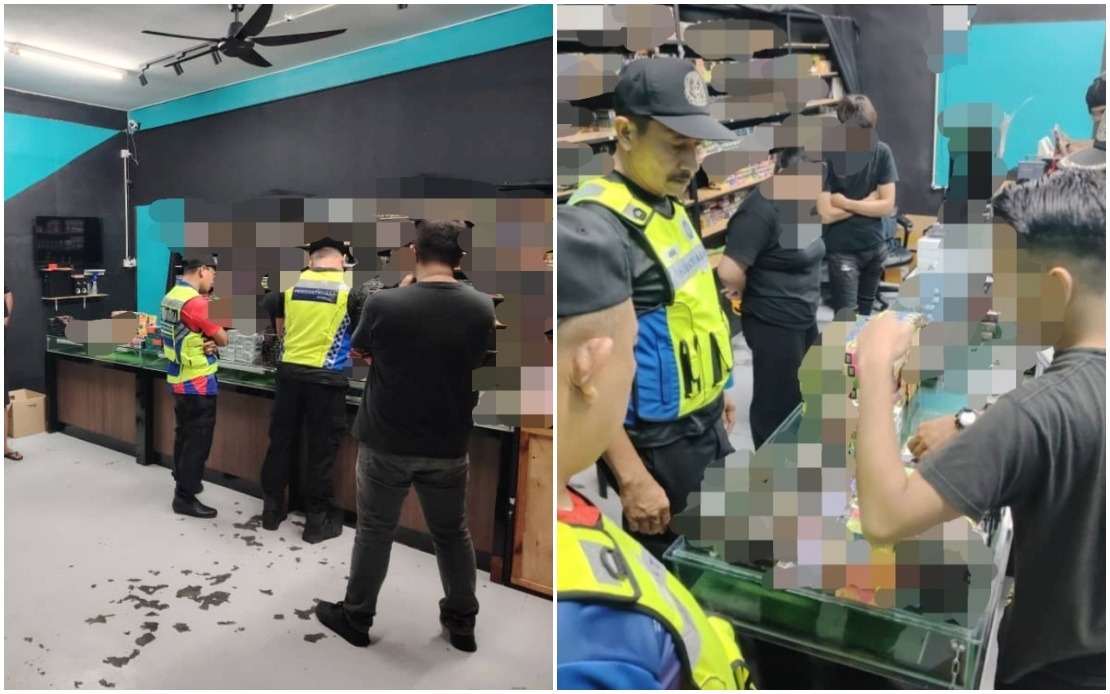
The Kangar Municipal Council (MPK) has moved aggressively to enforce local trading regulations, conducting a late-night raid that netted 400 units of electronic cigarette liquid and 70 related devices from an operating business premises on Jalan Padang Behor. The confiscated items, collectively valued at RM15,000, represent a significant enforcement action in the northern state's ongoing crackdown on vape distribution ahead of a statewide sales ban.
Council president Affendi Rajini Kanth disclosed details of the operation, which unfolded between 10.30 pm and 1 am with support from the Royal Malaysia Police (PDRM). The timing and scale of the intervention underscore municipal authorities' determination to suppress the vape market in Perlis following the state government's decision to prohibit all vape sales premises operations commencing August 1, 2025. This coordinated approach between local government and federal police demonstrates the multi-agency strategy now in motion across the state.
The targeted premises had become a repeat offender in the eyes of regulators. According to Affendi's statement, the business location had previously incurred multiple fines and received an official business cessation notice as far back as August 2025, yet continued to operate its vape sales activities regardless. This pattern of persistent violation following explicit regulatory warnings provides the context for the municipality's decision to escalate enforcement from administrative penalties to asset seizure.
The MPK's authority for the seizure derives from its Trade, Business, and Industry Licensing By-Laws, a regulatory framework that grants councils enforcement powers aligned with broader state policy objectives. By invoking these local ordinances in coordination with the Perlis government's proclamation against vape retail, municipal officials have established a legal foundation for their enforcement action that extends beyond simple licensing violations into state-level public health policy implementation.
The by-laws themselves carry graduated penalties designed to compel compliance. Any business found in breach faces a fine not exceeding RM2,000 upon initial conviction, coupled with an additional daily penalty of up to RM200 for each day the offence continues following that judgment. Such escalating fines theoretically incentivize rapid business closure, though the case of the Jalan Padang Behor premises demonstrates that financial penalties alone may prove insufficient to halt determined operators.
This enforcement action arrives amid a broader regional reassessment of vape regulation across Malaysia. Perlis's August 2025 prohibition represents one of the stricter approaches adopted by any Malaysian state, effectively closing the legal retail market for vape products rather than merely licensing and taxing it. Neighbouring Kedah and other northern states have observed these developments closely, with some considering comparable restrictions of their own.
For Malaysian consumers and retailers, the Perlis situation illustrates how state-level regulation increasingly diverges across the federation. Businesses that previously operated lawfully in one state must now navigate an evolving patchwork of restrictions, while consumers face shrinking legal supply options in certain jurisdictions. This fragmentation has already driven some vape users toward online purchases and cross-border acquisition, creating enforcement challenges that extend beyond any single municipal boundary.
The seizure also highlights the practical implementation challenges facing authorities attempting to suppress established underground markets. The fact that operators continued business following cessation notices and fines suggests that potential profit margins in vape retail may exceed the financial penalties and operational disruptions that enforcement currently imposes. Unless supply restrictions tighten significantly or consumer demand diminishes, simple seizure operations may only temporarily disrupt supply chains rather than permanently eliminating commercial activity.
From a law enforcement perspective, the cooperation between MPK and PDRM reflects an institutional recognition that municipal-level regulatory breaches often require police support to execute safely and effectively, particularly during night-time operations at commercial premises. This collaborative model may serve as a template for similar enforcement actions elsewhere in Perlis and other states preparing comparable vape prohibitions.
The broader implications for Malaysia's regulatory approach to vaping remain unsettled. While Perlis moves toward outright prohibition, federal authorities have not yet implemented a nationwide ban, leaving questions about long-term national policy. The Kangar seizure may represent either the beginning of an accelerating enforcement campaign or an isolated enforcement action in an otherwise permissive regulatory environment, depending on how other state governments ultimately respond to Perlis's policy shift and public health arguments supporting restrictions.

