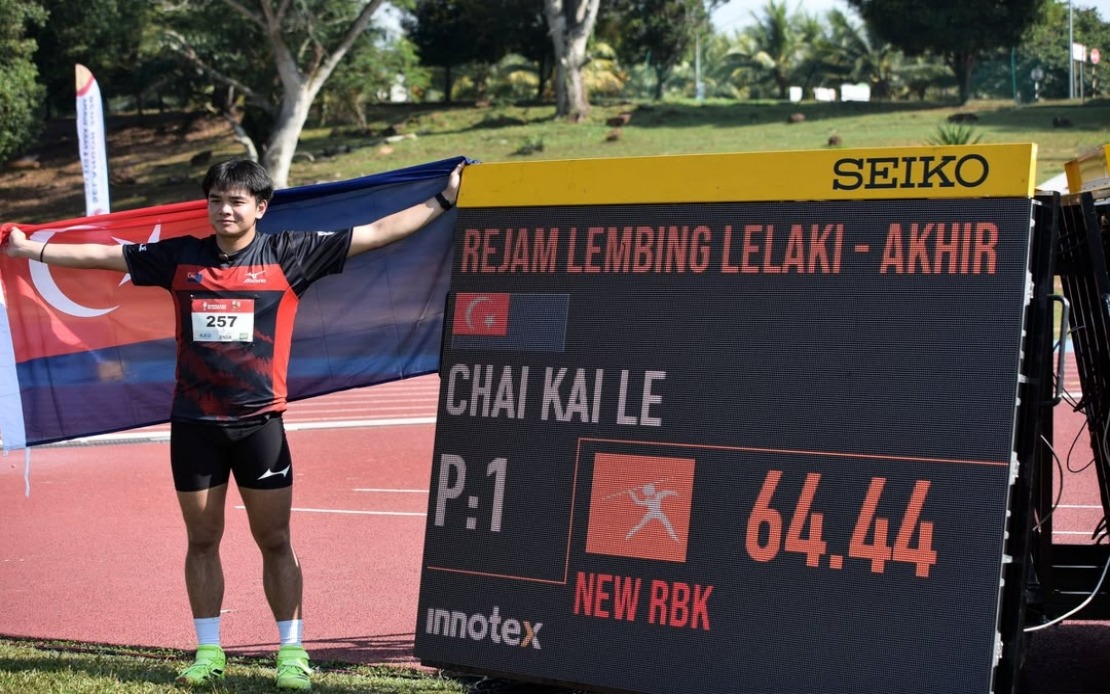
Johor's Chai Kai Le has reinforced his status as one of Malaysia's most promising field athletes, demolishing a quarter-century-old javelin benchmark at the Selangor 2026 Malaysia Games held at the Universiti Putra Malaysia Sports Centre in Serdang on August 17. The 18-year-old's commanding performance, highlighted by a 64.44-metre throw on his second attempt, erased the previous Games record of 62.33 metres set by Sarawak's Kho Mei Kuan in 2000 at the Penang edition. This achievement underscores the considerable progress made in javelin coaching and athlete development across Malaysian states over the past two decades.
Kai Le's decisive victory margin over his nearest competitor tells a broader story about the depth emerging in Johor's track and field programme. Penang's Tan Chun Wei secured the silver medal with a respectable 60.43-metre throw, while Kai Le's Johor teammate Mohd Noor Iman Norman claimed the bronze position with 59.04 metres. The fact that two Johor athletes claimed the top and third positions suggests that the southern state has invested meaningfully in identifying and nurturing javelin talent at the grassroots level. Such concentration of excellence in a single event demonstrates how systematic talent identification and coaching infrastructure can yield measurable returns on the competitive stage.
What makes Kai Le's achievement particularly significant is the trajectory he has already established at such a young age. The teenager holds the national under-20 record of 65.65 metres, a mark that sits comfortably above his Games-winning throw. This distinction between his personal best and his competition performance reveals the technical refinements he continues to master. When speaking to reporters immediately after his victory, Kai Le demonstrated the maturity expected of elite athletes, attributing his success to disciplined preparation spanning two years specifically targeted at this Games edition. His willingness to discuss the meticulous planning that underpinned his performance offers younger athletes a useful template for approaching major competitions with realistic, measurable objectives.
The javelin champion's candid assessment of his physical condition during the competition provides valuable insight into competitive sport at the highest amateur level in Malaysia. Following his second attempt that produced the record-breaking distance, Kai Le acknowledged that a technical execution error triggered lower back discomfort and accumulated fatigue, ultimately limiting his capacity to sustain intensity through the remaining throws. Rather than abandoning caution or attempting to push through pain that might have derailed his season, he adopted a pragmatic injury-management approach. This disciplined approach to self-preservation reflects coaching guidance that prioritises long-term athlete development over short-term gains, a philosophy that often distinguishes sustainable athletic careers from those derailed by preventable injuries.
Across the track, Penang's Mohammad Aiman Haikal Sahrudin delivered a commanding performance in the men's 10,000-metre race walk, securing gold with a time of 47 minutes 28.84 seconds. Kelantan's Ahmad Farish Irfan Ahmad Fahmi secured the silver medal in 47 minutes 37.17 seconds, while the Federal Territories' Khor Jing Hong, a junior national representative, completed the podium with bronze in 47 minutes 49.27 seconds. The race walk discipline, which demands exceptional cardiovascular endurance combined with precise technical execution, has traditionally received less public attention than sprint and middle-distance running in Malaysia, yet the performances recorded at this Games suggest growing competitive intensity in the event.
Mohammad Aiman's pathway to the gold medal demonstrates the value of Games participation as a developmental stepping stone. The 18-year-old from Kampung Tanah Liat in Penang previously claimed the silver medal in the same race walk event at the preceding SUKMA edition held in Sarawak, meaning his current victory represents clear progression between Games cycles. This incremental improvement aligns with the natural maturation of young athletes who combine competitive experience with ongoing technical refinement. His willingness to build systematically on past performances rather than accepting a plateau illustrates the professional mindset increasingly prevalent among Malaysia's junior sporting cohort.
Mohammad Aiman's articulated ambitions transcend the immediate satisfaction of a gold medal, pointing instead toward the broader competitive landscape that shapes Malaysian athletics planning. The teenager has explicitly targeted qualification for the National Squad ahead of the 2027 Southeast Asian Games. Notably, he has identified a strategic shift in his focus from the 10,000-metre walk contested at the Malaysia Games toward the 20,000-metre walk distance featured in the SEA Games programme. This forward-thinking approach to event selection—dictated by competition availability rather than personal preference—demonstrates the maturity with which emerging Malaysian athletes navigate the intersection between domestic and regional competition calendars. His statement that he intends to contest the 20,000-metre walk at the current Games, effectively using the Selangor edition as preparation for the international distance standard, reveals sophisticated planning rarely articulated by teenage competitors.
The performances at this SUKMA edition carry particular significance for Malaysian athletics as the country continues rebuilding its competitive standing in the region. Both Kai Le and Mohammad Aiman represent the generation of athletes who have developed entirely within the post-pandemic training environment, suggesting that despite the disruptions of recent years, systematic talent development has persisted. The records and progressive improvements evident at the Selangor Games indicate that Malaysian coaching expertise, access to training facilities, and talent identification systems remain competitive with regional standards.
These dual performances also reflect the geographical distribution of sporting excellence across Malaysia. Johor's dominance in javelin and Penang's strength in race walking underscore how different states have cultivated distinct areas of competitive advantage. This diversification of excellence across disciplines and regions should ideally encourage other states to identify and develop their own niche areas of sporting prowess, gradually elevating the overall competitive standard of Malaysian athletics. The challenge moving forward involves translating Games success into sustained international competitiveness, particularly at the SEA Games level where regional rivals maintain equally rigorous athlete development programmes.
As the Selangor 2026 Malaysia Games continue, the javelin and race walk performances have established early benchmarks against which remaining track and field competition will be measured. Kai Le and Mohammad Aiman have demonstrated that Malaysian junior athletes possess the technical capability, physical capacity, and competitive mindset to excel on the domestic stage. Whether this generation can sustain their trajectory and translate Games success into consistent international performances remains the critical question that will define Malaysian athletics for the remainder of this decade.

