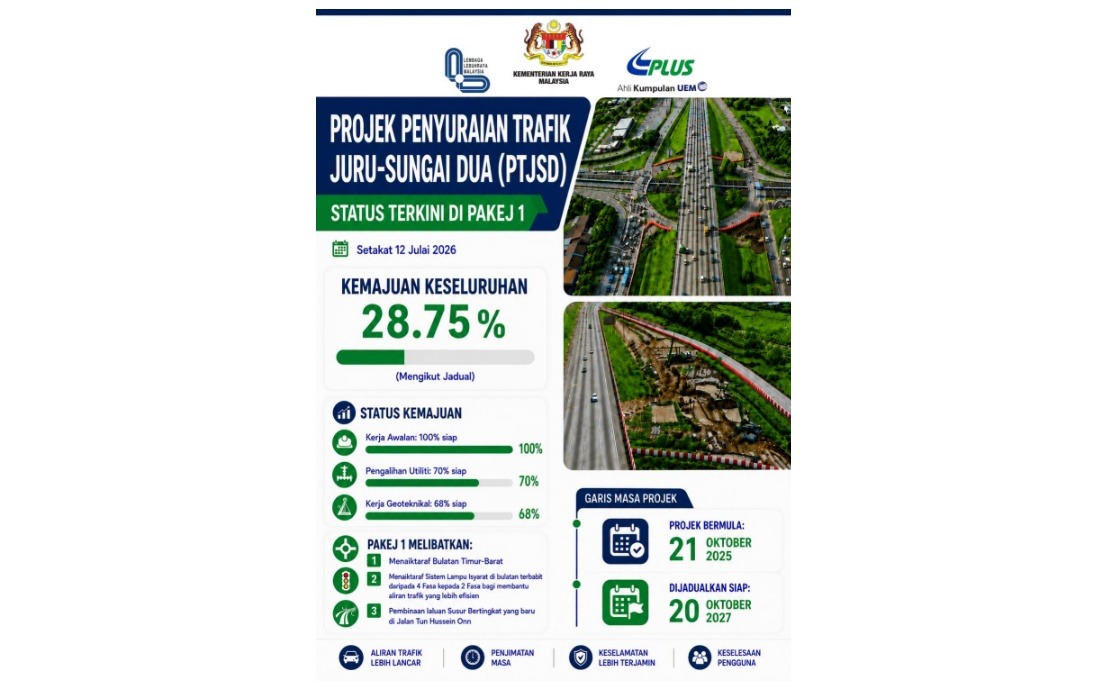
The Juru-Sungai Dua Traffic Dispersal Project (PTJSD) is tracking according to its original timeline, with Package 1 achieving 28.75 per cent completion as of July 12. PLUS Malaysia Berhad, the managing entity, announced the positive milestone in George Town on July 14, signalling that the mammoth infrastructure undertaking remains firmly on course for its scheduled October 2027 delivery.
The achievement reflects considerable progress across multiple fronts. Preliminary groundwork has been entirely finalised, removing a critical preparatory hurdle. Simultaneously, utility relocation work—a complex undertaking involving the repositioning of water, electrical, telecommunications and other essential services—has advanced to 70 per cent completion. Geotechnical investigations and site preparation have also progressed substantially to 68 per cent, indicating that the foundations for the main construction phases are solidifying on schedule.
Package 1 itself encompasses three major components designed to substantially reconfigure traffic movement in the Juru-Sungai Dua corridor. The East-West Roundabout is being comprehensively upgraded to modern standards. The traffic management system at that crucial junction is receiving a complete overhaul, featuring advanced traffic light coordination intended to dramatically improve vehicular flow. Additionally, a new elevated slip road is under construction along Jalan Tun Hussein Onn, creating alternative routes that will distribute traffic more evenly across the network.
The broader project ambitions are substantial. The 17.3-kilometre corridor spans three administrative zones—South, Central and North Seberang Perai—positioning it as a critical connector across the district. Approximately 200,000 vehicles traverse this route daily, making it one of the peninsula's busiest traffic arteries. The current bottleneck represents not merely an inconvenience but a significant constraint on economic activity and quality of life for residents and commuters alike.
Traffic congestion along this stretch has reached crisis proportions during peak periods. Journeys that should take 20 minutes frequently extend to a full hour, representing a massive productivity loss across the working day. The PTJSD directly addresses this through the introduction of a dedicated Juru-Sungai Dua route designed to absorb approximately 30 per cent of existing traffic volumes. This strategic diversion, combined with the improved roundabout functionality and enhanced traffic management infrastructure, is projected to reduce congestion substantially and restore the corridor to operational efficiency.
The scale of financial commitment underscores the project's importance to regional infrastructure strategy. The estimated RM3 billion cost reflects the complexity of executing major works across heavily populated and commercially active areas while maintaining existing traffic flows. This investment represents a significant allocation of public and concessionaire resources directed towards solving a transportation challenge that has constrained northern Penang's development and connectivity with the broader peninsula.
Implementation involves coordinated collaboration between multiple government agencies. The Ministry of Works and the Malaysian Highways Authority are working alongside PLUS Malaysia to ensure technical standards, safety protocols and project governance meet established criteria. This multi-agency coordination is essential given the project's intersection with federal highway operations, state infrastructure planning and local traffic management responsibilities.
The corridor's strategic significance extends beyond local convenience. The Juru-Sungai Dua route functions as the primary connection between Penang and the northern peninsula states. Any congestion here creates ripple effects across a much wider region, impacting intra-regional commerce, tourism flows and business connectivity. Alleviating this bottleneck therefore carries implications that extend well beyond the three Seberang Perai districts directly affected.
Completion by October 2027 would represent a realistic timeline given current progress rates. The achievement of 70 per cent on utility relocation and 68 per cent on geotechnical work suggests that these typically time-consuming preliminary phases are advancing appropriately. Assuming weather conditions remain cooperative and supply chains remain stable—both factors beyond the project team's complete control—the October 2027 delivery date appears achievable.
The projected benefits justify the investment and construction inconvenience. Beyond the raw travel time reduction from 60 minutes to 20 minutes during congested periods, the project promises improved safety outcomes through better traffic flow management and reduced instances of rear-end collisions endemic to congested conditions. The enhanced journey quality will benefit both commuters and goods transport operators, providing indirect productivity gains across the wider economy.
For Malaysian readers and businesses dependent on this corridor, the PTJSD represents a concrete response to long-standing infrastructure deficiencies. The visible progress to date suggests that project management remains disciplined and the delivery framework robust. Maintaining this momentum through the remaining construction phases will be critical to realising the anticipated congestion relief and economic benefits that this major investment promises to deliver.

