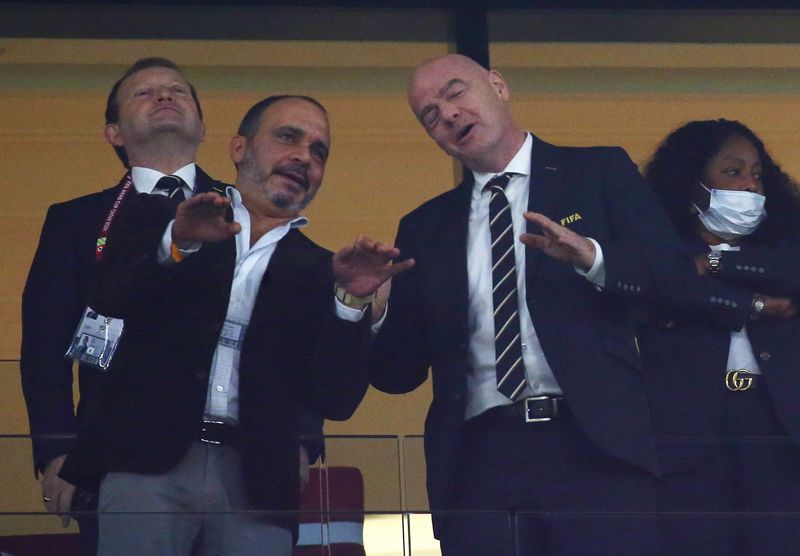
The Jordan Football Association has escalated its confrontation with FIFA's leadership hierarchy by levelling serious accusations against President Gianni Infantino. On Tuesday, JFA President Ali bin Hussein launched a pointed public rebuke, claiming that FIFA engaged in what amounts to coercive conduct by linking assistance for the association's operational challenges to Infantino's political backing. According to bin Hussein, FIFA officials made clear during the World Cup period that endorsing Infantino "would go a long way to helping our FA out," following months during which the global football governing body had withheld support on numerous matters affecting Jordan's football programme.
The allegation strikes at the heart of governance ethics in international sport and carries particular weight given FIFA's stated commitment to transparency and accountability. Bin Hussein's public statement, posted on X, emphasised Jordan's values around ethical conduct, declaring unequivocally that the federation had not endorsed Infantino previously and would refuse to do so regardless of inducements. His characterisation of the situation as "blackmail" represents unusually blunt language in the typically diplomatic world of football diplomacy, underscoring the depth of frustration within the JFA over what it views as a fundamental breach of proper institutional conduct.
Infantino's position has grown increasingly precarious as opposition crystallises across football's governing structures. The FIFA president recently abandoned a contentious proposal to monetise the World Cup through a partial stake sale, having faced coordinated resistance from both continental confederations and individual national associations. A hard deadline of September 19 that Infantino imposed failed to secure consensus, forcing the withdrawal of a plan FIFA had argued would generate billions for global football development initiatives. The collapse of this flagship proposal represents a significant political setback for the Swiss official.
Highly placed figures within FIFA's own administration have distanced themselves from Infantino during this period of turbulence. Mattias Grafstrom, FIFA's Secretary General, and Arsene Wenger, the legendary former Arsenal manager now serving in an executive capacity at the organisation, both moved to separate themselves from the controversial initiative. Bin Hussein's comments explicitly reference this internal dissension, framing it as evidence of fundamental leadership deficiencies at the world's football governing body. This convergence of criticism from multiple levels and regions of football administration suggests broader erosion of confidence in the current FIFA presidency.
Jordan's grievances extend well beyond questions of political endorsement, reflecting the persistent challenges confronting smaller football nations within FIFA's structures. As an association operating with minimal financial resources, the JFA has contended with cascading obstacles that underscore inequities built into international football administration. Supporters travelling to World Cup matches have faced prohibitively high ticket prices while simultaneously encountering visa denial for participation in major tournaments, a combination that effectively excludes ordinary fans from following their national team on the international stage.
The issue of unpaid tournament rewards exemplifies FIFA's financial opacity and uneven treatment of participating nations. Jordan reached the final of the 2025 Arab Cup, a tournament organised and sanctioned by FIFA, yet remains unpaid for this achievement. Bin Hussein's frustration appears compounded by FIFA's simultaneous public statements about billions held in reserve—suggesting that delayed payments to smaller federations reflect priorities rather than cash constraints. The JFA has awaited these funds since December, money earmarked for players and staff that represents crucial resource for a small nation's football development.
A taxation issue unique to Jordan's circumstances has further strained relations with FIFA and highlights how application of international regulations can create disparate burdens. The United States government imposed tax obligations on Jordan's participation in the recently held World Cup, costs that were channelled through FIFA's administration. However, teams representing Canada and Mexico, also participating in the same tournament, did not incur equivalent taxation. This divergence, seemingly based on geographic location within the tournament host nation, created a financial penalty specifically for the Jordanian federation and its players. Bin Hussein characterised these taxes as funds diverted from legitimate football operations, framing the arrangement as fundamentally unjust.
Jordan's qualification for the World Cup represented a historic achievement for the small Middle Eastern nation, marking its maiden appearance at the tournament despite being eliminated in the group stage. The expectation would be that such a milestone might be accompanied by supportive institutional conduct from FIFA. Instead, according to Bin Hussein's account, the federation encountered obstacles and conditional offers rather than the practical support and fair treatment that a newly qualified nation might reasonably expect from the sport's governing body.
The timing of these accusations carries significance beyond the immediate context of FIFA's internal politics. As Southeast Asian football observers note, smaller nations with developing football infrastructure face similar structural disadvantages within FIFA's systems. Malaysia, Thailand, and Vietnam similarly operate with budgetary constraints that make engagement with FIFA's increasingly commercialised requirements challenging. The Jordan case thus resonates across the region as a cautionary tale about power asymmetries within global sports governance and the vulnerability of smaller football federations to institutional pressures.
Bin Hussein's willingness to name the alleged blackmail openly represents a notable shift from typical diplomatic restraint in football administration. Rather than engaging in private representations to FIFA officials, the JFA president chose to air grievances publicly, a strategy that amplifies pressure on Infantino at a moment when his political position is already weakening. This approach may reflect the calculation that quiet diplomacy has yielded no results, or alternatively, that the stakes—integrity of football's governing institutions—justify the reputational risks of public confrontation.
FIFA has acknowledged the allegations through a statement that Reuters contacted the organisation for comment, though no substantive response has yet been published. The silence from FIFA headquarters suggests either an assessment that direct engagement with Bin Hussein's claims would further damage Infantino's standing, or an attempt to allow the controversy to fade from immediate scrutiny. However, the convergence of the World Cup monetisation controversy, the internal criticism from Grafstrom and Wenger, and now the Jordan FA's specific accusations of coercive conduct creates a compound challenge to FIFA's credibility that silence alone is unlikely to resolve.
The broader implications for football governance are substantial. If even partial credence attaches to allegations of quid pro quo arrangements linking institutional assistance to political endorsements, the foundational legitimacy of FIFA's decision-making processes comes into question. Asian football associations and smaller confederations across the global south will be observing closely whether formal accountability mechanisms within FIFA's structures are capable of investigating such allegations meaningfully, or whether institutional interests will protect senior leadership from scrutiny.

