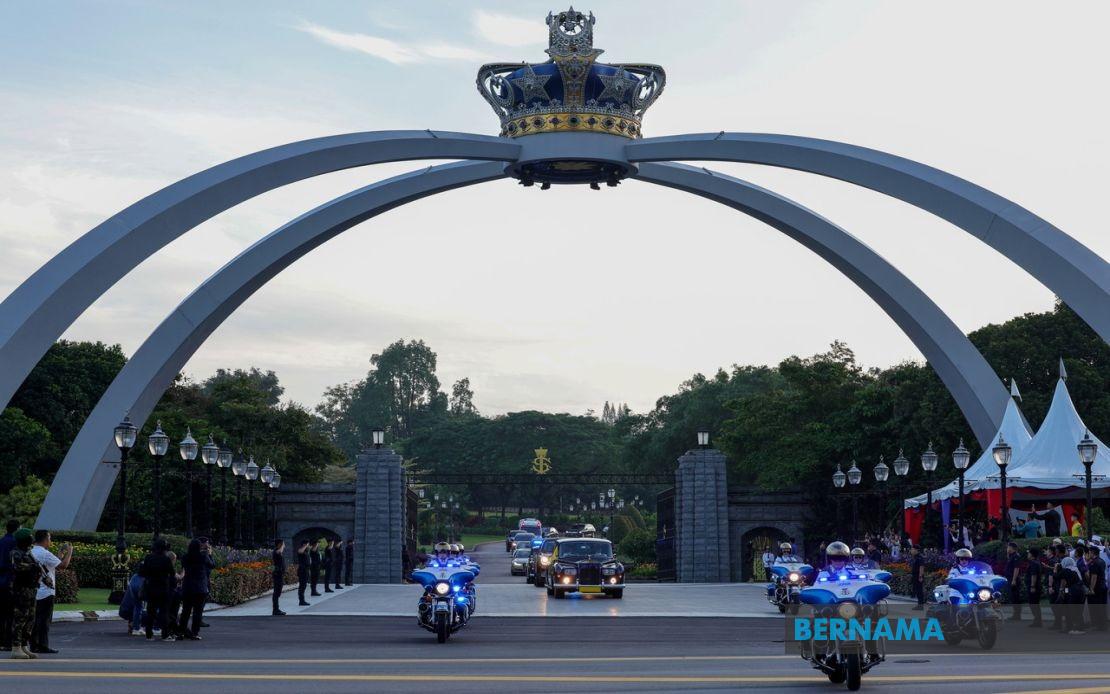
A Johor Menteri Besar is scheduled to take the oath of office at Istana Bukit Serene this afternoon at 3 pm, the Johor Palace announced on Wednesday. The ceremony marks the formal beginning of a new administration after the ruling coalition's decisive performance at the ballot box just one day earlier. While the palace confirmed the timing and venue through a WhatsApp invitation circulated to media organisations, the identity of the incoming chief minister remained undisclosed at the time of the announcement, adding an element of suspense to proceedings in the southern state.
The Crown Arch, or Pintu Mahkota, of Istana Bukit Serene has been designated as the media coverage point for the ceremonial event. This arrangement allows journalists to document the swearing-in while maintaining the dignity and protocol typically observed at royal occasions. By midday, reporters had already begun congregating at both the Menteri Besar's official residence in Saujana and outside the palace gates, anticipating the afternoon proceedings and seeking any last-minute developments that might emerge.
Barisan Nasional captured 48 of the 56 contested state assembly seats in Tuesday's election, delivering what political analysts would characterise as a commanding mandate. This result represents a substantial victory that grants the incoming administration considerable latitude to pursue its legislative agenda without significant parliamentary obstruction. The coalition's performance underscores the continued electoral appeal of BN in Johor, a state that has historically served as a crucial power base for the national ruling coalition.
Earlier on Wednesday, Sultan Ibrahim Iskandar received BN chairman Datuk Seri Ahmad Zahid Hamidi at Istana Pasir Pelangi for discussions lasting nearly an hour. The audience included Johor BN chairman Datuk Onn Hafiz Ghazi, indicating that high-level consultations regarding the state's political direction were well underway. Such meetings between the Sultan and party leadership typically precede formal appointments and serve as crucial forums for discussing governance priorities and ministerial arrangements.
The swift scheduling of the swearing-in ceremony, just over 24 hours after election results were announced, reflects the efficient institutional processes that characterise Malaysian constitutional practice. State governments in Malaysia follow well-established protocols when transitioning to new administrations, with royal involvement at every stage ensuring that procedures maintain their formal legitimacy and ceremonial weight. The timing also allows the new Menteri Besar to begin addressing state business without extended delays.
Johor's governance assumes particular significance within the broader Malaysian political landscape. As one of the nation's most economically developed states and a stronghold of BN support, developments in Johor often carry implications for national politics. The state's administration handles crucial portfolios including economic development, infrastructure projects, and inter-state commerce that ripple beyond its borders. For neighbouring Singapore and for regional business interests operating in the southern corridor of Peninsular Malaysia, the stability and direction of Johor's government holds tangible consequences.
The election result itself demands contextualisation within Malaysia's evolving political dynamics. BN's performance in Johor contrasts notably with its mixed fortunes in some other states, where opposition coalitions have made significant inroads. This victory therefore provides the federal ruling coalition with valuable political capital at a time when the national government faces various governance challenges. The scale of BN's majority in Johor suggests that the party retains substantial appeal among the state's electorate, despite broader political turbulence at the national level.
The palace's decision to keep the Menteri Besar's name confidential until the formal ceremony underscores the constitutional prerogatives retained by Malaysia's royal institution. While the Sultan's choice typically follows consultations with party leadership and reflects the wishes of the coalition government, the formal announcement traditionally occurs through official channels rather than advance media speculation. This approach preserves the dignity of the appointment process and prevents premature public positioning by various political figures.
For Malaysian observers and regional watchers, the swearing-in ceremony represents a milestone in Johor's political cycle and a moment to assess the new administration's stated priorities. The composition of the incoming state cabinet, which typically emerges in the days following the Menteri Besar's appointment, will provide further signals regarding how BN intends to deploy its commanding parliamentary majority. Given the diverse constituencies within Johor—spanning urban centres, agricultural regions, manufacturing clusters, and cross-border economic zones—the allocation of ministerial portfolios will indicate which development priorities the new government intends to emphasise.

