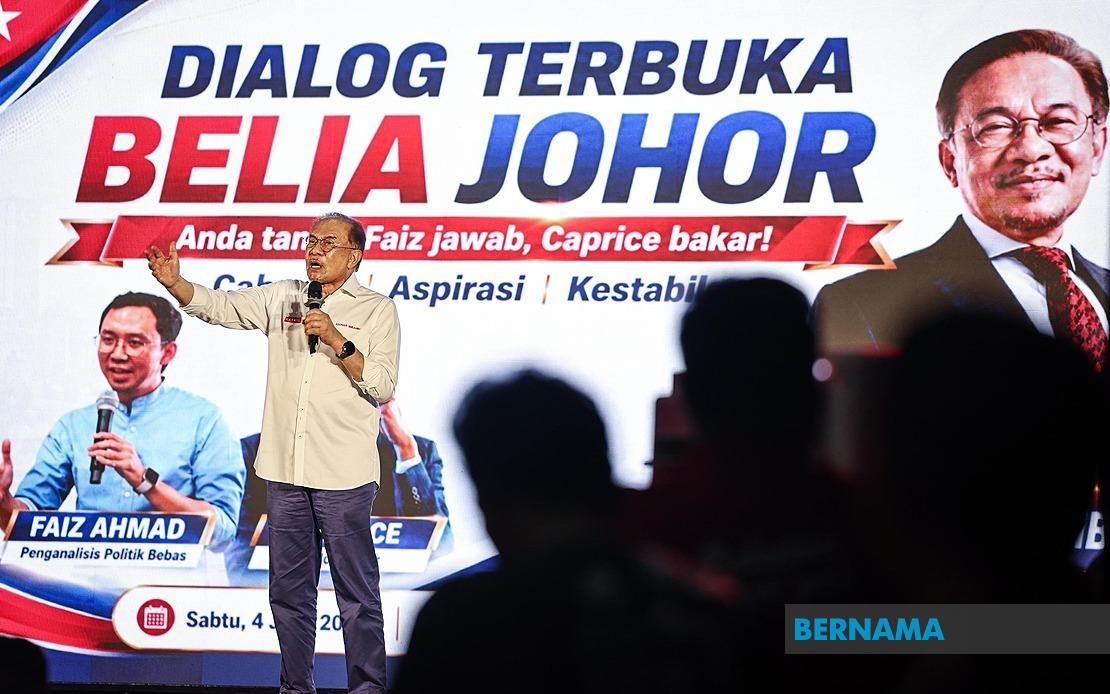
Prime Minister Datuk Seri Anwar Ibrahim has highlighted the urgent need for a more inclusive development strategy in Johor, one that stretches benefits across rural hinterlands and urban working-class neighbourhoods rather than concentrating resources in prosperous city centres. Speaking at the Kita Geng MADANI Johor youth programme in Johor Bahru on July 4, Anwar articulated a vision of balanced growth that incorporates both essential infrastructure and community-focused amenities tailored to local needs.
The Prime Minister's remarks reflect a growing awareness within the federal government that Malaysia's development trajectory has created stark disparities even within individual states. Johor, despite its reputation as an economically vibrant region and major commercial hub, contains pockets of considerable inequality. Anwar pointed specifically to the contrast between Johor Bahru's developed urban landscape and outlying areas such as Ulu Tebrau, located merely thirty minutes away, which lack comparable infrastructure investment. This geographical proximity underscores not merely a distance problem but a policy prioritization issue affecting how national and state resources are allocated.
Anwar's critique challenges the conventional development model that has long dominated Malaysian urban planning, where showcase mega-projects and towering commercial structures have served as symbols of progress. While such projects generate economic activity and attract investment, the Prime Minister contended that they frequently overlook the practical requirements of ordinary residents in less prominent areas. His specific rejection of building unnecessary high-rise structures in localities like Ulu Tebrau signals a shift toward pragmatism, acknowledging that not every area requires architectural grandeur and that development ambitions must align with actual community demand.
Instead, Anwar emphasised that state authorities should prioritize foundational amenities that tangibly improve daily life. His enumerated priorities—affordable housing, educational institutions, market stalls, community halls, and religious facilities—represent the bedrock of functioning communities. These are not glamorous investments that dominate headlines or attract international attention, yet they form the scaffolding upon which stable, cohesive societies are constructed. For rural and less developed areas of Johor, such investments would represent transformative change in residents' quality of life and economic opportunity.
The timing of these remarks carries particular significance given that they were delivered at a youth-focused political event in Kempas, where Pakatan Harapan fielded its candidate Faezuddin Puad for the state seat. The Prime Minister's emphasis on equitable development serves both as policy declaration and political messaging, signalling to constituents that the coalition government recognises their concerns about marginalisation within the broader development narrative. PKR Youth chief Muhammad Kamil Abdul Munim's presence at the event underscored institutional commitment to this agenda from within Anwar's party structure.
For Malaysia more broadly, Anwar's intervention in Johor's development strategy carries implications beyond a single state. Johor has historically functioned as a testing ground for new governance approaches, and its development model influences perceptions and policies elsewhere in the country. If the state can successfully implement more balanced growth strategies, it may establish a template for other regions grappling with similar rural-urban disparities. Conversely, if development remains concentrated in lucrative urban corridors, pressure will continue mounting from underserved communities, potentially fuelling political discontent.
The Prime Minister's framework also reflects evolving thinking about sustainable development within the government. Rather than pursuing growth measured solely through GDP figures and infrastructure megaprojects, there is recognition that genuine development encompasses quality of life improvements, social cohesion, and equitable resource distribution. Schools, community facilities, and affordable housing directly contribute to human development indicators that mega-projects may not substantially influence. This represents a more sophisticated understanding of how public investment translates into citizen wellbeing.
Implementing Anwar's vision requires coordination between federal and state authorities, as well as alignment between development financing mechanisms and ground-level community priorities. Johor's state government must actively redirect planning and budgeting processes to ensure that outlying areas receive proportionate investment. Currently, market forces alone tend to concentrate development where returns are highest, typically in urban centres, necessitating deliberate policy intervention to counterbalance these dynamics. Without such intervention, natural economic gravity will continue pulling resources toward established commercial zones.
The practical challenge lies in operationalizing these principles without compromising fiscal responsibility or economic competitiveness. States must balance the political and social imperative for equitable development against competitive pressures to attract investment and maintain economic dynamism. Anwar's position suggests that these objectives are not inherently contradictory—that ensuring basic amenities in rural communities and maintaining high-impact development initiatives can occur simultaneously through better prioritisation and planning.
Looking forward, Anwar's statements set expectations that development outcomes in Johor will be evaluated not merely by headline-grabbing projects but by measurable improvements in service delivery across all communities. This shifts accountability frameworks, requiring officials to track progress in school infrastructure, housing accessibility, and community facilities alongside traditional economic metrics. For residents in overlooked areas, it represents a policy acknowledgement that their concerns warrant serious attention. Whether subsequent implementation matches rhetorical commitment will determine the credibility of the government's development agenda and its broader claims to inclusive governance.

