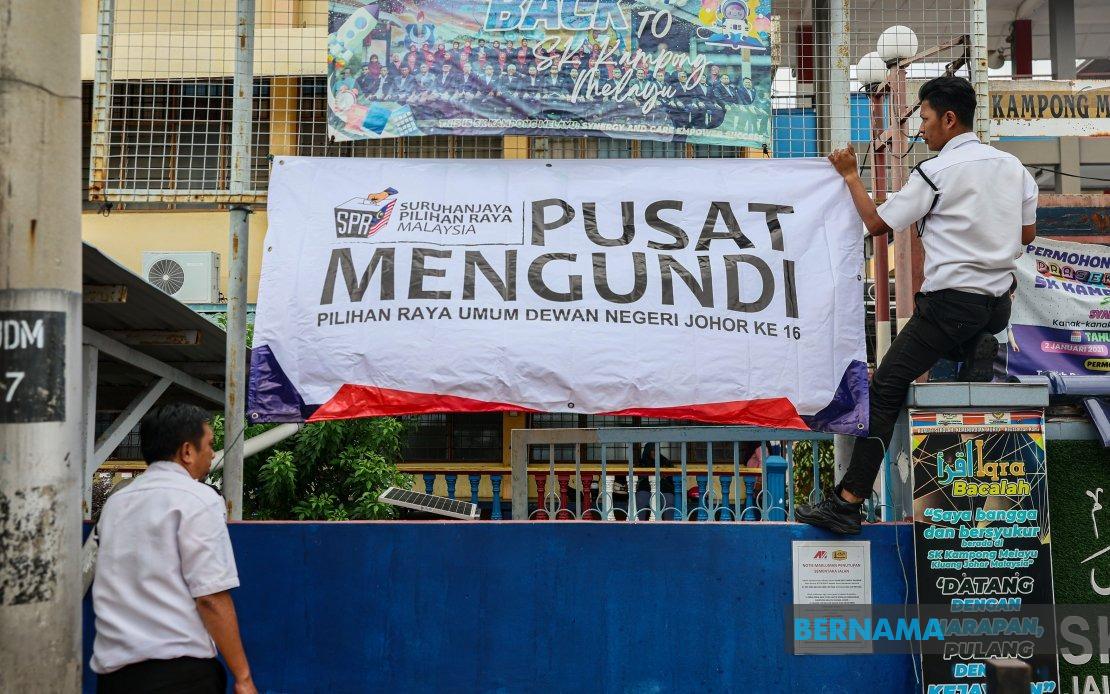
Johor holds the spotlight today as more than 2.7 million eligible voters exercise their democratic right in the state's 16th legislative election. The electoral exercise encompasses all 56 seats in the State Legislative Assembly, marking a significant political moment for Malaysia's second-largest state by population and one of its most economically dynamic regions. The timing of this poll carries implications beyond Johor's borders, with potential ripple effects across the broader Malaysian political landscape given the state's historical significance as a political bellwether.
Voting commenced at 8 o'clock this morning with 1,076 polling centres and 4,889 voting streams mobilised across Johor to process the anticipated voter volume. The Election Commission has coordinated a substantial logistical operation, stationing 43,036 election workers throughout the state to ensure administrative efficiency and prevent bottlenecks at individual polling stations. This workforce deployment reflects the scale of the undertaking—managing ballot flows across such extensive infrastructure requires meticulous coordination. Polling venues will close progressively between 11 in the morning and 6 in the evening depending on their geographical location, a staggered approach designed to accommodate variations in voter populations across urban and remote districts. The most remote locations, specifically Pulau Besar, Pulau Aur and Pulau Pemanggil, will conduct earlier closures to prevent logistical complications with vote transportation.
The electoral process incorporates approximately 24,677 postal ballots that require submission by the 6 o'clock evening deadline. Early voting took place on Tuesday, when 20,607 security personnel—comprising police officers, armed forces members and their spouses—participated in advance balloting. This mechanism allows those with deployment schedules that might conflict with standard voting times to fulfil their civic obligations without disruption to their duties. The Election Commission is targeting a voter participation rate of approximately 70 percent, substantially above the 54.92 percent turnout recorded during the previous Johor state election in 2022. Such an increase would signal elevated public engagement with this electoral cycle, potentially reflecting either heightened political polarisation or shifted electoral dynamics among Johor's diverse demographic constituencies.
Weather patterns present a secondary consideration for today's proceedings. The Malaysian Meteorological Department anticipates morning rainfall across Johor Bahru, Batu Pahat, Kulai, Muar, Pontian and Tangkak districts, with meteorological conditions expected to improve during afternoon and evening periods. Kluang, Kota Tinggi and Segamat face afternoon thunderstorm predictions, whilst Mersing experiences similar weather instability extending into evening hours. Such precipitation, whilst creating minor inconveniences for voters navigating to polling stations, is unlikely to materially suppress turnout given Malaysia's population's familiarity with tropical weather patterns.
The candidate field encompasses 172 contestants distributed across multiple political entities. Pakatan Harapan and Barisan Nasional each field the maximum 56 candidates, representing the two major political coalitions contesting every state seat. Perikatan Nasional presents 33 candidates, demonstrating its efforts to establish a substantial parliamentary footprint in Johor. Smaller formations including Parti Bersama Malaysia (15 candidates), MUDA (four candidates), Parti Orang Asli Malaysia and Parti Sosialis Malaysia each contribute individual candidates to the electoral competition, whilst six independent candidates round out the slate. This configuration reveals a fundamentally bipolar contest between established coalitions, though with meaningful third-force representation that could influence outcomes in closely contested constituencies.
The antecedent political arithmetic provides essential context. Before the State Legislative Assembly's dissolution on 1 June, Barisan Nasional controlled 40 of the 56 seats, delivering substantial governmental capacity and legislative dominance. Pakatan Harapan occupied 12 seats, positioning itself as the principal opposition formation. Perikatan Nasional held three seats, whilst MUDA secured a single legislative seat. This distribution reveals Johor as a state where Barisan Nasional's organisational machinery and established networks have historically maintained predominance, though Pakatan Harapan's presence indicates growing political competition. The dissolution and subsequent election call suggests either constitutional necessity or strategic positioning calculations by incumbent leadership, creating genuine uncertainty regarding seat distribution outcomes.
Employers across Johor have received explicit reminders to grant workers reasonable time away from workplaces to participate in voting. Such directives, typically issued by electoral authorities, reflect recognition that voting participation depends partly on workplace accommodation and that employment obligations must not constitute practical barriers to exercising the franchise. This administrative courtesy facilitates voter access and signals commitment to inclusive democratic participation across all occupational strata.
Results commencement is anticipated as early as 10 o'clock this evening, assuming vote-counting procedures proceed without unexpected complications. The concentrated timeline from polling closure through results announcement creates a high-intensity evening during which seat allocations, coalition trajectories and political fortunes will crystallise. For Malaysian political observers and international analysts monitoring Southeast Asian democratic processes, tonight's Johor outcome carries significance extending beyond state boundaries, potentially signalling broader electoral trends affecting federal-level politics and regional political competition.
Johor's electoral importance derives from multiple convergent factors. The state represents Malaysia's substantial population centre, substantial economic engine incorporating major industrial zones and port infrastructure, and historically consequential political territory where coalition performance often foreshadows national-level developments. Electoral outcomes in Johor frequently influence federal government stability and parliamentary mathematics, rendering today's exercise consequential for stakeholders monitoring Malaysian political trajectories beyond the state administration itself.

