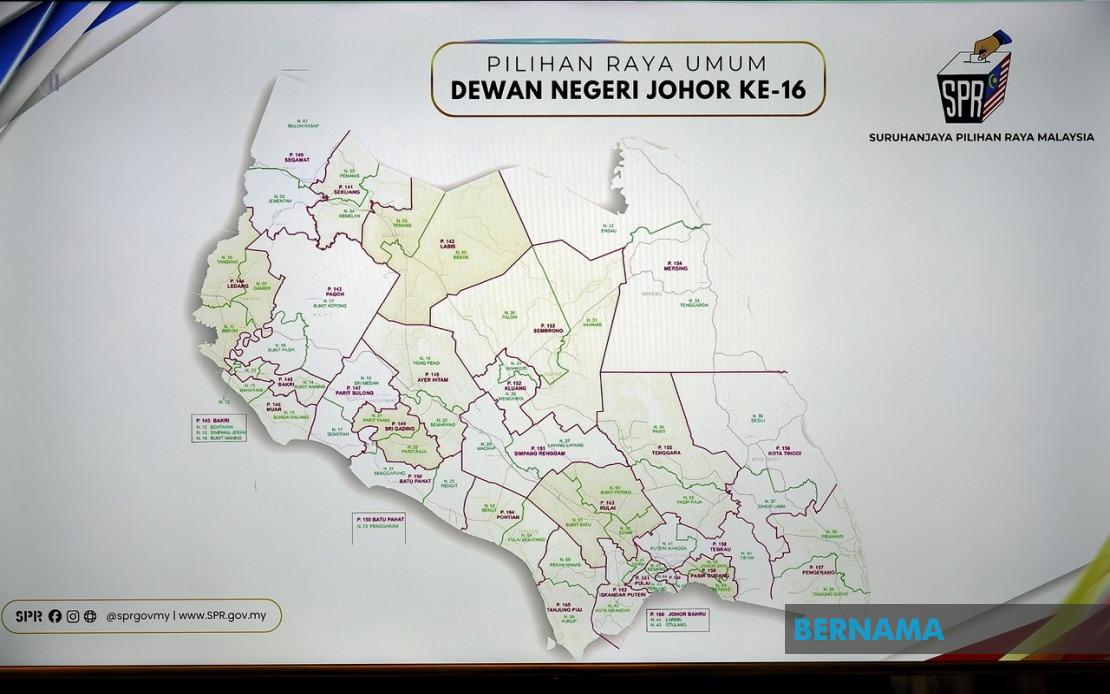
Johor's political landscape is about to undergo its most significant electoral test since the 2022 state polls, as the 16th state election formally commences tomorrow with nomination day. The process represents a pivotal moment not only for the state but for the broader Malaysian political equilibrium, as the results could reshape coalition dynamics ahead of future national contests. Nearly 2.73 million registered voters will ultimately determine the composition of the Johor State Legislative Assembly across all 56 constituencies, with the election process unfolding over the next fortnight.
The Election Commission has established a tightly controlled nomination schedule, with candidates required to register between 9 am and 10 am at designated centres across the state. Following the completion of screening procedures, the official roster of contenders will be released, providing the first concrete picture of how major coalitions have distributed their candidate slate and where they have chosen to contest or concede ground. This administrative step, though routine, carries significant strategic implications as voters await confirmation of who will represent their interests in the forthcoming ballot.
The electoral process itself spans a compressed but intensive timeline. Early voting is scheduled for July 7, allowing military and police personnel along with their spouses to cast ballots ahead of the general polling date of July 11. The Election Commission has meticulously identified 2,727,926 eligible voters, comprising just over 2.7 million ordinary electors supplemented by 12,041 military personnel and their spouses, and 12,710 police officers and their families. This voter composition underscores the military and security community's stake in Johor's governance, a factor that historically influences campaign strategies in the state.
Pakatan Harapan has committed to contesting every single seat in the assembly, fielding a coalition force of 56 candidates distributed across its three component parties. Parti Keadilan Rakyat brings 20 candidates to the contest, Parti Amanah Negara fields 19, while the Democratic Action Party contributes 17 representatives. This full-spectrum approach signals confidence and a determination to challenge the incumbent administration across all geographical and demographic divisions within Johor.
Barisan Nasional has mirrored this comprehensive strategy, deploying 56 candidates of its own through its traditional component structure. The United Malays National Organisation leads the alliance's charge with 36 candidates, the Malaysian Chinese Association contributes 16, while the Malaysian Indian Congress fields four representatives. This distribution reflects both the broader ethnic composition of Johor and the historical strength of the respective parties within the state, though it also suggests areas where BN may struggle to field competitive candidates.
Perikatan Nasional has positioned itself as a significant third force in the contest, though with a notably smaller footprint than the two major coalitions. The Pan-Malaysian Islamic Party is competing in 11 seats, Bersatu Malaysia brings 16 candidates to the field, while the Malaysian Indian People's Party contests five constituencies. This configuration indicates PN's selective approach, focusing resources and messaging on constituencies where it believes it can generate competitive outcomes rather than attempting to challenge across the entire state.
Several smaller parties and newer entrants are attempting to make their mark on Johor's electoral landscape. The Malaysian United Democratic Alliance, which secured one seat in the 2022 election, is contesting four constituencies this time, suggesting modest growth in ambitions. The Socialist Party of Malaysia has fielded a solitary candidate, while Parti Bersama Malaysia is making its maiden appearance in Johor politics with 15 candidates, representing an ambitious debut for the nascent political entity.
The Election Commission has issued stern guidance to all prospective candidates regarding administrative compliance, emphasizing the need to verify nomination forms in advance at the Returning Officer's Office or State Election Office to forestall last-minute complications. Candidates are simultaneously being advised to settle deposit payments promptly and retain receipts as documentation when submitting their nomination papers. These procedural requirements, while appearing routine, have historically tripped up unprepared campaigns and independent candidates lacking institutional support.
Anti-corruption enforcement remains a central concern throughout the electoral period. The Malaysian Anti-Corruption Commission has reminded all candidates and party organizations of their legal obligations to avoid unlawful conduct under both the MACC Act 2009 and the Election Offences Act 1954 as amended in 2012. To monitor compliance and investigate allegations, the MACC has activated five dedicated 24-hour operations centres distributed across Tampoi, Batu Pahat, Kluang, Segamat, and Mersing, providing a direct reporting mechanism for the public to flag suspected corruption or abuse of authority.
The context of this election derives from the dissolution of the Johor State Legislative Assembly on June 1, ending the tenure of the 15th assembly that had governed since 2022. In that previous election, Barisan Nasional achieved a commanding victory, securing 40 of the 56 seats and establishing a substantial majority that has governed largely without challenge over the intervening two years. Pakatan Harapan captured 12 seats, Perikatan Nasional won three constituencies, and Malaysian United Democratic Alliance's sole representative provided the remaining seat. This distribution gives context to the current contest as opposition coalitions seek to recover ground and challenge BN's dominance.
For Malaysian political observers and regional analysts, the Johor election carries implications extending well beyond state boundaries. The state remains a bellwether for national sentiment, and shifts in voting patterns could signal evolving preferences among voters regarding coalition politics, party performance, and priorities for governance. The extent to which younger political entities like Bersama and MUDA can gain traction, the effectiveness of Perikatan Nasional's third-force positioning, and whether Pakatan Harapan can recapture momentum all represent dynamics worth monitoring closely as Malaysia continues to navigate its post-2022 political evolution. The results will inform strategic calculations for federal politics and potentially influence the timing and nature of any future national electoral contest.

