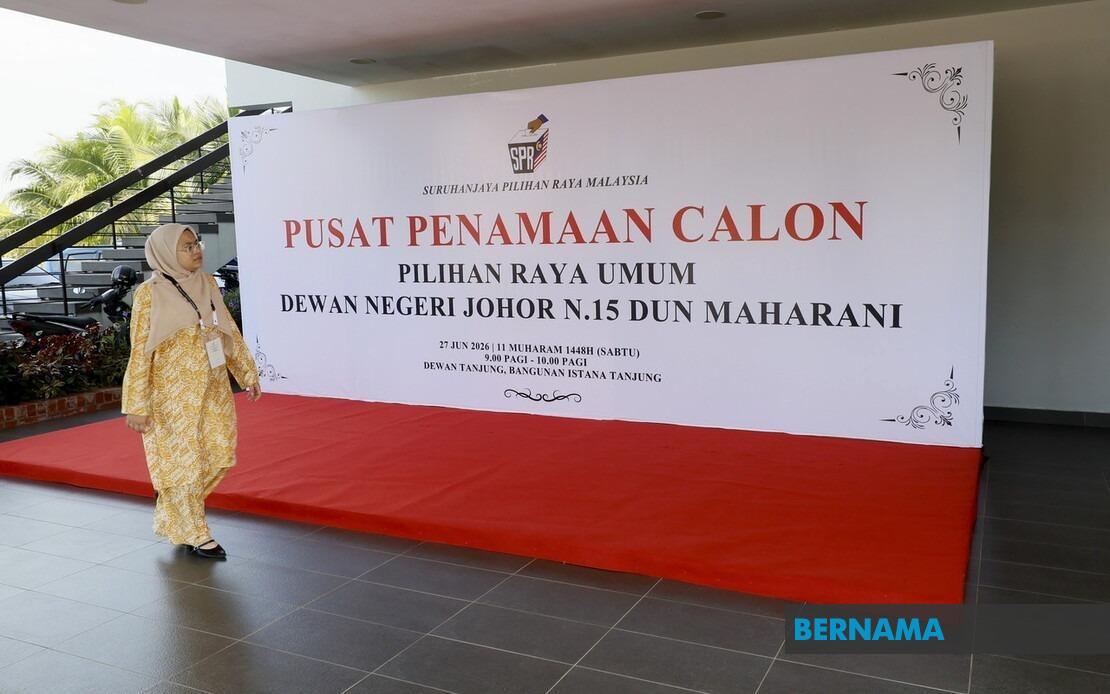
The 16th Johor State Election officially began today with nomination proceedings simultaneously underway at 56 centres across the state, marking the start of what is expected to be a closely watched electoral contest in Malaysia's second-largest state by population. The nomination process, which opened at 9 am and closes at 10 am, allows prospective candidates just one hour to lodge their nomination papers with Returning Officers before the Election Commission announces the final roster of eligible contenders.
As of yesterday morning, 593 nomination forms had been distributed to interested parties, with 133 prospective candidates already confirming their participation by paying the mandatory election deposits. This early momentum suggests healthy competition across the 56 state assembly seats, though the final number of nominations will only be known after the deadline expires. The figures reflect the political significance of this election in Johor, where control of the state assembly could influence the broader balance of power in Malaysian politics.
Following the formal announcement of candidates, the 14-day campaign period will commence immediately, running until 11.59 pm on July 10. This compressed campaign window gives political parties just two weeks to mobilize voters and articulate their respective visions for Johor's development. Early voting is scheduled for July 7, with the official polling day set for July 11. The election comes after the State Legislative Assembly was dissolved on June 1, formally triggering the electoral process and resetting the political calendar for the peninsula's most developed state.
The electoral roll encompasses 2,727,926 registered voters, comprising 2,703,175 ordinary citizens alongside 12,041 military personnel and their spouses and 12,710 police personnel and their spouses. This voter base underscores Johor's demographic significance and the substantial stakes involved in this contest. The distribution of voters across 56 constituencies will determine not only representation in the state assembly but also the formation of the state government and the direction of governance in a state critical to Malaysia's economic performance.
Barisan Nasional enters the contest fielding candidates in all 56 seats, deploying UMNO's organizational machinery across 36 constituencies, supplemented by MCA's 16 candidates and MIC's four representatives. This represents the traditional BN coalition structure, though BN must defend its current position of holding 40 seats following the last election. Pakatan Harapan is also mounting a comprehensive challenge across all constituencies, with PKR contributing 20 candidates, Amanah 19, and DAP 17, positioning itself as a serious contender for government formation.
Perikatan Nasional's campaign will be spearheaded by Bersatu's 16 candidates, complemented by PAS fielding 11 candidates, MIPP's five representatives, and a single Pejuang candidate. This coalition structure reflects the post-2022 political realignment in Malaysia, with Bersatu playing an expanded role compared to its traditional partner PAS. The PN's performance in Johor will offer important signals about its electoral viability and whether it can replicate successes achieved in other states.
The election will also feature participation from newer and emerging parties, signalling the increasingly fragmented nature of Malaysian electoral politics. MUDA is contesting four seats, while the Malaysia Socialist Party is fielding a single candidate. Most notably, Parti Bersama Malaysia marks its debut in electoral politics by contesting 15 seats, suggesting ambitions to establish a meaningful parliamentary presence. The participation of these parties reflects both dissatisfaction with established coalitions and efforts to offer voters alternative political narratives.
Nomination day traditionally generates considerable public engagement, with party supporters gathering at nomination centres to demonstrate backing for their preferred candidates. To manage the expected crowds and ensure orderly proceedings, the Election Commission has issued reminders that all candidates and supporters must comply with the Election Offences Act 1954 and relevant local authority regulations. These include restrictions on loudspeaker usage and musical instruments mounted on campaign vehicles, regulations designed to prevent noise pollution and maintain public order during the nomination process.
Logistical preparations have been substantial. The Malaysian Meteorological Department forecasts rain in several Johor locations during the morning hours, with thunderstorms anticipated in the afternoon, potentially affecting turnout and ground operations. To maintain security and manage traffic effectively, police authorities have deployed 4,832 personnel across the state, with preparations including road closures and diversions affecting 19 major roads adjacent to nomination centres. This deployment reflects the scale of security coordination required to facilitate a statewide election in Malaysia's fourth-most populous state.
The political context heading into this election is significant. Before dissolution, Barisan Nasional held 40 of 56 seats, Pakatan Harapan controlled 12, Perikatan Nasional held three, and MUDA claimed one seat. This distribution suggests the election is genuinely competitive, with multiple coalitions capable of winning. The previous composition also indicates that governance coalitions may be necessary if no single bloc wins a clear majority, making coalition-building negotiations a possible outcome after July 11. For Malaysian politics more broadly, the Johor result will offer insights into voters' preferences at a time when the nation's political landscape remains fluid and contested.

