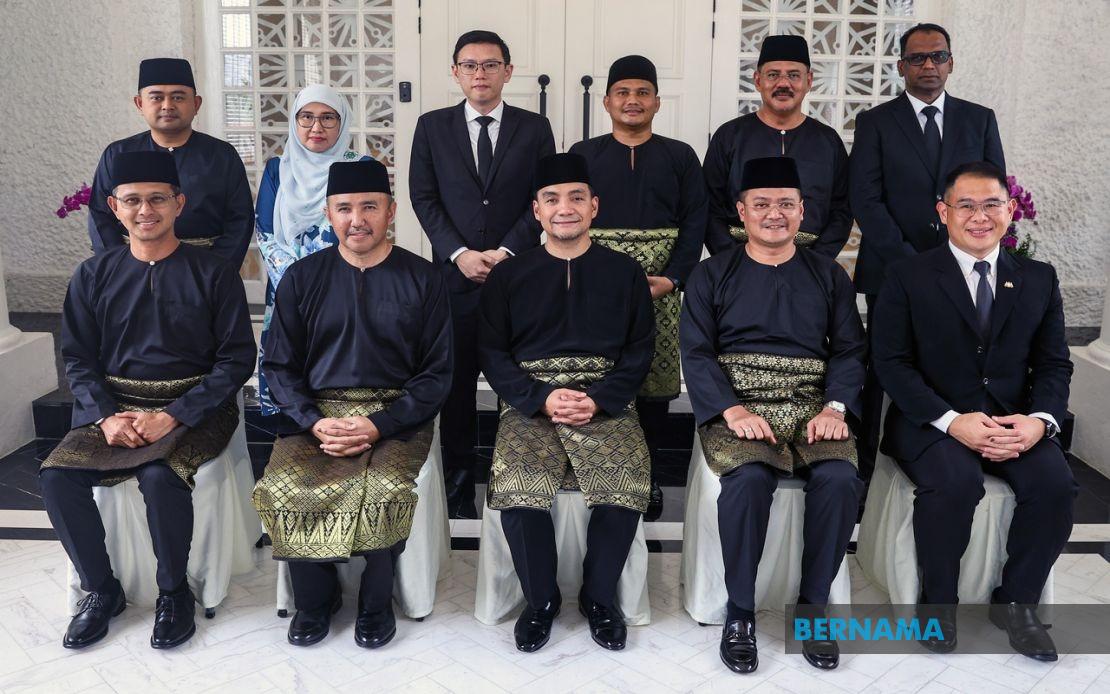
Johor's newly configured state administration formally commenced operations on July 18 when all ten members of the State Executive Council were sworn in at Istana Bukit Serene. The Regent of Johor, Tunku Mahkota Ismail, presided over the oath-taking ceremony and presentation of appointment letters, marking a significant milestone in the state's governance structure following the recent electoral mandate. The ceremonial gathering underscored the continuity and stability the ruling coalition aims to project across the region's most developed state by gross domestic product.
Four members entering the exco represent a substantial refresh to the cabinet, introducing new perspectives and energy to the council's deliberations. Md Israk Abdullah, representing Kukup, assumes stewardship of the Agriculture, Agro-Based Industry and Rural Development Committee, positioning him centrally in shaping rural economic policies across the state. P. Pannir Selvam, the Perling representative, takes charge of the Unity, Heritage and Culture Committee, a portfolio particularly sensitive in a state with significant multicultural demographics. Hasrunizah Hassan from Pulai Sebatang leads the Women, Family and Community Development Committee, reflecting growing emphasis on social welfare programmes. Dr Muhammad Naqib Md Ghazali, elevated to the Education and Information Committee, brings academic credentials to an increasingly critical portfolio in an era of digital transformation and educational reform.
The retention of six previous exco members ensures institutional memory and policy continuity during what officials have characterised as a consolidation period. These returning officials maintain their respective committee responsibilities, allowing them to shepherd ongoing initiatives and avoid disruptions to programmes already in motion. The balance between fresh faces and experienced hands reflects a deliberate governance strategy—maintaining the technical competence required for complex state administration whilst injecting new ideas and demographic representation.
The exco formations directly reflect Barisan Nasional's commanding performance in the 16th Johor State Election held on Saturday. The coalition secured 48 of 56 state assembly seats, translating to a decisive mandate for governance across the five-year term. This electoral strength provides considerable political capital for the administration to pursue its legislative agenda without coalition concerns, a luxury few state governments in Malaysia currently enjoy. The margin of victory substantially exceeds the simple majority required, offering scope for government stability and strategic planning horizons extending beyond immediate electoral cycles.
Menteri Besar Onn Hafiz's re-election for a consecutive second term was formally completed the preceding Sunday, consolidating his leadership position within both the state administration and Barisan Nasional's Johor branch. His personal victory in the Machap constituency, achieved with a 15,375-vote majority, represented the individual performance within the broader collective success. The double mandate—both as Menteri Besar and as the state coalition chairman—positions him with significant authority to shape the executive council's priorities and direction during the coming term.
The committee assignments reveal strategic thinking about demographic representation and policy emphasis. The prominence of social development portfolios, encompassing unity, heritage, culture, women, and family development, suggests the administration has recognised the interconnected nature of social cohesion and stable governance. This contrasts somewhat with purely economic or infrastructure-focused approaches, acknowledging that an increasingly diverse and educated electorate demands responsive engagement across lifestyle and values domains. The clustering of these portfolios among both new and returning members indicates intention to treat social governance as a cabinet-level priority rather than secondary concern.
The Education and Information Committee chairmanship assumes heightened relevance within contemporary governance frameworks. Educational institutions across Johor increasingly face questions about pedagogical modernisation, alignment with industry demands, and curriculum responsiveness to technological change. The information portfolio similarly commands attention given the state government's need to communicate effectively with constituencies across urban centres and rural regions, each with distinct media consumption patterns and information needs. Placing an academically-credentialed appointee in this position signals intent to elevate the discourse around knowledge creation and dissemination.
The agriculture portfolio assignment to Md Israk Abdullah reflects persistent political importance of rural constituencies within Johor's electoral mathematics, despite the state's status as Malaysia's most industrialised regional economy. Agricultural communities, whilst representing smaller workforce proportions than service and manufacturing sectors, maintain significant political leverage through concentrated geographical representation in assembly constituencies. The agro-based industry emphasis within this committee's remit signals attempts to modernise rural economic contributions, moving beyond subsistence or commodity-dependent production toward value-added agricultural enterprises and agrotourism ventures.
The investment and trade portfolio, now chaired by Lee Ting Han from Paloh, occupies critical strategic importance for a state that functions as Malaysia's manufacturing and petrochemical hub. Johor's economic relationship with Singapore, though complex and periodically strained by water and environmental concerns, remains fundamental to regional prosperity and employment patterns. The portfolio holder effectively becomes a principal interface between state government and multinational corporations, foreign direct investment decision-makers, and regional trade frameworks. The continued assignment to a returning member suggests this relationship's stability warranted preserving existing institutional knowledge.
Housing and local government responsibilities under Datuk Mohd Jafni Md Shukor carry considerable consequence for urban residents and developers across Johor's rapidly expanding metropolitan zones. The state's construction sector, intertwined with foreign investment flows and property speculation patterns, requires sophisticated regulatory oversight that balances development facilitation against livability concerns and environmental safeguards. This portfolio's allocation to an experienced hand similarly prioritises continuity within a complex regulatory environment where abrupt policy shifts could disrupt investment timelines and market confidence.
The health and environment committee, led by Ling Tian Soon, operates at the intersection of public health imperatives and environmental sustainability—concerns that gained elevated prominence across Southeast Asia following the COVID-19 pandemic and increasing climate-related disasters. The portfolio encompasses water quality management, air pollution monitoring, and disease surveillance systems that transcend administrative boundaries and require coordination with federal agencies, neighbouring states, and increasingly, regional bodies addressing transboundary environmental challenges.
The public works, transport, and infrastructure committee under Mohamad Fazli Mohamad Salleh manages portfolios essential to Johor's continued economic competitiveness and livability. Transportation networks connecting southern Johor to Singapore and eastern zones remain critical economic arteries, requiring constant investment and maintenance. The committee's scope encompasses legacy infrastructure maintenance and forward planning for next-generation mobility solutions, positioning the chair as custodian of long-term urban development trajectories.
The completed exco configuration marks the conclusion of administrative restructuring following the electoral mandate, establishing the formal apparatus through which the Barisan Nasional government will implement its policy agenda across the coming term. The appointments reflect deliberate balancing of demographic representation, sectoral expertise, and institutional continuity, suggesting a governance philosophy oriented toward inclusive development whilst preserving technical competence in complex portfolio management.

