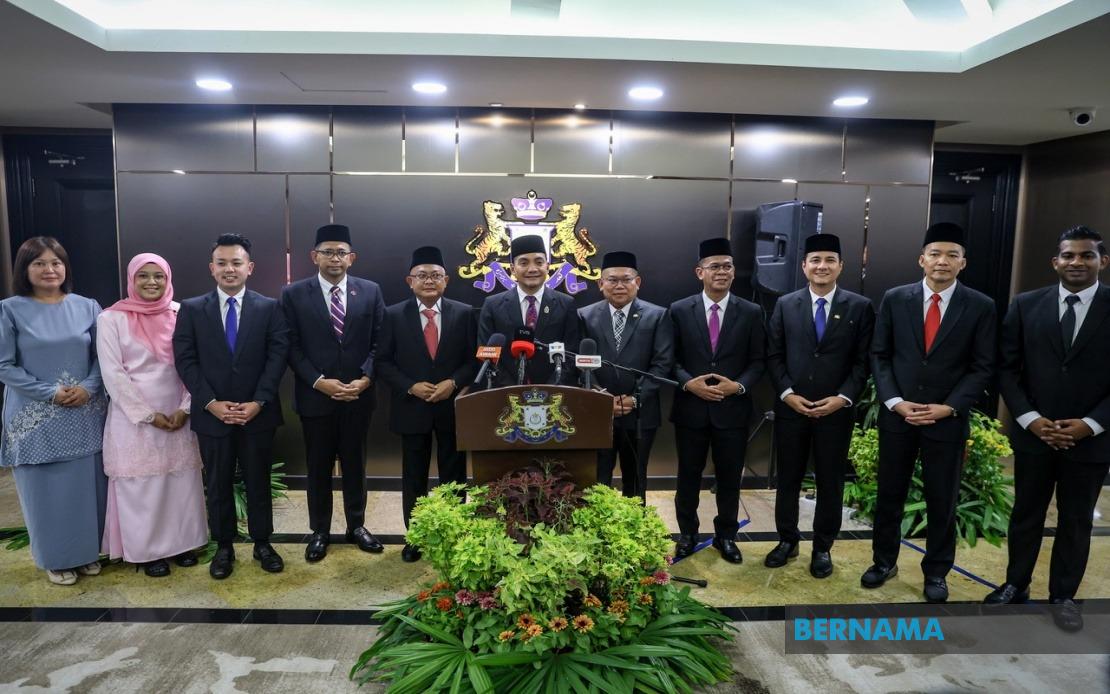
Johor's top political leadership has moved to reinforce its administrative machinery by appointing 10 deputy chairmen across the State Executive Council's committee structure, a structural decision designed to handle the growing complexity of governance as the state pursues accelerated economic and social development. Menteri Besar Datuk Onn Hafiz Ghazi unveiled the appointments at a press conference in Kota Iskandar on July 22, framing the measure as essential to sustaining momentum across the state's strategic development agenda. The appointments have already secured the formal approval of the Regent of Johor, Tunku Mahkota Ismail, underlining the constitutional and ceremonial backing for these administrative changes.
The underlying rationale for this expansion of the executive committee structure reflects mounting pressures facing state governments throughout Malaysia as they attempt to balance competing development priorities with responsive public administration. Onn Hafiz articulated this challenge directly, noting that as Johor's development agenda intensifies and policy demands grow more complex, the state government must correspondingly strengthen its internal capacity. Without additional leadership positions and distributed responsibilities, the existing committee structure risked becoming a bottleneck for policy implementation and public grievance resolution—a concern that resonates across Southeast Asia's rapidly urbanizing states.
These new positions sit within the broader framework of two interconnected state initiatives: the Maju Johor 2030 vision, which targets developed-state status within the coming decade, and the Johor Economic Transformation Plan (JETP), a more operationally focused roadmap for sectoral growth and economic diversification. Both frameworks demand sustained coordination between multiple government departments, statutory bodies, and local authorities, making the delegation of committee leadership responsibilities a practical necessity rather than merely a political reshuffling. The deputy chairmen roles are designed to distribute workload while maintaining oversight, allowing each major committee domain to have both strategic direction and tactical execution capacity.
From the perspective of administrative theory and practice, the appointment structure follows a hierarchical delegation model wherein deputy roles support principal chairmen while maintaining direct responsibility for specific operational domains. This arrangement is intended to accelerate issue resolution by creating multiple decision-making nodes within the committee system, reducing the bottlenecking effect of decisions requiring the principal chairman's attention for every matter. For a state managing infrastructure development, land planning, economic initiatives, and social services across nine districts with varying urbanization levels, this distributed approach offers potential efficiency gains.
Onn Hafiz emphasized that the deputy committee chairmen must operate in close coordination with their principal chairmen, relevant government departments, and agency partners—a requirement that underscores how these positions depend on collaborative cross-institutional working relationships rather than isolated power centers. This emphasis on teamwork and coordination suggests an awareness that adding titles without ensuring functional integration could produce administrative fragmentation rather than enhancement. The effectiveness of these appointments will ultimately depend on whether the state's bureaucratic culture supports genuine collaborative decision-making or whether territorial and hierarchical tensions undermine the intended benefits.
For Malaysian observers tracking governance innovation, Johor's move reflects a broader pattern of state governments attempting to optimize their administrative structures without major institutional overhaul. Rather than reorganizing entire departments or creating new agencies—moves that typically trigger resistance and turf conflicts—adding deputy positions leverages the existing framework while signaling commitment to more responsive governance. This approach has proven politically less contentious than wholesale restructuring while potentially yielding tangible improvements in service delivery if implementation is rigorous.
The appointments carry particular significance given Johor's economic importance within Malaysia's federal system. As the nation's second-largest economy by gross state product and a key growth corridor encompassing manufacturing, petrochemicals, logistics, and increasingly high-technology sectors, Johor's administrative efficiency directly influences Malaysia's broader economic performance. Any improvements in the state government's capacity to coordinate policy implementation, facilitate business operations, and resolve regulatory bottlenecks potentially cascade through national supply chains and investment flows. International investors evaluating expansion opportunities in Malaysia often assess subnational governance quality, making Johor's administrative proficiency a competitive asset.
The timing of these appointments also merits attention within Malaysia's current political environment. Johor has experienced significant shifts in state-level and federal political alignment over recent years, with the current administration operating within a specific coalition context. The appointment process, requiring formal consent from the Regent, demonstrates respect for constitutional protocols and the ceremonial role of the Johor monarchy—institutional elements that carry particular weight in this sultanate. This procedural adherence signals continuity and institutional stability even as administrative structures adapt.
From a Southeast Asian development perspective, Johor's initiative aligns with how other regional economies have responded to governance pressures accompanying rapid urbanization and economic complexity. Thailand, Indonesia, and the Philippines have all experimented with expanding second-tier administrative positions to manage the gap between strategic direction and operational implementation. The lessons from these regional experiences suggest that such appointments succeed when backed by commensurate budget allocation, clear performance metrics, and genuine authority delegation—factors that remain to be tested in Johor's case.
The deputy chairmen themselves will likely include figures with backgrounds spanning the state civil service, statutory bodies, and political appointees—a mix reflecting how Malaysian state governments typically blend technocratic expertise with political accountability. These individuals inherit responsibility for translating Maju Johor 2030 and JETP commitments into measurable outcomes across their respective committee domains, whether in infrastructure, economic development, social welfare, or environmental management. Their success or failure will become visible through tangible improvements in project delivery timelines, service responsiveness, and stakeholder satisfaction—metrics that the state government will presumably track and publicize.
Moving forward, the impact of these appointments will be discernible through examination of whether committee decision cycles accelerate, whether public service complaints decline, and whether major development projects advance according to schedule. The state government has positioned these appointments as instrumental to achieving the developed-state aspiration by 2030—a goal that requires not merely political commitment but sustained administrative excellence across all governance domains. Whether the structural change alone produces the intended results, or whether success ultimately depends on the caliber of personnel selected and the organizational culture they operate within, will become apparent through the coming years of implementation.

