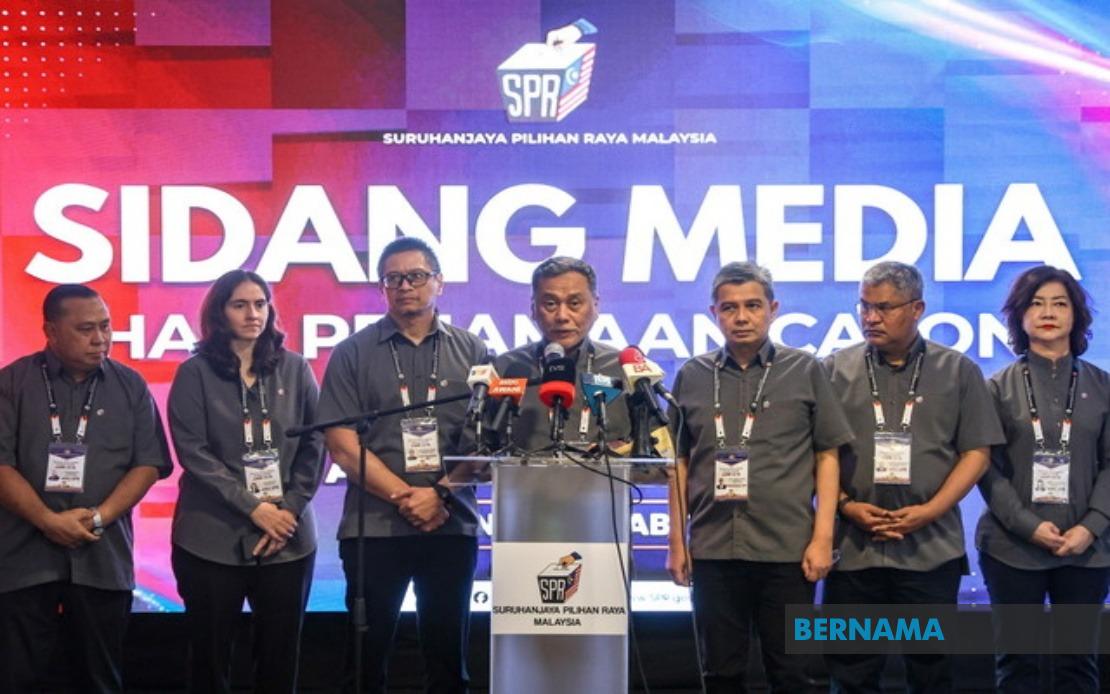
The 16th Johor state election will see a competitive field with 172 candidates cleared to contest after the nomination process concluded successfully across all 56 nomination centres. Election Commission chairman Datuk Seri Ramlan Harun confirmed that every nomination paper submitted met the required standards, resulting in zero disqualifications—a reflection of the administrative readiness shown by participating parties and independent candidates alike. The final nominee roster represents a diverse political landscape that will shape the electoral battle in Malaysia's southern economic heartland.
The gender composition of the candidate pool reflects ongoing shifts in political representation, with 138 male candidates and 34 female candidates making up the total field. While women still represent a minority of nominees at roughly 20 per cent, this proportion marks a gradual evolution in Malaysia's electoral participation. The Johor contest provides an opportunity to observe whether increased female candidacy translates into improved electoral performance and parliamentary representation for women at the state level, particularly as political parties increasingly recognise the mobilising potential of gender-inclusive campaigning.
The competition will be dominated by two major coalitions: Barisan Nasional and Pakatan Harapan, each fielding exactly 56 candidates—one for every seat. This symmetry underscores the structural parity between the two main political blocs contesting for control of the state government. Both coalitions have invested considerable organisational resources in preparing their campaigns, and their identical candidate strength suggests neither has attempted to overwhelm the other through numerical advantage alone. Instead, the battle will hinge on campaign effectiveness, incumbency records, and local constituency dynamics.
Perikatan Nasional represents the third major force with 33 candidates, positioning itself as a significant spoiler capable of fragmenting votes in tight contests. As a relative newcomer to Malaysia's political landscape compared to the established BN and PH coalitions, PN's presence in Johor signals its ambitions to consolidate influence in key states. The coalition's performance in this election will be closely watched as an indicator of whether it can translate recent parliamentary gains into sustained state-level traction. PN's strategic placement in Johor, a state with considerable economic and demographic importance, could prove consequential for its trajectory in Malaysian politics.
Several smaller parties and independent candidates complete the electoral picture. Parti Bersama Malaysia enters with 15 nominees, MUDA with four, while Parti Orang Asli Malaysia and Parti Sosialis Malaysia each field single candidates. Additionally, six independent contenders are running without party affiliation, offering voters alternatives outside the established coalition framework. This proliferation of smaller voices reflects both the democratic openness of Malaysia's electoral system and the strategic calculations of minor parties seeking to gain foothold or leverage in state politics.
The distribution of contest types across the 56 seats reveals a fragmented electoral landscape where multi-cornered races will predominate. Fourteen constituencies will witness straight fights between just two candidates, providing clearer binary choices for voters. However, the majority of seats will feature more complex contests: 27 seats will have three-way races, 12 seats will involve four candidates, and three seats will see five-way contests. This complexity reflects the multiplication of viable contenders in various localities, itself a function of both the strength of multiple political organisations and the varied political preferences across Johor's diverse communities.
Multi-cornered races introduce considerable unpredictability into electoral outcomes, as they can produce outcomes where the winning candidate receives substantially less than a majority of votes. In Johor's case, where urban areas around Kuala Lumpur's commuter belt neighbour rural constituencies with distinct political leanings, this variation suggests markedly different competitive dynamics by region. Johor Bahru and Iskandar Puteri may present different contest types than constituencies further inland or in peninsular Johor's interior regions, requiring candidates to tailor their campaign strategies to local realities.
The nomination process completion marks the formal commencement of the campaign period, with all candidates now permitted to conduct their outreach to voters. The fact that all 172 nomination papers were accepted without disqualification indicates that the Election Commission's vetting was thorough but not obstructive, and that all participating parties submitted candidates meeting the constitutional and administrative requirements. This administrative smoothness contrasts with previous elections where occasional disqualifications occurred, suggesting improved preparation by political organisations.
For Malaysia's broader political narrative, the Johor election carries significance beyond state-level governance. As a major economic contributor to federal revenue and home to a substantial portion of Malaysia's population, Johor's political complexion influences national power dynamics. Control of the state government affects resource allocation, infrastructure development, and the positioning of political forces ahead of potential federal elections. The coalition that emerges victorious will gain a platform from which to advance its national agenda, while defeat could weaken a coalition's morale and organisational momentum heading into subsequent electoral contests elsewhere in Malaysia.
The 172-candidate field also reflects the maturation of Malaysia's democratic institutions, which now routinely accommodate double-digit numbers of political parties and tens of thousands of registered candidates at various electoral levels. This vibrancy contrasts sharply with earlier periods of Malaysian democracy when competition was more limited. Yet complexity also raises questions about campaign finance transparency, the quality of political discourse when resources must be spread across numerous contestants, and the mechanics of coalition-building when multiple players vie for influence. The Johor election will provide empirical evidence of how Malaysian voters navigate such complexity and what factors ultimately determine their choices among numerous available options.

