The race to determine Johor's next government intensified dramatically on July 10 as all major political coalitions compressed their final campaign strategies into the closing hours before the official campaigning blackout at 11:59 pm. With 172 candidates competing for 56 state assembly seats in the 16th Johor State Election, the political machinery across the spectrum shifted into maximum overdrive, deploying their senior leadership to critical constituencies in a last-ditch effort to sway undecided voters. The frenetic pace of activity underscored how closely contested the election has become and the immense stakes riding on tomorrow's results for Malaysia's second-largest state by population.
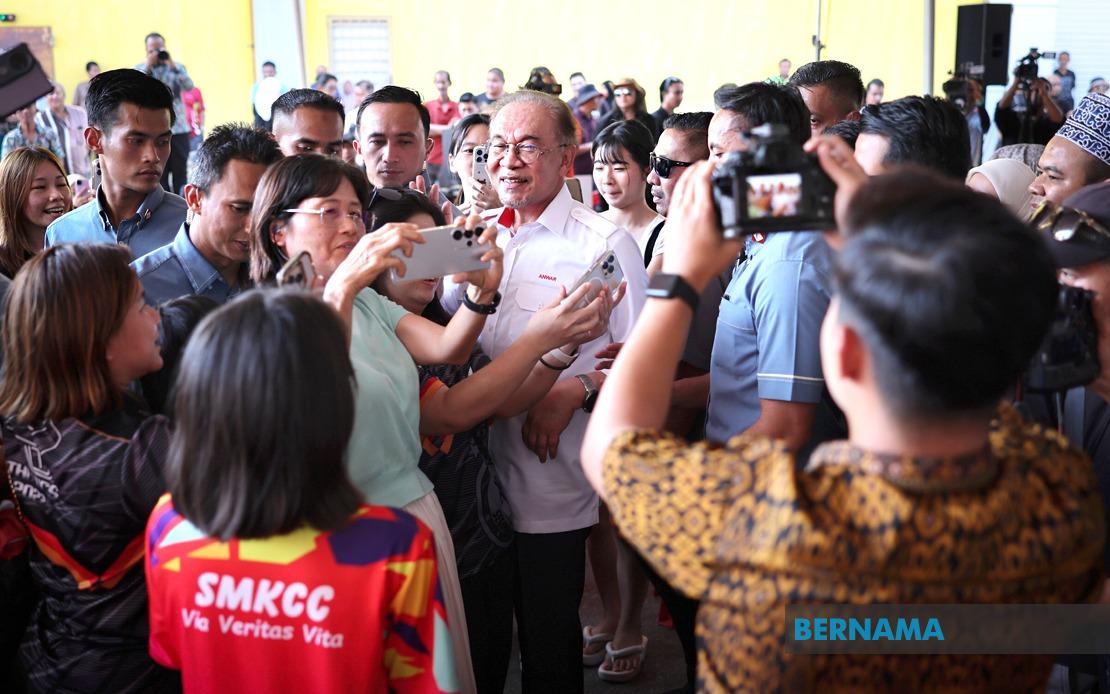
Prime Minister Anwar Ibrahim, leading Pakatan Harapan's charge, orchestrated an ambitious five-location tour across the state designed to energise the coalition's ground operations in what party strategists clearly identified as battleground constituencies. Beginning in Bukit Gambir, the tour progressed through Bukit Batu and Layang-Layang before culminating in Pasir Gudang with the 'Johor Ke Depan, Undi Harapan Grand Finale Programme', a symbolic closing event intended to consolidate momentum heading into polling day. The geographic spread of Anwar's itinerary reflected a calculated assessment of where Pakatan believed it could either gain new seats or defend existing ones against determined Barisan Nasional challenges. Through social media messaging, the Prime Minister combined practical campaign theatre with spiritual appeals, asking that all matters concerning his coalition's election day operations proceed smoothly.
Meanwhile, Pakatan's Larkin state seat candidate Suhaizan Kaiat adopted a markedly different tactical approach, eschewing large-scale rally formats in favour of grassroots engagement at a shopping mall in Johor Bahru. Accompanied by Amanah Vice President Datuk Seri Dr Dzulkefly Ahmad, the candidate conducted a walkabout designed to maintain connection with ordinary voters in their daily environments, presenting an accessible, neighbourhood-level campaign style. Suhaizan characterised his campaign experience as having generated substantial voter feedback and community input, framing this as a personal mandate to serve should Johor voters grant Pakatan the opportunity to govern. This bifurcated approach—simultaneous large-rally positioning by the coalition leadership and targeted micro-level engagement by individual candidates—represents a sophisticated understanding of how voting preferences form across different voter demographics and geographic contexts.
Barisan Nasional's response reflected a distinctly different campaign philosophy. Deputy Prime Minister Datuk Seri Dr Ahmad Zahid Hamidi, heading Barisan's election efforts, opted for a spiritually-anchored final campaign message, attending the 'BN Grand Supplication & Doa Selamat' event in Kulai district. This choice to invoke religious and spiritual themes in the campaign's final moments represents a deliberate appeal to Johor's Muslim-majority electorate, positioning Barisan as a coalition invested not merely in political victory but in community spiritual wellbeing. The incumbent Menteri Besar, Datuk Onn Hafiz Ghazi, representing Barisan in the Machap seat, took the unusual step of publicly apologising through a video message for perceived shortcomings in his administration. Such candour from a sitting state leader, whether interpreted as strategic humility or genuine accountability, demonstrates how competitive Barisan perceives this election to be and signals acknowledgment that the incumbent administration faces genuine electoral vulnerability despite its organisational advantages.
Bersatu, the Muhyiddin-led component within the governing coalition, framed its campaign conclusion differently, with party President Tan Sri Muhyiddin Yassin issuing a direct appeal to voters to synthesise the information they had gathered during the two-week campaign period into a clear voting decision. His message underscored the philosophical approach underpinning Bersatu's strategy: positioning the party as the reasonable choice for voters who had invested time in understanding the competing platforms and governance models on offer. This intellectual appeal contrasts sharply with both the grassroots intimacy of Pakatan's targeted constituency campaigns and Barisan's spiritual messaging, suggesting Bersatu's assessment that its base and persuadable voters respond to appeals grounded in rational political evaluation.
The Bersama coalition, despite its relative newness in Malaysian politics, mounted its own closing statement through party luminaries Datuk Seri Rafizi Ramli and Nik Nazmi Nik Ahmad. Rafizi's promise to use his final campaign speech to comprehensively address and counter arguments raised throughout the election period indicates Bersama's determination to shape the narrative immediately before voters cast their ballots. This approach weaponises the campaign's final hours as an opportunity to rebut competitor claims and reinforce Bersama's own messaging when voter attention is presumably at its peak. The deliberate scheduling of such events in the campaign's waning moments reflects a sophisticated understanding of voter attention patterns and the disproportionate weight carried by information consumed in the immediate pre-election period.
MUDA, the reform-focused party founded by former politician Muhammad Azeez Abdul Rahim, characterised its final campaign moment differently through the 'Puteri Wangsa Grand Finale Lecture' featuring party President Amira Aisya Abd Aziz. Amira's emphasis on reminding Johor citizens of their fundamental democratic power to determine outcomes represented a meta-level campaign appeal, directing voter attention to the existential significance of electoral participation itself. This positioning allows MUDA to transcend the partisan competition framework and position itself as the articulation of voter agency and democratic empowerment, a rhetorical strategy particularly potent among younger voters and those sceptical of traditional two-coalition politics. The variety of closing messages deployed by different parties—ranging from spiritual invocation to rational deliberation to democratic empowerment—reflects the heterogeneous persuasion landscape in contemporary Malaysian electoral competition, where no single message architecture dominates all voter segments.
The Malaysian Meteorological Department's forecast of morning clear skies with potential afternoon thunderstorms carries practical implications for polling day logistics and voter turnout patterns. Fair morning weather should facilitate early voting, while afternoon storms might suppress later-day turnout depending on rainfall intensity and distribution across constituencies. This weather intelligence likely informed campaign scheduling decisions, explaining the concentration of final campaign events in morning and early evening slots where visibility and accessibility could be maximised. The meteorological context thus becomes a material element shaping electoral outcomes, as turnout patterns generated by weather conditions can shift seat outcomes in closely contested races where margins prove narrow.
The sheer scale of this election—172 candidates pursuing 56 seats across a state comprising over 4 million residents—underscores Johor's pivotal role within Malaysian federalism. Johor serves as an economic powerhouse and has historically functioned as a bellwether for broader Malaysian political currents. An election result here carries implications far beyond state boundaries, potentially signalling shifting voter sentiment that could influence calculations for the next federal election, anticipated within the next two years. For Pakatan Harapan, victory in Johor would consolidate the coalition's position and provide momentum for federal-level governance initiatives. For Barisan Nasional, retaining Johor would represent successful defensive positioning against Pakatan's expansion. For Bersatu and smaller coalition partners, the Johor result will determine their perceived relevance within the broader coalition architecture and their leverage in forthcoming federal-level political negotiations.
The final campaign day demonstrated how Malaysian electoral competition has evolved beyond simple two-coalition frameworks. The presence of multiple distinct political vehicles—Pakatan Harapan, Barisan Nasional, Bersatu, Bersama, and MUDA—each deploying differentiated campaign messages and tactics, reveals an increasingly complex and fragmented political marketplace. Voters face choices not merely between two broad coalitions but among five distinct political offerings, each claiming legitimacy and competence to govern. This fragmentation creates both opportunities and risks: opportunities for voter expression of nuanced preferences, but risks of vote splitting and outcomes divorced from voter intentions. As Johor voters prepare to cast ballots tomorrow, they navigate a political landscape far more complicated and contested than Malayan electoral competitions of previous decades, reflecting broader regional patterns of democratic maturation and political pluralisation across Southeast Asia.

