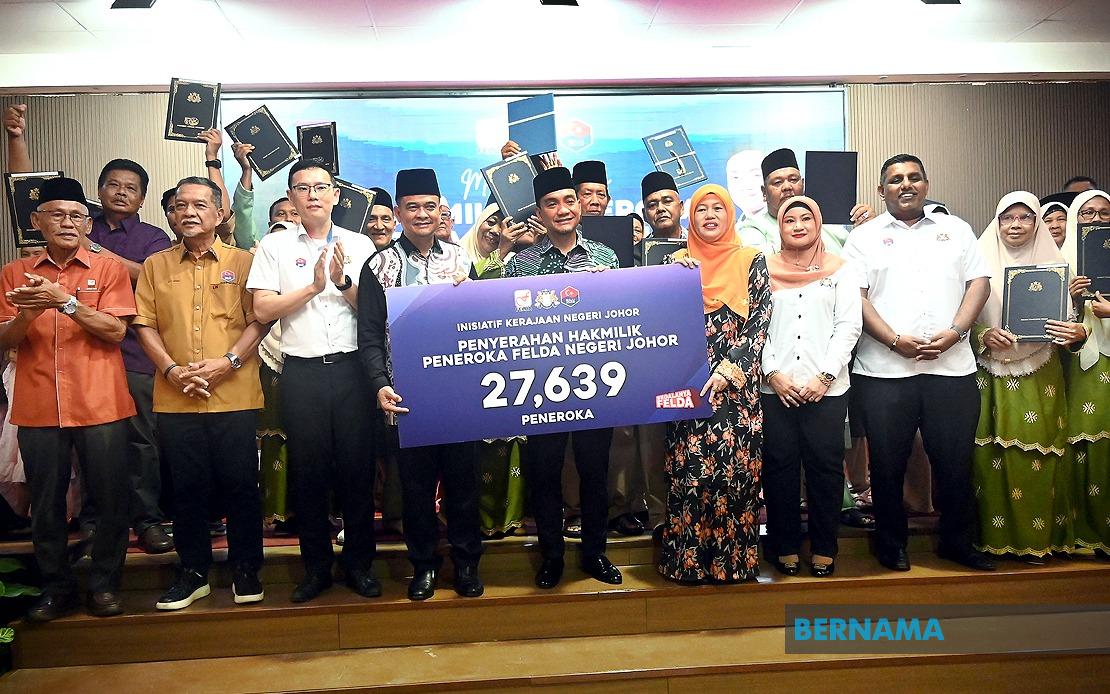
The Johor state government has virtually completed resolution of a protracted land title dispute that has weighed heavily on the Federal Land Development Authority (FELDA) settler communities across the state. During a land title presentation ceremony in Kluang on June 23, Johor Menteri Besar Datuk Onn Hafiz Ghazi announced that 27,639 out of 27,642 applications have been successfully processed, representing a 99.99 per cent completion rate that marks a significant breakthrough in addressing rural land ownership concerns.
The resolution carries particular weight given the historical significance of FELDA schemes as anchors of rural development in Malaysia. These agricultural settlements, first established in the 1950s as part of a broader land resettlement programme, have long grappled with bureaucratic obstacles in formalising title ownership. For settlers who have invested decades farming their allocated plots, the absence of proper documentation has created barriers to accessing credit, undertaking improvements, and passing assets to successors. The Johor initiative therefore addresses not merely an administrative matter but a fundamental question of livelihood security for thousands of rural families.
At the June 23 ceremony, 210 settlers representing three districts—Kluang, Kota Tinggi, and Mersing—physically received their land title documents, providing tangible confirmation of the government's progress. These three locations represent significant concentrations of FELDA settlement activity in the state, where agricultural plots remain economically important despite broader economic diversification. The symbolic presentation of titles underscores the government's intention to elevate the visibility of rural concerns in state policy discourse, moving beyond incremental administrative processing toward public acknowledgement of settler communities.
Menteri Besar Onn Hafiz framed the achievement within a broader rural development narrative, positioning land title resolution as integral to the state government's commitment to agricultural communities. His statement emphasised that treating FELDA settlements as a policy priority reflects recognition that rural welfare remains central to Johor's economic and social fabric. This rhetorical positioning matters significantly in a state where rural votes remain electorally consequential and where agricultural communities have historically felt marginalised relative to more urbanised constituencies in government resource allocation.
The scale of the undertaking becomes clearer when examining the remaining 3 unresolved cases among the 27,642 total applications. Rather than representing administrative failure, this near-completion suggests that the state apparatus has successfully implemented whatever procedural, legal, or technical mechanisms were required to process the overwhelming majority of claims. The three outstanding cases likely involve complications—disputed boundaries, conflicting documentation, or incomplete records—that resist straightforward resolution and may require individualised attention or further investigation. That such exceptions remain at so marginal a percentage indicates systematic competence rather than systemic dysfunction.
For Malaysian readers, the Johor achievement offers a case study in how state-level governments can address longstanding structural grievances if political will and administrative capacity align. FELDA land title disputes have persisted across multiple federal administrations and state governments, suggesting that the problem lay not in legal impossibility but in competing priorities and resource constraints. The Johor government's decision to prioritise resolution demonstrates that agricultural communities can secure government attention when political leadership designates their concerns as significant. This model carries implications for other state governments managing similar land ownership disputes in their own FELDA settlements.
The involvement of Johor Agriculture, Agro-based Industry and Rural Development Committee chairman Datuk Zahari Sarip at the ceremony signals institutional coordination between multiple levels of government responsibility. Land titles involve state land administration departments, agriculture ministries, and local district offices. The ceremonial presence of the committee chair suggests these agencies have been brought into coordinated action, reducing the bureaucratic fragmentation that often impedes rural development initiatives. Such coordination, when effective, accelerates implementation of policies affecting dispersed rural populations who lack the centralised institutional presence of urban constituencies.
From a Southeast Asian perspective, Malaysia's experience with FELDA land issues mirrors challenges across the region where state-sponsored agricultural settlement schemes established decades ago have encountered governance obstacles. Countries including Indonesia and the Philippines have similarly grappled with formalising land rights among settler communities established through government programmes. The Johor resolution, if sustained and replicated, could offer a transferable model for regional peers addressing comparable situations. It demonstrates that institutional mechanisms exist for converting long-delayed administrative matters into completed outcomes, provided political leadership and state capacity are mobilised purposefully.
The resolution also carries economic implications for the settlers themselves and regional agricultural productivity. Formalised land titles enable farmers to access institutional credit previously unavailable, potentially facilitating agricultural modernisation, mechanisation, or crop diversification. For some settlers, titles create the legal foundation necessary to lease land or consolidate holdings. At a state level, reduced uncertainty regarding land ownership in FELDA areas may encourage agricultural investment and development planning. These economic benefits extend beyond individual settlers to regional supply chains and agricultural markets that depend on stable, productive farming communities.
The state government's framing of land title resolution as part of a broader rural development agenda suggests this initiative may be a precursor to additional attention to FELDA communities. Educational facilities, infrastructure, cooperative credit systems, and market access mechanisms within FELDA settlements remain potential areas for further government intervention. If the land title resolution establishes political momentum around rural concerns, subsequent state budgets and policy announcements may reflect expanded investment in agricultural community wellbeing. Conversely, if the land title initiative represents a circumscribed response to a specific grievance without broader implications for rural policy, its significance becomes primarily symbolic rather than transformative.
The near-total resolution rate suggests that remaining challenges, if any, will likely require individualised legal or administrative remedies rather than systemic policy overhaul. The three unresolved cases may eventually be processed through alternative mechanisms—judicial proceedings, additional documentation review, or negotiated settlements—but their persistence at such negligible levels indicates the basic institutional competence exists to handle remaining obstacles. For FELDA communities across Johor, the 99.99 per cent completion rate represents vindication of persistence in pursuing land rights that should, arguably, have been formalised far earlier in these settlements' histories.