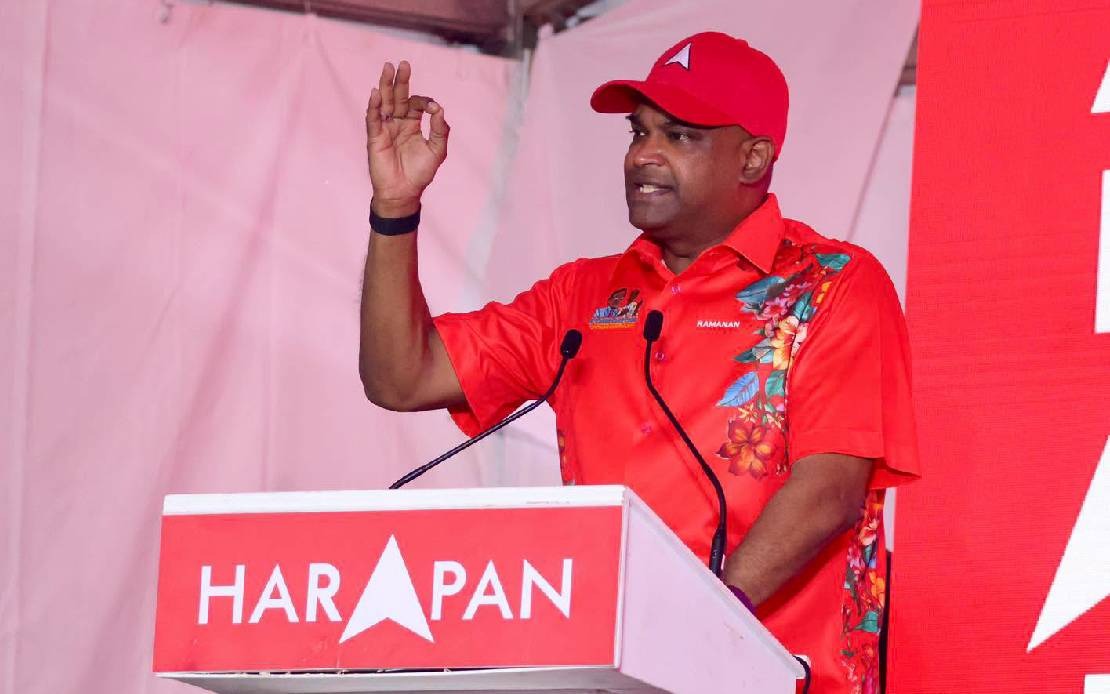
The Federal Government remains deeply invested in Johor's economic and social development, with senior Pakatan Harapan leadership doubling down on that message as the state heads toward its election on July 11. Speaking at a campaign roadshow in Simpang Renggam on Tuesday, PKR Vice-President Datuk Seri R Ramanan outlined what he described as the administration's sustained commitment to large-scale infrastructure projects and targeted assistance schemes designed to lift living standards across the state.
Ramanan's remarks underscore the government's strategy of tying Johor's prosperity directly to federal policy implementation. The state, which sits at the southern gateway of peninsular Malaysia and serves as a critical economic hub linking the region, has long featured prominently in federal development blueprints. Infrastructure spending and investment initiatives targeting Johor residents aim to create tangible improvements in household incomes and quality of life, messaging that carries particular weight in a state where economic sentiment and job creation remain voter preoccupations.
The push to maintain administrative cohesion between Johor's state government and the federal centre emerged as a secondary but significant theme in Ramanan's campaign appeal. He urged voters to grant Pakatan Harapan the state mandate, arguing that alignment between state and federal administrations would streamline project implementation and reduce bureaucratic friction. This argument carries practical force: when ruling coalitions differ between state and federal levels, resource allocation, land policy coordination, and infrastructure planning can encounter delays or become politicised, ultimately frustrating development timelines.
Johor's electoral landscape features 172 candidates contesting seats in what is formally the 16th state election cycle. The contest follows years of shifting political alignments in the state, which has experienced several changes in ruling coalitions and chief ministers. Early voting is scheduled for July 7, giving the broader electorate a four-day window before the main polling day. This compressed timeline underscores the central election commission's operational approach to managing state elections during Malaysia's ongoing political transition.
The Simpang Renggam roadshow drew several prominent Pakatan Harapan figures alongside Ramanan. Amanah Secretary-General Faiz Fadzil joined the event, along with PKR Vice-President Datuk Seri Amirudin Shari, who holds significant influence within the coalition's organisational apparatus. Three coalition candidates contesting in Johor state seats—Nur Hafiz Roslan for Machap, Abd Razak Ismail for Benut, and Guna Balakrishnan for Layang-Layang—were present to reinforce local messaging and connect federal-level party machinery with ground-level campaigns.
For Malaysian observers, Johor's electoral dynamics merit particular attention because the state remains economically significant and politically volatile. The state's manufacturing base, port facilities centred on Port Klang and Pasir Gudang, and its role as Malaysia's southern industrial corridor make it strategically important to any federal government seeking to demonstrate economic competence. Election results in Johor have historically influenced broader perceptions of incumbent performance and shifted momentum heading into subsequent national contests.
The emphasis on assistance programmes reflects how the Pakatan Harapan coalition has calibrated its messaging toward bread-and-butter concerns. Rather than focusing exclusively on mega-projects, Ramanan highlighted the breadth of support reaching ordinary families—an approach designed to counter opposition claims that development benefits concentrate among politically favoured groups. This framing implicitly addresses voter anxieties about cost-of-living pressures and income adequacy, issues that consistently rank among top concerns in polling.
The timing of these campaign activities coincides with Malaysia's broader political recalibration since the 2022 general election. The Pakatan Harapan coalition, which returned to federal office under Prime Minister Anwar Ibrahim, has worked to consolidate support in key states while navigating internal tensions and coalition management complexities. State-level elections serve as crucial testing grounds for coalition viability and voter sentiment between federal cycles.
From a Southeast Asian perspective, Johor's election carries implications extending beyond Malaysia's borders. The state's economic integration with Singapore and its role in regional supply chains mean that political stability and consistent policy implementation matter to cross-border business interests. A state government aligned with federal policy direction theoretically enables more coordinated regional economic engagement and smoother implementation of bilateral development initiatives.
Ramanan's central argument—that electoral alignment produces better governance outcomes—appeals to voters fatigued by divided government. The experience of states governed by opposition parties during previous administrations sometimes involved resource withholding or political brinkmanship, a pattern that has shaped voter preferences in subsequent contests. Whether this alignment logic resonates sufficiently on July 11 will depend on whether Johor voters prioritise state-federal coordination over other considerations, including local leadership quality and incumbent performance records.

