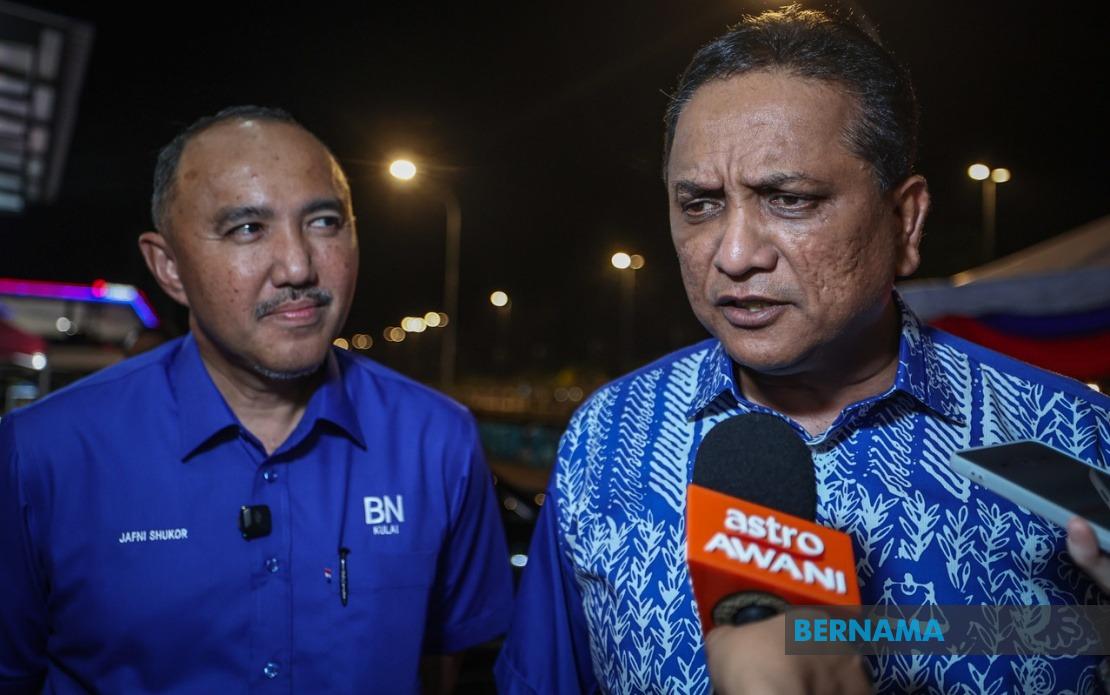
A senior UMNO politician has forcefully rejected allegations that Johor's Regent, Tunku Mahkota Ismail, exercises improper control over the state administration, characterizing such claims as grossly distorted and lacking substantive foundation. Datuk Seri Reezal Merican Naina Merican, a member of UMNO's Supreme Council, made the assertion while responding to recent political controversy in the state, just days before Johor is set to hold its state election.
The controversy stems partly from the departure of Datuk Dr Mohd Puad Zarkashi from UMNO, with the former Speaker of the Johor State Legislative Assembly citing the Menteri Besar's position as compromised. Reezal Merican suggested that such characterizations fundamentally misunderstand the nature of constitutional monarchy and the proper exercise of royal prerogatives. He contended that the Regent's vocal involvement in state affairs represents a legitimate extension of his duties rather than an overreach into executive functions.
According to Reezal Merican, Tunku Mahkota Ismail's public commentary on Johor's development trajectory should be interpreted within the framework of his constitutional responsibilities. The Regent, operating as a constitutional check on executive power, participates in governance through formal channels available to him under the state constitution. This supervisory function, Reezal Merican argued, serves the broader interest of Johor's residents by ensuring that decision-makers remain accountable to both the people and the institution of the monarchy.
The UMNO leader emphasized that every action undertaken by the Regent falls squarely within his legitimate purview and represents an exercise of rights granted by the state's constitutional arrangements. Rather than constituting an improper intervention, the Regent's interventions embody a form of institutional oversight that operates independently of party politics. Reezal Merican maintained that characterizing such legitimate functions as tantamount to puppet-mastering fundamentally distorts both the nature of those functions and the position of the state's political leadership.
Significantly, Reezal Merican claimed that within UMNO's own deliberative structures—specifically its Supreme Council—there has never been any suggestion that the Johor branch operates under palace direction. This assertion carries weight given UMNO's historical dominance in Johor and the party's ongoing centrality to state politics. The absence of such concerns among senior party figures implies that concerns raised by departing politicians may reflect individual grievances rather than systemic dysfunction.
The timing of these allegations carries particular political significance, occurring just days before Johor voters head to the polls. The Election Commission has scheduled nomination day for June 27 and set July 11 as polling day, meaning the state's electoral competition is entering its final phase. Reezal Merican appeared troubled by the decision to inject royal institution questions into this heated political moment, suggesting that Mohd Puad's framing represented a calculated effort to leverage constitutional sensitivities for partisan advantage.
The controversy illuminates broader questions about the proper relationship between hereditary constitutional institutions and elected executive bodies in Malaysia's federal structure. Johor's situation, where the Regent maintains substantial formal and customary influence, differs from some other states where such relationships remain less publicly contentious. The current dispute reflects tensions inherent in Westminster-influenced constitutional systems grafted onto monarchical foundations—tensions that become particularly acute during electoral cycles when political actors have incentive to mobilize constitutional grievances.
Reezal Merican's defense of the Regent's role fundamentally rests on a distinction between legitimate constitutional oversight and illegitimate political domination. From this perspective, the mere fact that a Regent expresses views on governance does not automatically translate into inappropriate control. Rather, such expression falls within normal parameters of constitutional monarchy, where royal figures maintain advisory and oversight functions while elected bodies retain primary responsibility for day-to-day governance.
The allegations and their refutation occur against Johor's unique constitutional backdrop. The state maintains a hereditary ruler with powers more explicitly defined and historically more robustly exercised than in many other Malaysian states. This constitutional reality means that questions about the proper scope of royal prerogatives carry particular urgency in Johor's political discourse. What might constitute unremarkable oversight in other contexts potentially assumes greater significance in Johor's heavily monarchical constitutional framework.
The substance of Reezal Merican's remarks suggests confidence within UMNO circles that the Regent's involvement, whatever its scope, does not fundamentally undermine the legitimacy of elected government. This positioning allows the party to maintain its traditional relationship with the palace while simultaneously defending the autonomy of its political leaders. However, the very necessity of such public defenses indicates that palace-government relations have become contentious enough to require clarification.
Looking forward, the resolution of these tensions will likely depend on how Johor voters respond in the forthcoming election and whether the next government, regardless of composition, can establish clearer boundaries regarding royal involvement in routine administration. The current controversy highlights the challenge of maintaining constitutional monarchy within democratic systems—a balance that requires both restraint from palace institutions and respect for their legitimate roles from political actors.
For Malaysian political observers more broadly, the Johor situation underscores how constitutional arrangements that functioned smoothly during periods of political stability can become contested when partisan competition intensifies. The outcome may well influence how similar tensions are managed in other states and potentially inform broader national conversations about the evolving relationship between Malaysia's hereditary institutions and its democratic structures.

