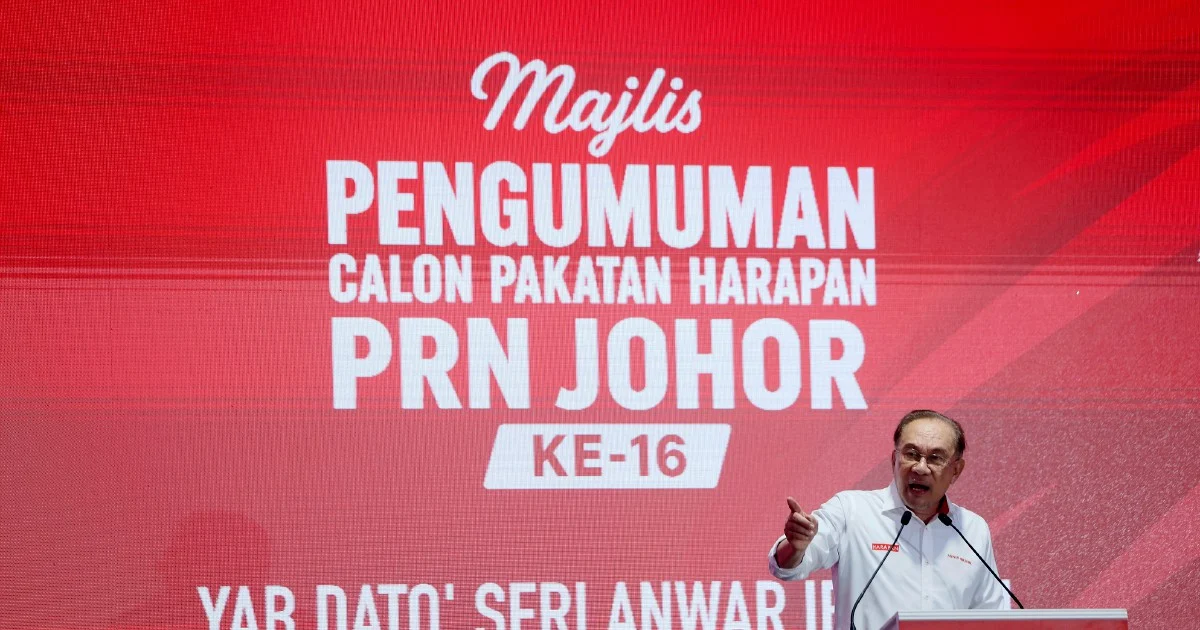
Prime Minister Datuk Seri Anwar Ibrahim disclosed in Tangkak that the federal government has directed substantially higher allocations to Johor than the state's direct revenue contributions to the national coffers across the preceding three-year period. The disclosure underscores the mechanism through which Malaysia's federal fiscal system distributes resources to support regional economic and social development initiatives.
The disparity—with Johor receiving RM16 billion in federal allocations while contributing RM14 billion in state-level revenue—reflects a deliberate policy orientation toward ensuring that wealthier or economically significant states receive reinvestment beyond their immediate tax yield. This inverted flow mechanism is central to how federal systems maintain interstate equity and prevent economic concentration in high-revenue generating regions.
For Malaysian observers tracking fiscal federalism debates, the figure carries particular weight. Johor, as a state with substantial manufacturing, tourism, and port-related economic activity centred around Klang Valley logistics networks and its position as a gateway to Singapore, represents a significant revenue contributor to the federal government. That such a state nonetheless benefited from a RM2 billion surplus allocation suggests the government's interpretation of "fairness" extends beyond simple revenue proportionality.
The announcement arrives as Malaysia grapples with complex questions about interstate resource distribution. The federal system must balance competing imperatives: rewarding productive economic zones that generate national wealth while simultaneously addressing regional disparities that could fuel social tensions or undermine less-developed areas. Johor's position—neither among Malaysia's poorest states nor its wealthiest per capita—illustrates the middle ground where these calculations become contentious.
Understanding the composition of these RM16 billion allocations remains important for fuller analysis. The figure likely encompasses infrastructure development projects, education and healthcare investments, social welfare programmes, and various federal grant schemes. Each category reflects different federal priorities and policy objectives. Infrastructure spending, for instance, often prioritises national connectivity and economic corridors rather than purely proportional distribution. Educational and health allocations typically follow population-weighted formulas with adjustments for socioeconomic need.
The timing of Anwar's statement in Tangkak—a Johor locality—suggests an effort to communicate governmental responsiveness to the state's concerns and priorities. Johor has historically occupied an important position in Malaysian politics and economics, and public reassurance about federal support carries political significance alongside fiscal substance. Such messaging matters for maintaining confidence in federal-state relations and broader national cohesion.
Regional observers across Southeast Asia may find the Malaysian example instructive as other federal systems navigate similar distribution questions. Thailand, Indonesia, and the Philippines all grapple with balancing central government resource allocation against regional contribution levels, though through different institutional frameworks. Malaysia's approach—acknowledging disproportionate allocation while framing it within equity logic—offers a particular model for justifying redistributive fiscal federalism.
The RM2 billion surplus favoring Johor must also be contextualised within broader federal spending patterns. If similar analyses applied to other states revealed significant disparities in the opposite direction—with some states contributing proportionally more than they receive—the aggregate story becomes more complex. A truly equitable federal system might deliberately advantage lower-income or less-developed states while moderating allocations to high-revenue contributors. The Johor figure therefore tells only a partial story about overall federal fiscal equity.
Looking ahead, such disclosures about federal-state financial flows could inform ongoing conversations about Malaysian federalism's future direction. As states increasingly scrutinise their fiscal relationships with the federal government, transparency about allocation mechanics and justifications becomes more valuable. Anwar's willingness to highlight concrete figures suggests openness to such dialogue, though critics might question whether purely numerical comparisons adequately capture the complexity of federal responsibilities and resource needs.
For Malaysian investors and business analysts, understanding federal-state fiscal relations carries practical implications. Development patterns, infrastructure investment trajectories, and government spending priorities in specific states all flow partly from these allocation decisions. Johor's continued position as a recipient of federal surplus allocation may support business confidence in the state's economic development prospects and infrastructure modernisation efforts.
The announcement also reflects broader fiscal pressures confronting Malaysia's federal government. Maintaining allocations to economically significant states requires sustained revenue generation and effective fiscal management at the national level. Economic headwinds, whether cyclical downturns or structural challenges, inevitably pressure the government's ability to sustain such distribution patterns. This dimension suggests that future federal-state financial relationships may require recalibration depending on overall national economic performance.
Moving forward, both federal and state governments will likely face pressure to demonstrate that allocated resources translate into tangible development outcomes and improved public services. The RM16 billion directed to Johor should theoretically manifest in measurable improvements across infrastructure quality, educational attainment, healthcare provision, and economic opportunities. How effectively these funds translate into development outcomes will ultimately shape public perception of federal-state fiscal arrangements and broader confidence in governmental resource stewardship.