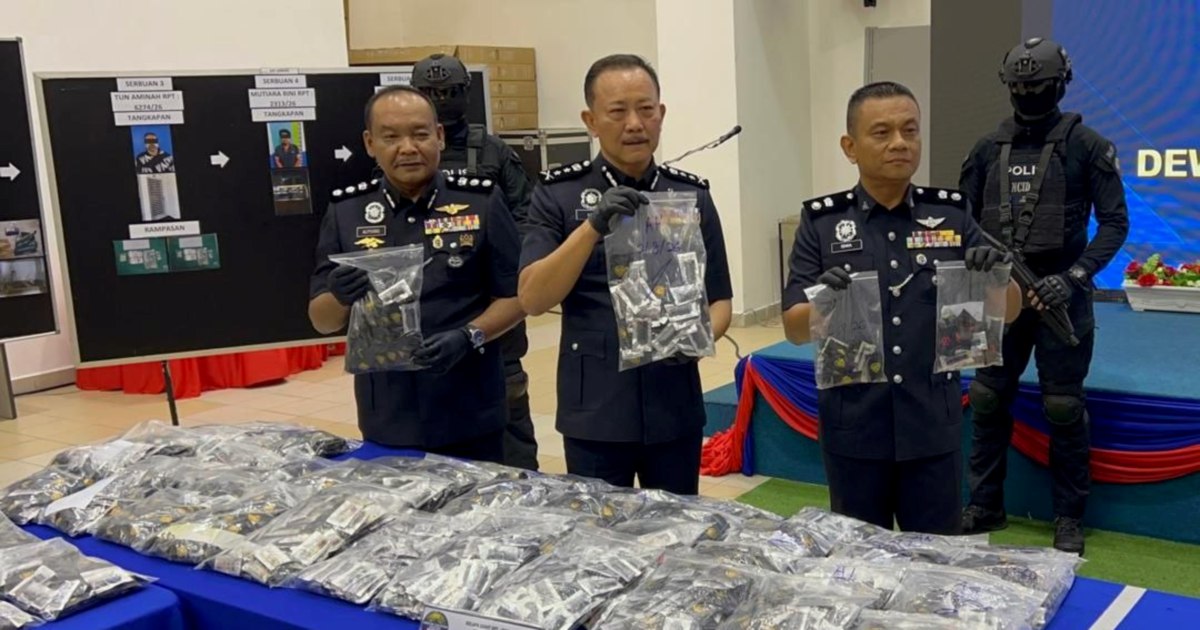
Law enforcement authorities in Johor have successfully dismantled what appears to be a substantial organised operation involved in manufacturing and trafficking drug-contaminated vaping products. The breakthrough came through coordinated enforcement action on Sunday, when police executed five separate raids across the state, culminating in the apprehension of seven individuals suspected of orchestrating the illicit enterprise. The seized inventory of narcotics-infused vape cartridges carries an estimated street value of RM10.68 million, underscoring the scale and profitability of this particular criminal venture.
The simultaneous nature of the raids indicates a carefully planned investigation that likely involved weeks or months of intelligence gathering and surveillance. By striking multiple locations at the same time, authorities minimised the risk of suspects fleeing or destroying evidence, a tactic commonly employed by Malaysian police in dismantling organised crime networks. This coordinated approach has become increasingly refined in recent years as enforcement agencies recognise the interconnected nature of drug manufacturing and distribution chains.
Drug-laced vaping products represent a concerning evolution in narcotics trafficking, particularly given the widespread accessibility and perceived legitimacy of vaping devices among younger demographics. The integration of controlled substances into vape cartridges allows traffickers to disguise illegal drugs as commercial products, complicating detection efforts and broadening the potential market beyond traditional drug users. The substantial monetary value attached to this seizure reflects both the high demand for such products and the considerable profit margins that make such operations attractive to organised criminal groups.
Johor's emergence as a focal point for this type of criminal activity warrants closer examination. The state's proximity to Singapore and its extensive port facilities, combined with its position as a major commercial hub, makes it an ideal location for both manufacturing operations and distribution networks. The fact that law enforcement detected and disrupted this syndicate suggests improved intelligence capabilities, though the existence of such an operation in the first place indicates ongoing vulnerabilities in enforcement or supply chain monitoring that criminals continue to exploit.
The arrest of seven individuals raises important questions about the structure and scope of the broader organisation. Typically, a seven-person crew would represent those directly involved in manufacturing, packaging, and local distribution rather than the complete network. Higher-level organisers and financial facilitators often remain insulated from street-level operations, meaning the full dimensions of this criminal enterprise may extend considerably beyond those currently in custody. Police investigations will likely focus on identifying these upstream connections and dismantling the supply chains that provided precursor chemicals and controlled substances.
The emergence of designer drug products infused into consumer devices underscores a troubling trend in Southeast Asian narcotics markets. Criminal entrepreneurs continuously adapt their approaches to circumvent regulatory frameworks and law enforcement detection. Vaping represents a particularly effective delivery method because the devices are ubiquitous, the aerosol output normalises the activity in public spaces, and consumers may remain unaware they are inhaling controlled substances rather than nicotine products. This opacity creates enforcement challenges distinct from traditional drug distribution.
For Malaysian society more broadly, the discovery of such operations carries implications for public health policy and drug prevention strategies. The prevalence of vape-based narcotics, especially if they successfully penetrate youth markets, could undermine decades of drug awareness education that taught users to recognise and avoid traditional drug forms. Young people accustomed to legitimate vaping culture may be particularly vulnerable to manipulation through seemingly normalised products. Schools, parents, and health authorities will need to update their understanding of modern drug delivery mechanisms to effectively communicate risks.
The enforcement success in Johor reflects the capabilities of state-level police operations, yet it also illustrates why regional cooperation across state boundaries remains essential. Major criminal syndicates operate fluidly across administrative divisions, and disruption in one jurisdiction often shifts activity to adjacent regions unless coordinated enforcement occurs simultaneously. The RM10.68 million valuation suggests this operation had been accumulating inventory over considerable time, indicating that such manufacturing facilities may have been operating without detection for extended periods.
The coming weeks will prove critical as investigators interrogate the arrested suspects and examine seized materials. Understanding the chemical composition of the vape cartridges, the sources of precursor materials, and the intended distribution networks will provide valuable intelligence for disrupting similar operations elsewhere. Authorities will likely examine financial records, communications, and travel patterns to map the complete organisational hierarchy and identify individuals who escaped the initial sweep.
This case demonstrates that Malaysian law enforcement continues developing sophisticated capabilities in tackling evolving forms of organised crime. However, the very existence of such a substantial operation underscores that criminal ingenuity consistently outpaces regulatory adaptation. For policymakers, the incident serves as a reminder that emerging technologies and consumption patterns can be rapidly weaponised by traffickers unless authorities maintain vigilant oversight. The challenge ahead involves maintaining this enforcement momentum while simultaneously enhancing surveillance of supply chains, precursor chemical transactions, and the sale of vaping equipment to suspected smuggling networks.

