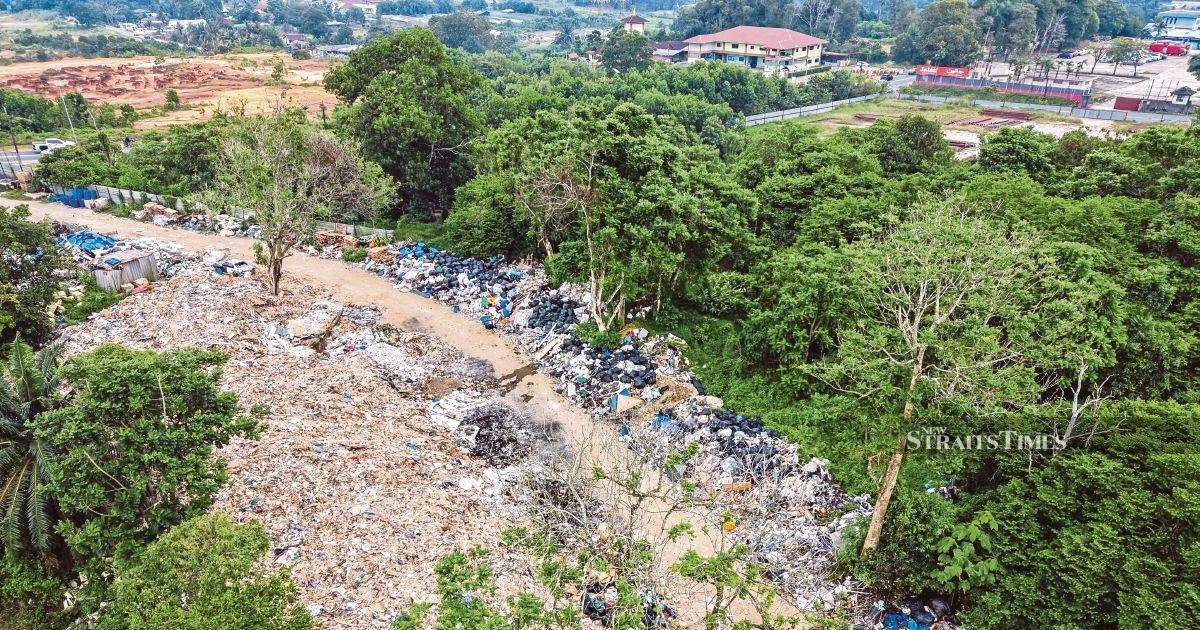
Johor authorities have announced plans to establish a comprehensive multi-agency task force following allegations that construction and demolition waste originating from Singapore has been deposited illegally at several locations throughout the Pontian district. The investigation represents an escalation in the state's response to what officials characterise as a serious environmental and regulatory violation that demands coordinated action across multiple jurisdictions and enforcement bodies.
The decision to mobilise a dedicated task force underscores growing concern among Malaysian environmental and local government officials about the transboundary nature of waste management challenges in the Johor–Singapore border region. Pontian, which sits directly across from Singapore's western coast, has historically faced pressure as a potential destination for illegally transported waste due to its proximity to the city-state and less stringent enforcement mechanisms in some areas. The establishment of this investigative body signals that state authorities are taking the matter with appropriate seriousness.
SWCorp Malaysia, the statutory waste management and cleanliness corporation that operates under the Ministry of Housing and Local Government, is leading the investigation. The corporation's involvement indicates that the alleged dumping falls within federal waste management oversight frameworks, requiring coordination between state and federal agencies. This multi-tier approach is essential given the international dimensions of the case and the need to establish clear evidentiary chains that could support potential legal action.
The task force composition will likely include representatives from Johor's environmental enforcement division, SWCorp, the Department of Environment, local council authorities, and potentially customs and border control agencies. This intersectoral cooperation is crucial because investigating cross-border waste trafficking requires expertise in environmental compliance, forensic waste analysis, import regulations, and coordinated intelligence gathering. Each agency brings specific investigative capacity that would be impossible for a single organisation to deploy effectively.
Preliminary investigations must establish several critical facts: the point of origin of the waste materials, the method by which they crossed into Malaysia, the specific locations where disposal occurred, the volume and composition of materials involved, and the parties responsible for arranging the transfer. These details are essential not merely for building a legal case but for understanding whether this represents an isolated incident or part of a broader pattern of illegal waste trafficking into Johor.
The environmental implications are substantial. Construction and demolition waste that includes asbestos, lead-painted materials, electronic components, or other hazardous substances poses direct risks to soil and groundwater contamination in Pontian. The district's groundwater systems feed agricultural areas and settlements, making contamination a matter of public health concern. Additionally, illegal dumping undermines the regulatory frameworks that both Malaysia and Singapore have established to ensure responsible waste management, creating competitive disadvantages for legitimate waste disposal operators.
From a bilateral perspective, this investigation has subtle diplomatic dimensions. Singapore has become increasingly strict about waste exports and domestic waste management practices, partly because it faces severe spatial constraints and partly due to environmental consciousness. If Singaporean companies or individuals are indeed responsible for illegally exporting waste to Malaysia, it represents a violation of both countries' environmental protocols and reflects poorly on corporate practices in the city-state. Malaysia's firm investigative response sends a clear signal that such practices will not be tolerated, regardless of the source.
The investigation also highlights broader Southeast Asian challenges with waste management and illegal dumping. As the region becomes wealthier and construction activity accelerates across countries, the volume of construction waste grows exponentially. Some countries and companies attempt to minimise costs by shipping waste across borders to locations with weaker enforcement. Malaysia, as a middle-income country with increasing construction activity, faces particular vulnerability to such practices, making proactive investigation and enforcement essential to protect its environment and discourage future violations.
For Johor specifically, this matter intersects with the state's development ambitions. The Johor–Singapore border region is earmarked for significant economic growth initiatives, and environmental credibility is essential for attracting quality foreign investment. Companies considering establishing operations in Johor will evaluate the state's environmental governance quality, and demonstrating rigorous enforcement against illegal dumping sends positive signals about regulatory seriousness. Conversely, allowing transboundary waste dumping to proceed unchecked would tarnish Johor's environmental credentials.
The task force's methodology will likely include site inspections to identify dumping locations, collection of physical evidence for laboratory analysis to determine origin and composition, interviews with local residents and workers who may have witnessed disposal activities, and examination of transport records and business documentation. If evidence points to specific Singaporean entities, officials may need to engage Singapore's National Environment Agency for reciprocal investigation and potential enforcement action.
Public disclosure of the investigation, including the decision to publicise the task force's establishment, serves an important deterrent function. Potential offenders become aware that Malaysian authorities are actively monitoring and investigating cross-border waste trafficking. It also invites public participation in reporting suspected illegal dumping, expanding the authorities' investigative reach through community vigilance.
The timeline for the investigation remains unclear, but complex transboundary cases typically require several months to complete. The task force must balance thorough investigation with reasonably swift action to prevent continued environmental damage. Once completed, the investigation's findings could inform policy discussions about strengthening border monitoring for illegal waste, enhancing coordination between Malaysian and Singaporean environmental agencies, and potentially renegotiating waste management protocols between the two countries.

