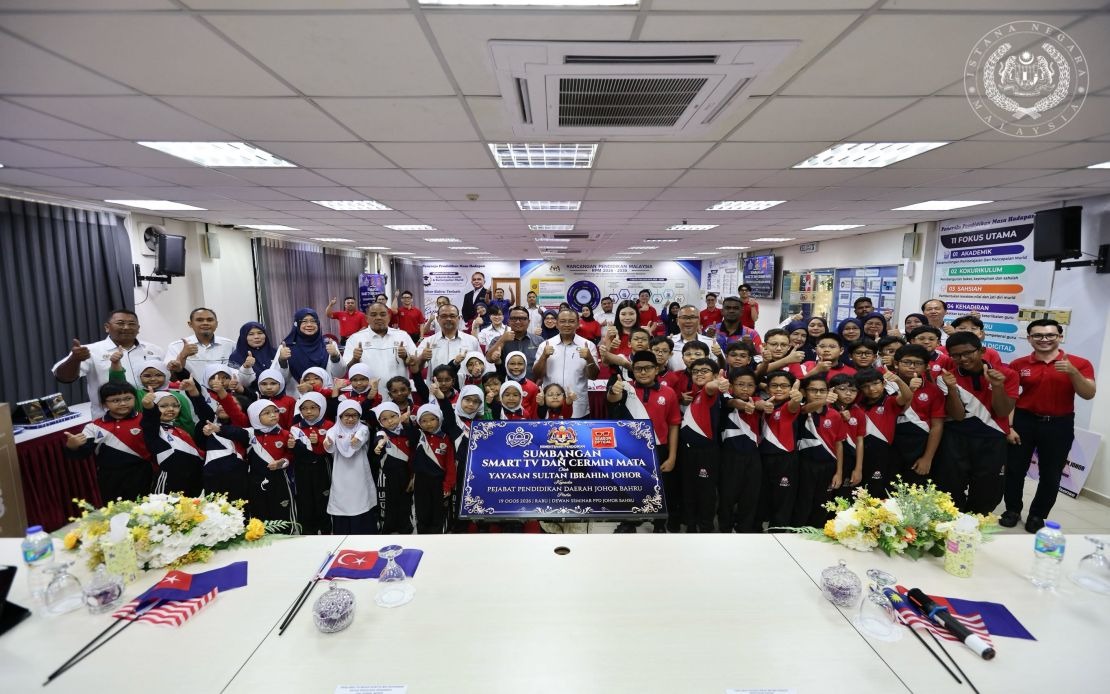
The Yayasan Sultan Ibrahim Johor (YSIJ) has reinforced its commitment to educational advancement in the southern state by delivering classroom technology and corrective eyewear to deserving pupils across the Johor Bahru district. The initiative encompasses the provision of ten 75-inch smart televisions distributed to selected schools alongside 2,000 pairs of spectacles distributed to economically disadvantaged students across twenty educational institutions, representing a substantial investment in both infrastructure modernisation and student welfare.
The contribution underscores a broader strategy by the foundation to address dual challenges facing Malaysian education: the digital divide in classroom instruction and unmet healthcare needs among lower-income populations. By targeting both technological capability and preventative health measures, YSIJ demonstrates a holistic understanding of factors that constrain academic performance beyond conventional curriculum delivery. The integration of these two distinct interventions within a single programme reflects strategic thinking about student readiness and learning environment optimisation.
The smart television installations are designed to facilitate multimedia-based instruction, enabling educators to incorporate video content, interactive presentations, and digital resources into their teaching methodologies. For schools in the Johor Bahru district that may lack contemporary audiovisual infrastructure, these devices represent meaningful capacity enhancement. The 75-inch display size ensures visibility across typical classroom configurations, making digital content accessible to entire student cohorts simultaneously rather than requiring individual device access.
Equally significant is the spectacles distribution component, which addresses a frequently overlooked barrier to educational attainment. Vision impairment among school-age children—particularly those from lower-income households unable to afford corrective lenses—creates substantial learning disadvantage. Students unable to clearly view classroom materials, whiteboards, and instructional content experience cumulative academic detriment over months and years. By removing this obstacle for B40 category students, the programme targets a structural impediment to educational equity within the district's school system.
The foundation partnered with Season Optical to facilitate the spectacles initiative, establishing a supply chain that ensures consistent quality standards and appropriate frame-lens combinations for student populations. This collaborative approach distributes implementation responsibility across both public and private sector actors, reducing administrative burden on educational authorities while leveraging commercial expertise in optical retail operations. Such partnership models have become increasingly common in Malaysian social programming, where government institutions increasingly co-implement initiatives with private sector partners.
A particularly innovative component involves deployment of Columba Vision Screener technology, an automated eye-scanning device that Sultan Ibrahim himself donated. The technology performs preliminary vision assessment in approximately ten seconds, substantially accelerating screening timelines compared to conventional optometric examination procedures. For school settings where time and professional expertise represent constraints, rapid preliminary screening facilitates identification of students requiring corrective intervention. The frames and lenses provided through the programme are engineered for student durability and appropriateness, addressing practical concerns about eyewear longevity in school environments.
The formal handover occurred at a ceremony conducted by YSIJ senior manager Shah Reza Md Kanafe, who transferred documentation and materials to Johor Education Department officials Mohd Khatta Muhamad and Johor Bahru district education officer Adnan Samsudin. This administrative formalisation establishes clear responsibility for programme oversight and ensures that recipient schools maintain appropriate records regarding equipment allocation and student beneficiary identification. Season Optical's managing director Sally Loh participated in the ceremony, signifying corporate stakeholder commitment to implementation.
From a Malaysian policy perspective, this donation exemplifies how state-level institutions and royal foundations can mobilise resources for educational improvement in targeted geographic areas. Johor Bahru, as the state capital and largest education district, presents both concentration of student need and logistical feasibility for comprehensive programme rollout. The approach demonstrates that educational equity initiatives need not originate exclusively from federal government budgeting, but can emerge through foundation structures linked to state institutions.
The spectacles initiative particularly resonates within broader Southeast Asian development discussions, where vision correction remains underutilised despite significant impact on educational outcomes. Many regional students lack access to affordable optical services, and programmes combining automated screening technology with subsidised eyewear distribution represent scalable models for addressing this gap. Malaysia's relatively advanced technological infrastructure positions it to pioneer such approaches that might subsequently be adapted across ASEAN contexts with similar socioeconomic challenges.
The 2,000-spectacle distribution across twenty schools suggests systematic targeting methodology, with schools selected based on B40 student concentration or demographic need assessment. This targeted approach avoids dispersing resources too thinly across state-wide school systems, instead concentrating benefits where student disadvantage is most pronounced. Such precision targeting has become hallmark of effective social programming in Malaysia, where demographic profiling and needs assessment inform resource allocation decisions.
Looking forward, the success of this initiative may establish precedent for expanded versions in subsequent years, or for replication across other Malaysian states. The combination of technological infrastructure investment with healthcare intervention provides a framework that addresses multiple educational barriers simultaneously. As Malaysian schools continue responding to evolving digital learning requirements and persistent socioeconomic inequality in student populations, such integrated programmes offer practical demonstration of how foundation resources can complement government investment.

