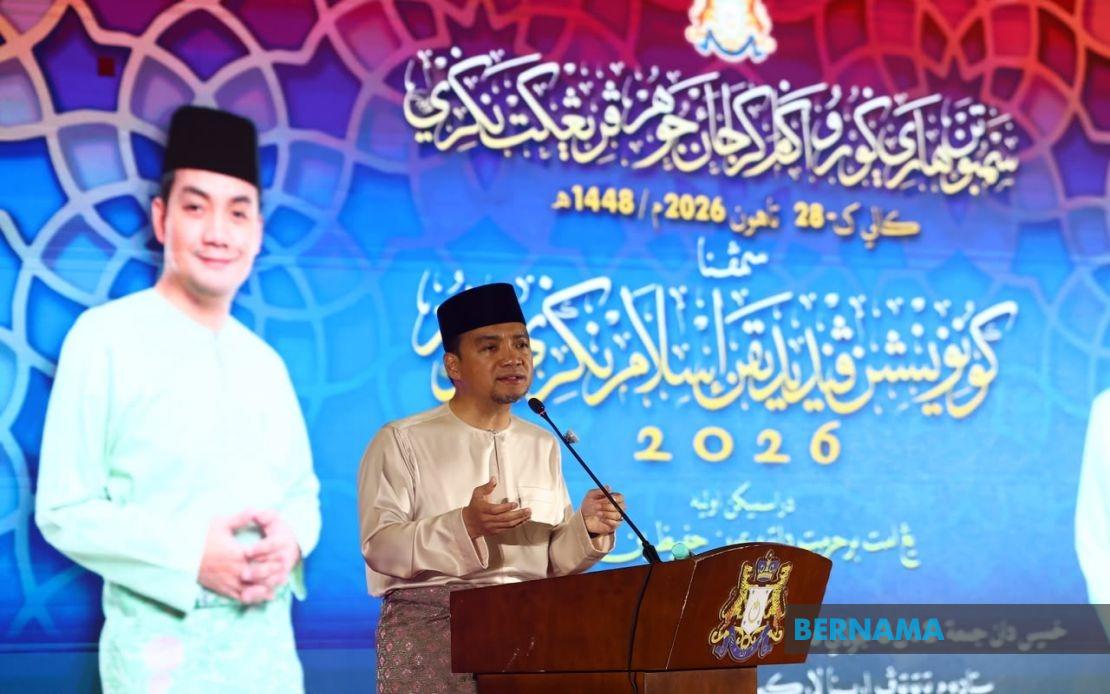
Johor's government has moved to broaden the scope of its ambitious education transformation programme by introducing it into the Islamic school sector, marking a significant expansion of its reform efforts beyond conventional institutions. The first Sekolah Agama Rintis Bangsa Johor (SARBJ) will be constructed in Kota Iskandar this year, representing an important step in integrating modern pedagogical approaches with religious education. This extension addresses a longstanding gap in Malaysia's education landscape, where religious schools have traditionally operated under different regulatory frameworks and modernisation timelines compared to mainstream institutions.
Menteri Besar Datuk Onn Hafiz Ghazi attributed the initiative's genesis to Tunku Mahkota Ismail, the Regent of Johor, whose vision encompasses a holistic reimagining of the state's entire educational ecosystem. The programme, originally launched as Sekolah Rintis Bangsa Johor (SRBJ) in conventional schools, has already demonstrated tangible results with four pilot institutions operational across primary and secondary levels. Two of these schools—Sekolah Menengah Kebangsaan Seri Kota Puteri 2 and Sekolah Kebangsaan Seri Kota Puteri 4—are located in Pasir Gudang, while SMK Tasek Utara and SK Tasek Utara operate in Johor Bahru. The decision to scale this model into religious education signals confidence in the framework's adaptability across different school types and pedagogical contexts.
The SRBJ framework rests on five interconnected pillars designed to modernise Malaysian education comprehensively. Digital learning integration forms the technological backbone, enabling schools to leverage contemporary tools and platforms that have become essential in post-pandemic educational landscapes. Multilingual proficiency is another cornerstone, recognising that Johor's position as a major economic hub demands graduates capable of communicating across multiple languages in an increasingly interconnected Southeast Asian region. Character development remains central to the philosophy, reflecting growing recognition that academic achievement alone cannot prepare students for complex societal challenges. Teacher empowerment through professional development and institutional support systems seeks to elevate the pedagogical quality that has long been constrained by resource limitations in many schools. High-quality educational facilities represent the final element, ensuring that physical infrastructure keeps pace with curricular ambitions.
The introduction of SARBJ into this ecosystem carries particular significance for Malaysia's Islamic education network. Religious schools serve approximately 120,000 students nationwide and function as crucial institutions for transmitting Islamic knowledge and values across generations. However, many have faced challenges integrating contemporary teaching methods with traditional curricula, resulting in perceived disparities in graduate employability and digital competence compared to their mainstream counterparts. By applying SRBJ's holistic transformation model to religious institutions, Johor potentially bridges this gap while maintaining the distinctive religious and moral dimensions that characterise Islamic education in Malaysia.
The practical implications for Johor extend beyond individual school improvements. Religious education in Malaysia operates within unique regulatory structures, with oversight shared between state Islamic affairs departments, the federal government, and Islamic bodies. Johor's initiative, announced during the state's 28th Religious Teachers' Day celebration, demonstrates coordination between secular educational governance and religious authorities—a collaboration often complicated by competing jurisdictional interests. The presence of State Islamic Religious Affairs Committee chairman Mohd Fared Mohd Khalid at the announcement underscores this institutional alignment, suggesting that Johor has successfully navigated potentially contentious governance questions.
Forward momentum will extend even further into early childhood education, with plans for a pilot kindergarten operating under the SRBJ framework. This downstream expansion recognises that educational transformation must begin at foundational stages rather than attempting remediation at secondary or tertiary levels. Early childhood programmes employing SRBJ principles could establish developmental trajectories that carry through subsequent years of schooling, potentially generating compounding benefits in digital literacy, character formation, and multilingual capabilities. The kindergarten initiative also acknowledges that Johor's education system requires comprehensive restructuring rather than isolated interventions targeting single school types.
Regionally, Johor's education initiatives assume heightened importance given the state's economic prominence and its function as a gateway between Malaysia and Singapore. The state hosts significant foreign investment, multinational operations, and increasingly serves as a technology hub. Graduates emerging from SRBJ-reformed schools possess skill sets better aligned with regional economic demands, potentially enhancing Johor's competitive positioning in attracting and retaining knowledge-intensive industries. The multilingual proficiency component particularly resonates in a context where cross-border collaboration with Singapore and regional ASEAN integration demand communicative flexibility.
However, sustaining this ambitious reform trajectory presents evident challenges. The four existing SRBJ schools represent pilot testing grounds, but scaling to encompass religious schools, kindergartens, and potentially other institutional categories requires substantial resource allocation, teacher training programmes, and curriculum development. Johor's approach appears cognisant of these demands, with the phased expansion suggesting realistic sequencing rather than overambitious rollout. The emphasis on teacher empowerment acknowledges that pedagogical transformation ultimately depends on educator capacity, commitment, and professional development opportunities that cannot be improvised.
The expansion into religious education also reflects broader Malaysian educational debates about balancing modernisation with preserving institutional distinctiveness. Islamic schools exist partly to transmit specific religious knowledge and values; too aggressive modernisation risks undermining their core purpose. The SRBJ framework appears calibrated to enhance effectiveness rather than fundamentally alter institutional missions, integrating digital tools, language competencies, and character development within Islamic educational contexts rather than imposing external templates. This approach may serve as a model for other states contemplating similar initiatives.

