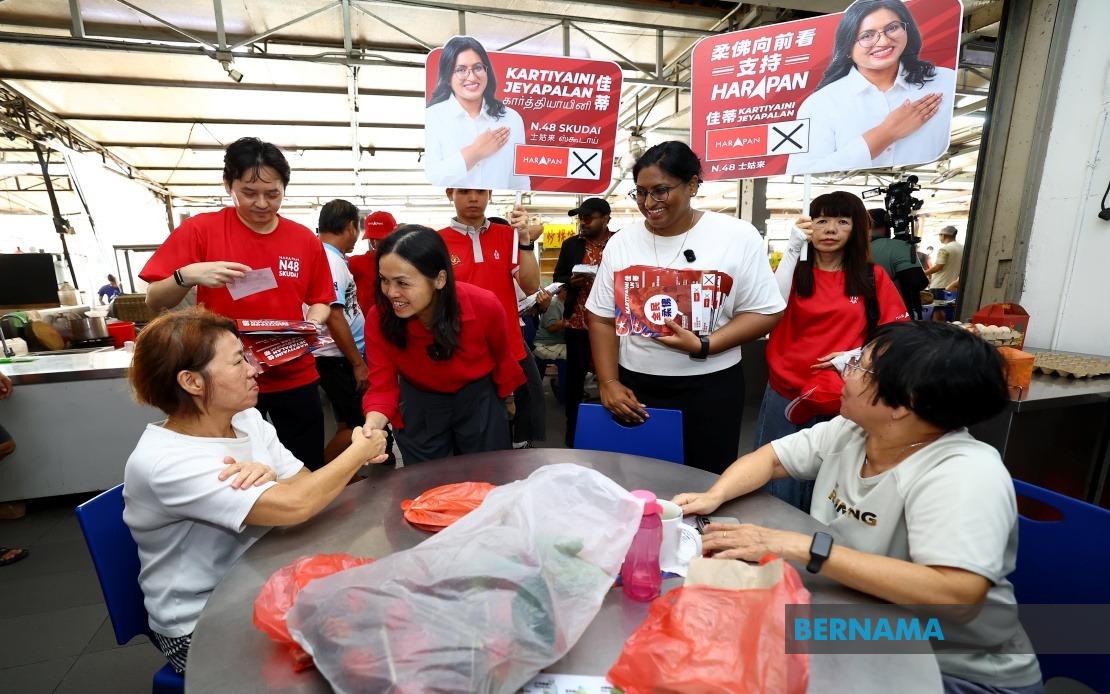
Johor's Democratic Action Party chairman Teo Nie Ching has made an impassioned plea to voters across the state, particularly those who have relocated for work or studies, to recognise the value of their ballot and participate in this Saturday's state election. Speaking after a campaign stop in Skudai, the Deputy Communications Minister emphasised that casting a vote represents a fundamental democratic privilege that many Malaysians take for granted, especially those living comfortably within the country.
To illustrate her point, Teo recounted several moving accounts of overseas voters who demonstrated extraordinary commitment to participating in Malaysia's electoral process. One voter based in Queensland, Australia, undertook a personal mission to locate someone at the airport willing to hand-carry his postal ballot back to Malaysia after courier services indicated they could not guarantee timely delivery before the July 11 deadline. These anecdotes highlighted the sacrifices that distant Malaysians endure simply to exercise a right that domestic voters can exercise with minimal inconvenience.
Another account involved a postgraduate student studying in China who rebooked an airline ticket at considerable personal expense—exceeding RM1,000—solely to return home and vote. Similarly, a Malaysian voter in the United States invested significant effort in identifying a fellow citizen who could properly witness their postal voting procedure. Teo presented these narratives not merely as touching human interest stories, but as a challenge to voters within Malaysia, particularly those working in economic hubs like Kuala Lumpur and Singapore, to demonstrate equivalent respect for their electoral participation.
The campaign messaging carries particular resonance for Johor, which hosts a substantial cross-border workforce commuting daily to Singapore. Pakatan Harapan candidate for Skudai, Kartiyaini Jeyapalan, revealed that the coalition's ground operation had been intensified to specifically target these workers, recognising that many might otherwise dismiss the state election as less consequential than federal polls. The strategy included early morning engagement at the Sultan Iskandar Building Customs, Immigration and Quarantine Complex, where PH activists positioned themselves at 5 am to intercept cross-border commuters and encourage their participation.
Jeyapalan noted that the campaign also extended to boarding buses transporting workers across the causeway, transforming routine commute journeys into impromptu voter mobilisation opportunities. She reported that the reception had been overwhelmingly positive, suggesting that voters recognised the relevance of state-level governance to their immediate circumstances. However, this enthusiasm at the grassroots level would need to translate into actual ballot box participation to meaningfully alter electoral outcomes in Johor.
Beyond voter mobilisation efforts, Teo sounded an urgent warning about the proliferation of deliberately misleading information designed to influence undecided voters in the election's final days. She identified misinformation as a growing threat to electoral integrity, particularly given how rapidly false narratives can proliferate across social media platforms compared to the dissemination of accurate reporting. The challenge is compounded by the difficulty of distinguishing legitimate news sources from spoofed accounts deliberately designed to appear authentic while promoting specific political narratives.
Teo advocated for a cultural shift toward greater digital literacy among Malaysian voters, proposing a "verify before you share" approach as a simple but potentially powerful countermeasure against misinformation's spread. She acknowledged that the internet's speed in distributing information, while beneficial for legitimate news dissemination, also enables falsehoods to gain traction more rapidly than fact-checks can debunk them. Her suggestion that voters simply refrain from sharing unverified claims represents an attempt to crowd-source the fight against fabrication by making individual social media users complicit in information quality control.
The Johor state election represents one of Malaysia's most closely watched sub-national contests, with 2.7 million registered voters preparing to determine representation across 56 state assembly seats. The election carries significance beyond Johor's borders, as it serves as a barometer for voter sentiment toward the current political configuration and an indicator of how electoral dynamics may shift at future general elections. Strong turnout among voters who have previously migrated within Malaysia suggests that state governance issues have assumed greater salience in voters' consciousness.
Teo's emphasis on voter registration and participation reflects recognition that elections are ultimately decided by turnout differentials as much as by persuasion. In competitive contests, the difference between victory and defeat often hinges on which campaign can more effectively mobilise its base voters and convert sympathisers into actual participants. For Pakatan Harapan in Johor, mobilising the geographically dispersed working population could prove decisive in several closely contested seats.
The misinformation warning carries particular weight given documented instances in recent elections where false claims about voting procedures, candidate backgrounds, or polling logistics have depressed participation among targeted voter populations. Teo's public emphasis on this threat serves dual purposes: alerting voters to exercise caution while simultaneously elevating the salience of information quality as an election issue. This meta-campaign against falsehood may itself influence voter perceptions of which parties can be trusted to govern responsibly.
The 16th Johor state election occurs within a broader context of Malaysian political transition, following the 2022 general election that substantially reshuffled parliamentary coalitions and introduced new governing arrangements at federal level. State elections in this period carry heightened significance as laboratories for testing how federal-level coalition dynamics translate into sub-national governance arrangements. Johor's result will provide early evidence regarding whether the federal arrangement has stabilised or whether underlying tensions continue creating electoral volatility.
For Malaysian voters observing from outside Johor, the election underscores broader questions about voter responsibility in democracies, the relationship between individual participation and collective outcomes, and the shared burden that maintaining electoral integrity places on all citizens. As Teo's anecdotes suggest, voters who contemplate the considerable effort others undertake to participate may be prompted toward greater reflection about the intrinsic value of voting beyond instrumental calculations about whether their individual vote could prove decisive.

