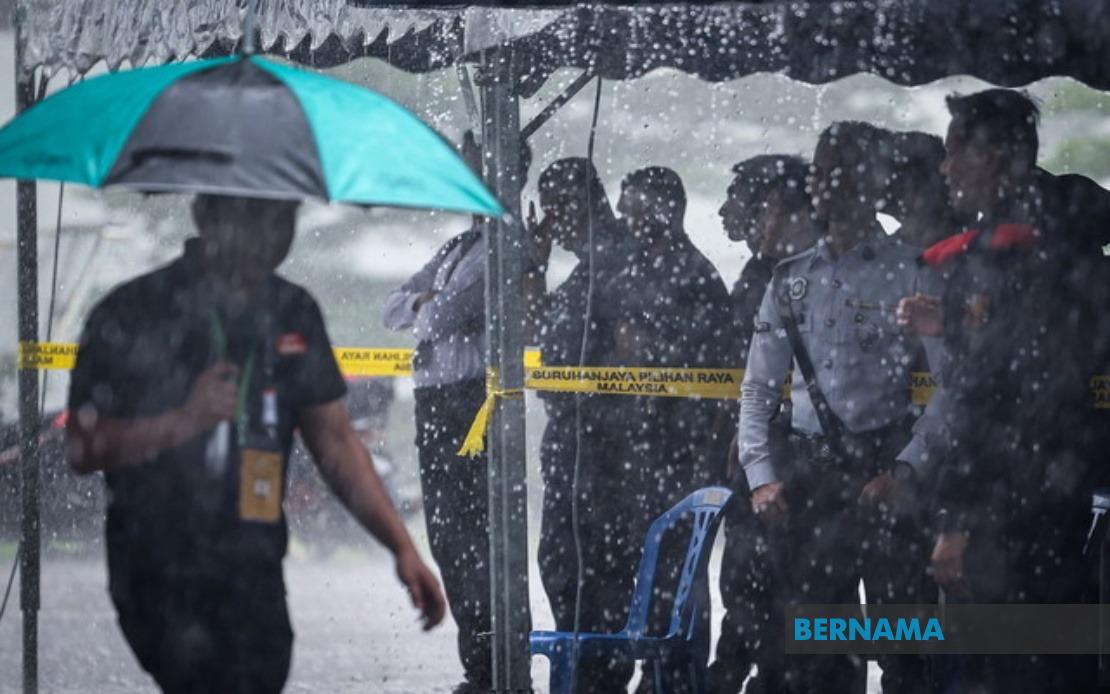
Early voting operations for the 16th Johor state election moved forward without significant disruption today in Johor Bahru, even as a heavy downpour swept through the area around 9.40 am. The inclement weather, while substantial enough to send media personnel scurrying for shelter and cause arriving police officers to quicken their pace, proved no obstacle to the orderly conduct of balloting at the State Police Contingent Headquarters. The scene reflected the professionalism and preparedness of both election officials and voters, who demonstrated remarkable resilience in navigating weather challenges that might otherwise have hampered electoral processes.
Police officers and their family members eligible to vote made steady progress through the polling centre throughout the morning, undeterred by the rain drumming on rooftops and creating temporary puddles in the surrounding area. The continuous flow of uniformed personnel arriving to exercise their franchise demonstrated strong participation among the force, a constituency that always commands attention in Malaysian electoral cycles. Media representatives documenting the early voting exercise had to improvise, positioning themselves under temporary tents erected specifically to protect them and election observers from the downpour, allowing coverage to continue uninterrupted.
The scale of the police vote reflects the institutional importance of security forces in Johor's electoral timeline. A total of 12,067 police personnel and their spouses participated in the in-person early voting process at designated polling centres across the state on this particular day, representing a significant bloc of the electorate. In addition to those voting physically at polling stations, another 643 police voters opted for postal voting arrangements, accommodating those whose operational duties or postings elsewhere precluded their attendance at designated venues.
The broader context of the Johor state election underscores why these advance voting arrangements matter. The full polling day is scheduled for Saturday, when the general electorate will exercise their franchise across the state. The contest itself is extensive in scope, with 172 candidates competing for representation across 56 state seats, reflecting vigorous political competition across multiple constituencies. The potential electorate extends to more than 2.7 million ordinary voters, making this a significant electoral exercise for one of Malaysia's most populous and economically important states.
Arrangements for early voting by police and security personnel have become standard practice in Malaysian elections, recognizing the operational constraints that prevent uniformed services from participating in normal polling day voting in many cases. By conducting dedicated early voting sessions, electoral authorities ensure that members of the security forces do not forfeit their democratic right to vote while simultaneously managing the logistics of maintaining security presence on the main polling day. This pragmatic approach has generally proven effective in maximizing participation while maintaining operational readiness.
The weather encountered on this particular voting day, while noteworthy, did not present the kind of severe disruption that occasionally affects election operations in the region. Heavy rain is not uncommon during Malaysian election cycles, and polling operations are typically designed with contingencies for such conditions. The covered facilities at the IPK headquarters provided adequate shelter, and the professional conduct of poll workers ensured that voting procedures remained orderly and efficient despite the atmospheric challenges.
For Malaysian voters and observers, the smooth conduct of police early voting serves as an indicator of broader election preparedness. The performance of electoral machinery on advance voting days often provides insight into whether systems can handle larger volumes of voters on the main polling day itself. The absence of significant bottlenecks or organizational failures during this specialized voting exercise suggests that preparations for Saturday's general voting have proceeded according to plan. Election officials would have adjusted procedures and staffing based on lessons learned in previous electoral exercises, and the seamless operation observed reflects that accumulated experience.
The participation of police spouses in this early voting opportunity is also administratively significant. Recognizing that family members of serving personnel also require accommodation in electoral scheduling ensures broader political participation and prevents the disenfranchisement of citizens whose household circumstances involve someone in uniform. The inclusion of spouses in dedicated early voting slots represents an evolution in electoral practice aimed at maximizing inclusion and participation across different demographic groups.
Johor's electoral significance extends beyond the state itself. As Malaysia's second-largest state by population and a major economic and political powerhouse, results in Johor traditionally influence broader national political calculations. Strong or weak performances by political coalitions in state elections here often foreshadow trends at the federal level. Journalists and political analysts will be watching Saturday's polling closely for signals about voter sentiment, the strength of competing political coalitions, and the trajectory of political forces ahead of potential future general elections. The early voting process, conducted efficiently despite weather challenges, sets the tone for what officials hope will be a well-organized and peaceful electoral exercise.
As voting progresses through its various phases, the early indications suggest that electoral officials have successfully managed the complex logistics involved in accommodating police and security personnel while maintaining normal voting procedures for the general electorate. The cooperation demonstrated by voters and the organizational capability shown by election officials despite atmospheric challenges provide reasonable confidence that the broader polling day will proceed effectively. For the millions of ordinary Johor voters awaiting their opportunity to cast ballots on Saturday, the smooth conduct of advance voting serves as a positive signal about the state of election management.

