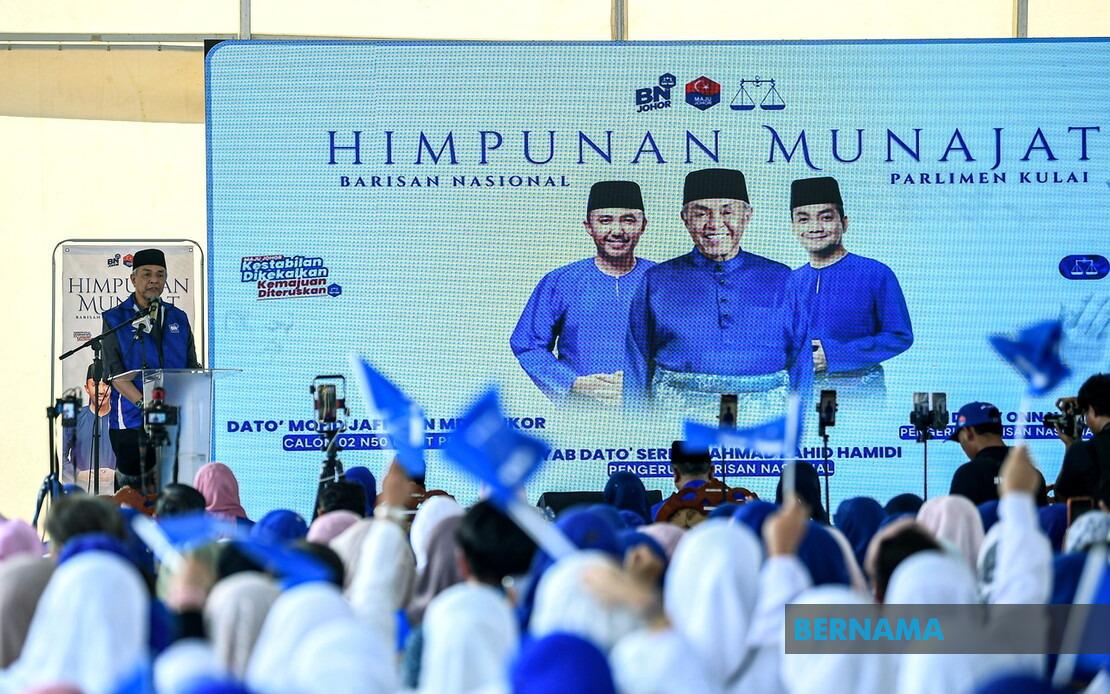
As Malaysia prepares for the 16th Johor State Election, Barisan Nasional has moved to reassure the nation that the outcome will pose no threat to the stability and cohesion of the federal administration, regardless of which coalition emerges victorious in the peninsular state. The statement from BN chairman Datuk Seri Dr Ahmad Zahid Hamidi reflects broader concerns about whether intense state-level political competition could spill over into damaging the working relationship between government coalition members in Putrajaya.
Addressing reporters after a BN prayer gathering in Kulai, Ahmad Zahid, who simultaneously serves as Rural and Regional Development Minister, emphasised that the federal government has continued operating smoothly throughout the campaign period. The message carries significance given that both Barisan Nasional and Pakatan Harapan are contesting all 56 seats in Johor, creating a genuinely competitive battle for control of the state assembly. Such high-stakes contests occasionally generate friction between national coalition partners, yet Ahmad Zahid's remarks suggest the government intends to maintain professional boundaries between electoral ambition and cabinet collaboration.
The Deputy Prime Minister's comments underscore a delicate balancing act that modern Malaysian coalition governments must perform. Ministers and deputy ministers from different parties competing fiercely in the same state election face inherent tension between their loyalty to party interests and their responsibility to the collective federal administration. Ahmad Zahid specifically highlighted that government ministers have demonstrated professionalism by compartmentalising these competing pressures, ensuring that campaign activities in Johor do not bleed into cabinet decision-making or inter-ministerial cooperation.
This distinction between state-level political competition and federal-level governance is crucial for understanding contemporary Malaysian politics. The current federal coalition comprises multiple parties with distinct organisational structures and electoral interests, yet they must function as a unified executive. Ahmad Zahid's remarks suggest that cabinet members have committed to maintaining this separation, treating policy discussions and administrative decisions as non-partisan matters even when their respective parties are locked in fierce electoral combat at the state level.
Ahmad Zahid further articulated that political differences emerging during the Johor campaign should not prevent coalition partners from working together effectively in cabinet. He acknowledged that parties will inevitably raise issues and deploy arguments designed to benefit their own candidates, as is customary during election campaigns. However, he stressed that these tactical moves represent normal political engagement rather than harbingers of instability at the federal level. Cabinet meetings, he indicated, have remained forums for deliberation conducted with wisdom, amicability, and professionalism.
The reassurance carries particular weight given Malaysia's recent political history. The country has witnessed several instances where state elections have triggered broader political realignments or created tensions within federal coalitions. By making this preemptive statement, Ahmad Zahid appears determined to establish a precedent that the Johor contest will not follow such patterns. The emphasis on ministerial professionalism suggests an expectation that personal relationships and institutional norms will prove resilient enough to withstand electoral competition.
Ahmad Zahid also appealed for emotional restraint from party members and grassroots supporters once results are announced tomorrow. Elections generate genuine passion among activists and ordinary supporters, and losing candidates sometimes struggle to accept outcomes gracefully. By calling for measured responses from both BN and Pakatan Harapan supporters, the BN chairman attempted to establish a framework for dignified political behaviour regardless of the winner. Such appeals, while sometimes dismissed as platitudinous, serve an important function in Malaysian democracy by reinforcing expectations of acceptable conduct during contested elections.
The remarks reflect broader lessons from mature democratic practice. Ahmad Zahid explicitly invoked the professionalism demonstrated by top leadership from both major political blocs, suggesting that institutional norms established by senior figures have filtered down to create genuinely cooperative relationships even amid electoral competition. This vertical transmission of professional standards represents one mechanism through which democracies prevent electoral contests from destabilising governing arrangements.
For Malaysian readers, the implications extend beyond immediate political calculations in Johor. The capacity of competing political coalitions to maintain functional federal governance while contesting vigorously at the state level demonstrates whether the country's institutional frameworks can sustain multiparty democracy. Successful separation of electoral competition from governing cooperation would validate the viability of Malaysia's current coalition model, potentially influencing how future state elections are managed across the federation.
The stakes are particularly significant because Johor represents the largest and most developed state in Peninsular Malaysia outside the federal territories. Control of the state government carries substantial implications for resource allocation, development priorities, and political influence within the broader Malay-Muslim community. Yet Ahmad Zahid's message suggests that both coalitions have accepted an implicit compact: intense state-level competition will not translate into federal instability.
Looking forward, the success of this arrangement depends on whether ministers and deputy ministers can genuinely maintain the compartmentalisation Ahmad Zahid described. Temptations will exist to leverage federal resources or administrative decisions to influence state-level outcomes, or alternatively, for defeated parties to retaliate through reduced federal cooperation. That Ahmad Zahid felt compelled to issue this reassurance suggests the tension is real, even if both coalitions apparently wish to manage it responsibly.

