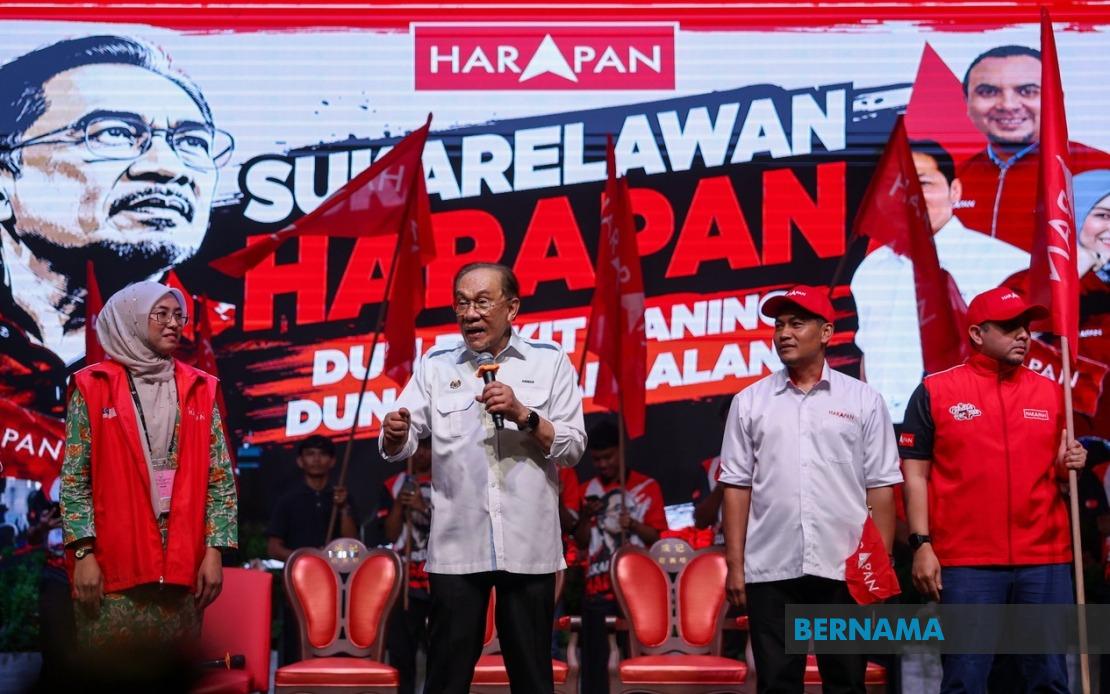
Prime Minister Datuk Seri Anwar Ibrahim has made an impassioned appeal to young voters in Johor, urging them to look beyond the racial and communal messaging that has long dominated Malaysian electoral campaigns and instead focus on electing leaders with concrete agendas to improve their lives. Speaking at campaign events in Muar ahead of the July 11 state election, Anwar positioned the ballot box as a tool for generational change, particularly among Malaysia's diverse youth population who he argued are increasingly fed up with tired political divisions.
The overarching message Anwar delivered centres on a fundamental rejection of what he terms the "rotten political system" that relies on stoking interethnic tension to mobilise voters. Rather than allowing themselves to be manipulated by narratives designed to create fear of Chinese voters, resentment towards Indians, or conflict between Malay and other communities, young people should evaluate candidates on their ability to deliver practical outcomes. Education quality, job creation, and equitable state development should be the currency of political debate, Anwar contended, not appeals to ethnic solidarity or historical grievances.
This messaging reflects a broader strategic calculation within Pakatan Harapan as it contests 56 state seats across Johor with 172 candidates in the field. By explicitly calling out what he characterised as outdated and divisive political narratives peddled by "the old guard," Anwar is attempting to frame the election as a choice between a modern, inclusive vision and a backward-looking politics rooted in ethnic compartmentalisation. The appeal to young voters is particularly significant in Malaysian politics, where youth demographics have become increasingly influential, yet often underrepresented in actual voter turnout relative to older cohorts.
Anwar's critique goes further than mere campaign rhetoric. He articulates a vision in which those who benefit from divisive politics—the elites "at the top" he references—deliberately maintain ethnic tensions to distract ordinary people while consolidating personal enrichment. This framing attempts to reorient political debate away from identity-based concerns towards class-based critique, suggesting that working and middle-class Malaysians of all backgrounds share common economic interests that transcend communal boundaries. For Malaysian readers, this represents a significant rhetorical shift in how the prime minister is positioning his coalition's electoral appeal.
The context of Johor's election carries particular weight in Malaysian politics. As a large, politically significant state with substantial populations of Malays, Chinese, and Indians, Johor has traditionally been a battleground between Barisan Nasional and opposition forces. The state's economic importance and its position as a gateway to Singapore make it a symbolic prize in Malaysian electoral contests. An election campaign centred on transcending racial politics in Johor carries implications for how national political discourse might evolve, especially if younger voters respond positively to such messaging.
Anwar's observation about the extraordinary turnout of young volunteers at his campaign events appears calculated to reinforce his argument that generational change is underway. By highlighting youthful energy and engagement, he seeks to demonstrate that young Malaysians are ready to move beyond the ethnic politics of their parents' era. This narrative of generational shift, whether empirically grounded or aspirational, serves to legitimise his coalition's campaign strategy and to suggest that history is tilting in favour of inclusive, issues-based politics.
The Prime Minister also emphasised that Malaysia's greatest strength historically has been its ability to maintain multiethnic harmony and coexistence. He framed divisive racial narratives not merely as bad politics but as fundamentally incompatible with Malaysia's identity as an independent, united nation. This patriotic framing—suggesting that racial divisiveness amounts to national sabotage—attempts to place opponents on the defensive by casting their tactics as anti-Malaysian rather than simply as alternative political strategies. For readers across Southeast Asia observing Malaysian politics, this represents an effort to reshape the terms on which political competition occurs.
Critically, Anwar's message also carries an implicit warning about the consequences of inaction. By calling on young people not to be mere bystanders but to actively take responsibility for shaping Malaysia's future, he frames political participation as a moral imperative for the younger generation. Those who abstain from voting or remain passive, by this logic, are complicit in allowing outdated elites to continue controlling the country's direction. This framing attempts to convert demographic advantage into actual electoral mobilisation, a perpetual challenge for opposition or reform-minded coalitions.
The messaging around the Johor election also reflects broader challenges facing multiethnic democracies in Southeast Asia and beyond. As societies grapple with economic inequality, job insecurity, and social fragmentation, the temptation for political leaders to resort to communal mobilisation remains strong. Anwar's campaign represents a counter-strategy—an attempt to persuade voters that their interests are better served by politicians who address material conditions rather than play on ethnic anxieties. Whether this appeal succeeds will offer important signals about voter appetite for post-racial politics in Malaysia.
Looking forward, the July 11 polling date will provide early indicators of whether Anwar's strategy of emphasising youth engagement and issues-based politics over ethnic messaging can translate into electoral gains. Early voting scheduled for July 7 provides an additional opportunity to assess turnout patterns, particularly among younger voters. For Malaysian political observers and regional analysts tracking democratic trends in Southeast Asia, the Johor result will help clarify whether the region's voters are genuinely shifting away from identity-based politics or whether communal considerations remain dominant factors in electoral decision-making.
The presence of specific Pakatan Harapan candidates for Simpang Jeram and Bukit Naning at Anwar's events underscores the grassroots nature of the campaign effort. These local contests, multiplied across 56 seats, will ultimately determine the election's outcome. Anwar's broader messaging about generational change and inclusive politics must filter down into constituency-level campaigns where candidates must convince local voters that their specific interests will be better served by PH representatives focused on practical governance rather than ethnic politics. The translation of his nationwide narrative into localised electoral success remains the crucial test of his campaign strategy in Johor.

