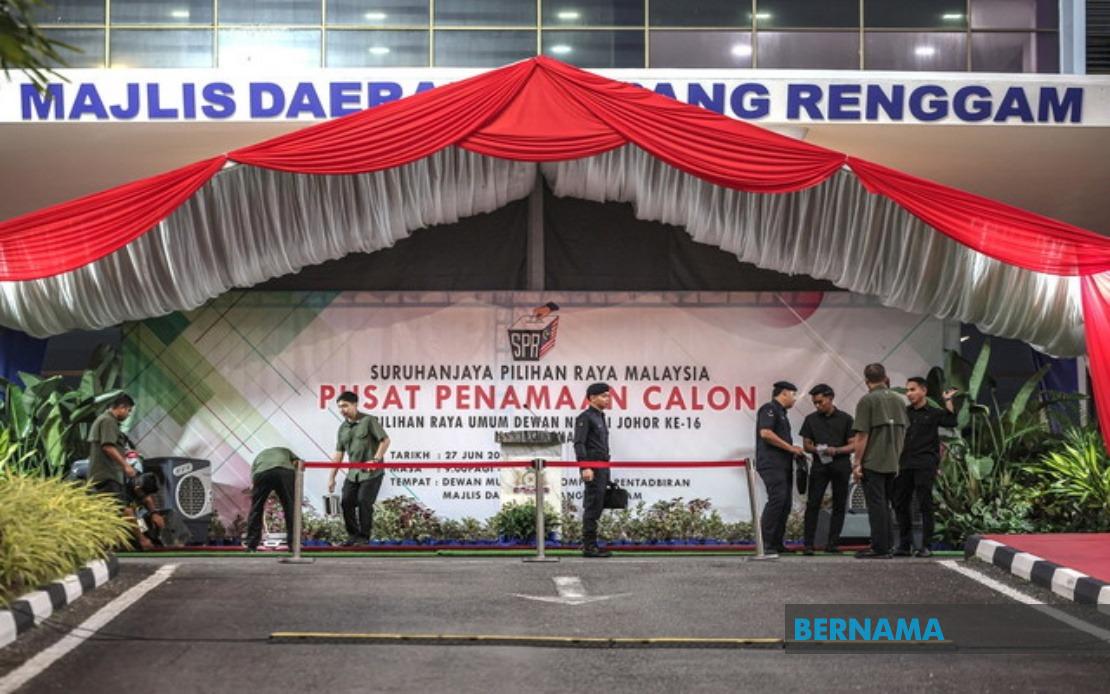
The 16th Johor State Election entered its critical nomination phase this morning as all 56 designated centres across the state began receiving candidate registration forms at 9am sharp. This coordinated opening marked the formal launch of the electoral process in Malaysia's southern state, with tight procedural timelines designed to ensure administrative efficiency and equal treatment across all constituencies. The compressed nomination window—restricted to just one hour until 10am—reflects the Election Commission's structured approach to managing a complex, multi-centre operation affecting millions of voters across the state.
Candidates, their proposers, and seconders were required to appear in person or through authorised representatives to lodge their nomination papers with the returning officer at their respective centres. The Election Commission's regulations specify flexibility in submission requirements, permitting the candidate alone, a combination of two persons, or all three to present the documentation. This procedural framework attempts to accommodate varying circumstances while maintaining clear accountability for each nomination submission. The verification process that follows will determine the final roster of eligible contestants before the official announcement, establishing the definitive field for the subsequent campaign period.
Political enthusiasm was evident from early morning, with party supporters converging on nomination centres from 6.30am onwards to demonstrate backing for their candidates. The visible mobilisation underscored the considerable stakes involved in this election and the genuine grassroots engagement that accompanies state-level contests in Malaysia. Such early gatherings are typical features of nomination day ceremonies, transforming administrative processes into occasions for party activism and public political expression across multiple constituencies simultaneously.
Weather conditions presented variable challenges across Johor's diverse geography on nomination morning. The Malaysian Meteorological Department had forecast scattered rainfall in several key areas including Johor Bahru, Muar, Batu Pahat, Kota Tinggi, Pontian, Tangkak, and Kulai, while drier conditions were expected in Segamat, Kluang, and Mersing. Afternoon thunderstorms were anticipated across most districts, adding precipitation uncertainty to an already logistically demanding day. Despite these meteorological complications, the nomination process proceeded as scheduled, with security and administrative personnel adapting to weather conditions without operational delays.
Security arrangements were notably comprehensive, reflecting the Election Commission's commitment to maintaining order during potentially volatile nomination proceedings. Police personnel, augmented by volunteers from the People's Volunteer Corps (RELA), deployed around all 56 centres to regulate traffic flow and prevent any disturbances. This multi-agency approach addresses the dual challenge of managing large supportive crowds while ensuring candidates and officials can conduct their business unimpeded. The visible security presence serves both practical and symbolic functions, demonstrating state capacity to administer complex electoral operations professionally.
The electoral franchise for this contest is substantial and geographically dispersed. The Election Commission's official statistics confirm that 2,727,926 registered voters are eligible to participate, comprising 2,703,175 ordinary citizens alongside 12,041 military personnel and their spouses and 12,710 police officers and their families. This voter base represents Johor's full demographic spectrum and underscores the significant political stakes involved. The inclusion of serving military and police personnel reflects Malaysia's constitutional arrangements regarding security force participation in electoral processes, a distinctive feature of the country's democratic model.
With candidate registration concluded, attention now shifts to the formally designated campaign period, which commences following the Election Commission's verification of submitted nominations and runs until 11.59pm on July 10. This 14-day window represents the compressed timeframe during which political parties, candidates, and civil society organisations must conduct their public outreach activities, debates, rallies, and targeted messaging. The abbreviated campaign duration compared to federal elections reflects state-level electoral norms in Malaysia and creates an intensive period of political activity across Johor's constituencies.
The electoral calendar itself condenses several key dates into a brief window. Early voting has been scheduled for July 7, permitting eligible voters unable to participate on polling day—including certain categories of workers, individuals with medical circumstances, and others—to cast their ballots in advance. This accommodation represents a modernising trend in Malaysian electoral administration aimed at improving accessibility and reducing barriers to participation. The main polling day itself is fixed for July 11, when the decisive outcome will be determined across all state constituencies simultaneously.
For Malaysian observers and international commentators, the Johor election carries particular significance beyond the state's borders. Johor represents one of Malaysia's most politically competitive and economically important states, with constituencies reflecting diverse demographic compositions, urban-rural divides, and distinct community interests. The state's electoral outcomes frequently serve as indicators of broader political trends affecting national coalition configurations and parliamentary majorities. Success or failure in Johor has historically reverberated through Malaysian politics, influencing calculations regarding federal government stability and the balance of power between competing coalitions. As the nomination process concludes and the campaign intensifies, all stakeholders recognise that Johor's 2,727,926 voters will help shape not only their state's immediate governance trajectory but potentially the broader political landscape across Malaysia's federal system.

