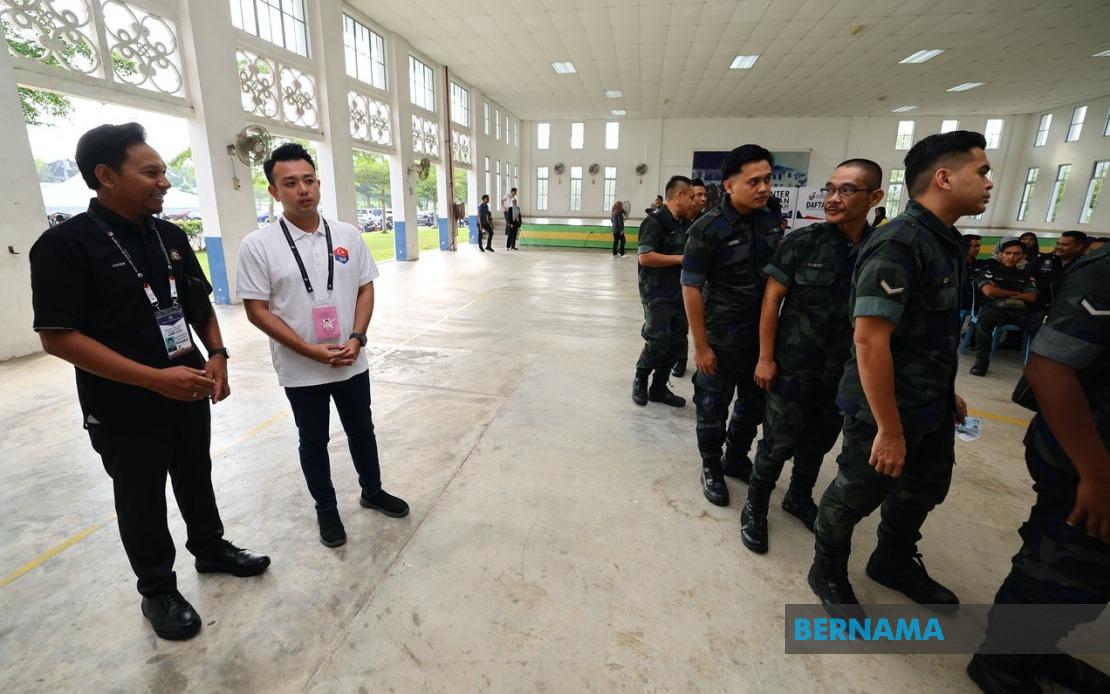
The intensity of campaigning in Johor did not prevent candidates from pausing to witness the mechanics of democracy in action. On Thursday, contenders vying for state seats made their way to early voting centres across the southwestern state to observe the polling process for uniformed personnel, just three days before Saturday's state election that will determine the composition of the Johor State Legislative Assembly.
The presence of these candidates at early voting venues served multiple purposes beyond mere observation. It provided them with an opportunity to demonstrate their commitment to electoral transparency while also keeping abreast of voter turnout among a crucial demographic — the armed forces and police personnel who, due to security duties on polling day, exercise their franchise ahead of the general public. The coordinated attendance of candidates across the political spectrum signalled the fundamental importance of credibility in Malaysia's electoral machinery, even amid intense partisan competition.
At the 5th Battalion General Operations Force Camp in Simpang Renggam, all three candidates contesting the Layang-Layang seat converged to observe proceedings. Guna Balakrishnan representing Pakatan Harapan, Chua Jian Boon of Barisan Nasional, and Abd Mutalip Abd Rahim of Perikatan Nasional stood as witnesses to how the Election Commission administered ballots for this strategic constituency. Similarly, the three candidates competing for the Tenggaroh seat — Muhamad Amerul Muhamad of Perikatan Nasional, Mohd Youzaimi Yusof of Barisan Nasional, and Md Yusof Dawam of Pakatan Harapan — carried out comparable observations at the Iskandar Camp early voting centre in Mersing.
Other constituencies also saw candidate participation. Lim Chin Eng, the oldest contender in the entire Johor contest, observed proceedings at the Johor Contingent Police Headquarters. Muhammad Faezuddin Mohd Puad of Pakatan Harapan monitored voting at Kempas Police Station, while Barisan Nasional's Datuk Jafni Md Shukor attended proceedings at Kulai District Police Headquarters. These distributed observations across multiple locations underscored how deliberately candidates had scheduled their monitoring activities to cover different voting centres and constituencies throughout the state.
Beyond the candidates themselves, the early voting process attracted senior military and security leadership. Army Chief General Tan Sri Azhan Md Othman and Major General Datuk Ahmad Shuhaimi Mat Wajab, commander of the 21st Special Service Group, visited the Iskandar Camp in Mersing. Johor police chief Datuk Ab Rahaman Arsad cast his own vote at Dewan Dato Onn at the Johor Police Contingent Headquarters. The participation of these top-ranking officials in the voting process highlighted the institutional significance attached to early polling for uniformed services.
The scale of early voting operations was substantial. A total of 20,607 registered voters participated in the early voting scheme, comprising 8,544 personnel from the Malaysian Armed Forces and their spouses alongside 12,063 police officers and their spouses. This figure underscores how Malaysia's security apparatus constitutes a sizable electorate segment that requires special arrangements to exercise voting rights without compromising operational readiness. For both the military and police, staging early voting ensures that critical positions remain adequately staffed on polling day itself.
The logistical framework supporting this exercise was equally impressive. The Election Commission opened 64 early voting centres that commenced operations at 8 am, with closure schedules varying between noon and 6 pm depending on voter registration numbers and geographical considerations. This staggered approach allowed the commission to manage the flow of voters while preventing congestion. Reports from observers confirmed that security personnel arrived in organised stages and maintained orderly queues, adhering strictly to procedures outlined by Election Commission officials.
Weather conditions posed a minor challenge as rain briefly fell across several locations. However, this precipitation did not materially disrupt the voting process or deter the turnout among eligible personnel. The continued arrival of uniformed voters despite inclement weather reflected both the seriousness with which they regarded their civic obligations and the effectiveness of the administrative arrangements that had been established.
The 16th Johor State Election represents a competitive three-cornered contest with 172 candidates contesting 56 assembly seats. The early voting process therefore offered genuine strategic value to candidates keen on assessing preliminary participation levels and observing the actual mechanics of ballot management. Such observations can inform campaign teams about electoral procedures and help candidates understand the mood among voter cohorts voting in advance of the main polling event.
The presence of candidates from all three major coalitions at early voting centres carries symbolic weight beyond mere observation. It demonstrates that despite polarised campaign rhetoric, there exists consensus among competing parties regarding the integrity and transparency of Malaysia's electoral administration. When candidates voluntarily attend early voting venues and permit themselves to be seen as witnesses to the process, they implicitly endorse the credibility of the electoral machinery. This implicit endorsement, in turn, strengthens public confidence in the legitimacy of results that will emerge from Saturday's polling.
For Malaysian observers and Southeast Asian analysts watching Johor's electoral dynamics, the professional conduct of early voting operations provides reassurance about institutional competence. While Johor politics remains contested and coalitions vigorously compete for voter support, the underlying electoral infrastructure demonstrates the maturity of Malaysia's democratic institutions. The ability of competing candidates and security leadership to coexist at early voting centres while respecting prescribed procedures reflects democratic norms operating beneath the surface of electoral contestation.

