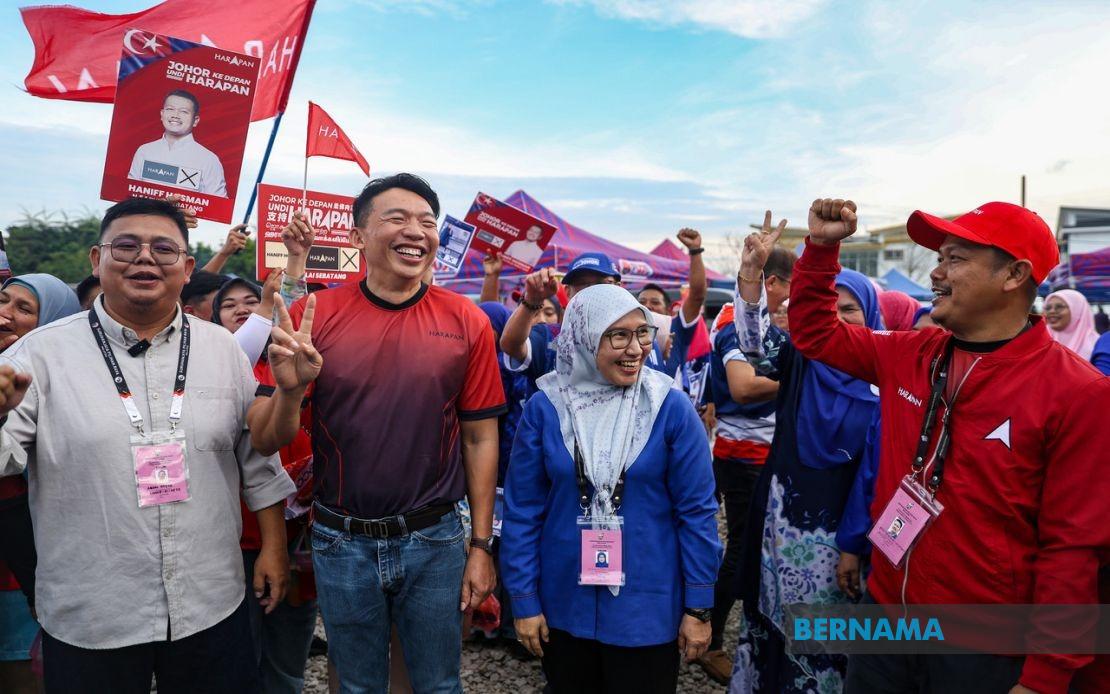
At a night market in Pontian, four election candidates representing rival political coalitions encountered each other during separate campaign activities, creating a moment that captured the civil nature of Malaysia's ongoing democratic processes. The meeting involved three Pakatan Harapan (PH) campaigners—Haniff @ Ghazali Hosman contesting Pulai Sebatang, Abd Razak Ismail running in Benut, and Cheah Chee Hong representing Kukup—who were conducting a joint walkabout through the Taman Megah night market. Their path crossed with Hasrunizah Hassan, the Barisan Nasional (BN) candidate for Pulai Sebatang, who was independently campaigning in the same location.
Initially, the convergence of two campaign teams displaying opposing political colours—red and blue flags respectively—appeared to create a tense moment at their junction point. However, the situation quickly transformed into a cordial exchange as the candidates acknowledged each other professionally. This unexpected interaction drew immediate attention from night market visitors, many of whom paused their shopping and conversations to observe the encounter, demonstrating public interest in how political rivals conduct themselves during the campaigning period.
When speaking to journalists immediately after the meeting, Haniff characterised the interaction as embodying the fundamental principles of a functioning democracy. He emphasised that the PH campaign team's approach in the Pontian area prioritised peaceful engagement with voters, and he welcomed the opportunity to encounter his direct opponent in a collegial manner. His comments suggested that such meetings, rather than being divisive, could reinforce the democratic norm of allowing opposing sides to coexist respectfully within the same physical and political space.
The Pulai Sebatang candidate further underscored that the campaign environment across Pontian remained orderly and undisturbed, implying that political competition could proceed without compromising community harmony or public safety. This perspective is particularly significant given Malaysia's history of contentious elections, where campaigns occasionally escalated into confrontational territory. The measured tone of his remarks suggested an intention to distinguish the current campaign from potentially more contentious scenarios.
Cheah, representing the Kukup constituency for PH, expressed satisfaction at campaigning alongside his coalition partners and used the platform to appeal directly to voters across the three contested seats in the region. His statement emphasised the unity and mutual support within the PH alliance, positioning the joint campaign strategy as both organisationally efficient and symbolically important for coalition cohesion. By framing the encounter in this context, he highlighted how even chance meetings during campaigning could serve as informal demonstrations of alliance strength.
Hasrunizah, speaking from the BN perspective, characterised encounters between candidates from different parties as unremarkable occurrences that actually reflected positive democratic maturity within Johor. Her interpretation suggested that the ability of rivals to meet without incident or acrimony represented democratic progress rather than anomaly. She indicated that while the campaign intensity was increasing as election day approached, the overall situation across Johor remained stable and controlled, with no significant disturbances reported.
The BN candidate's statement carried particular weight given her dual representation of both BN and Maju Johor, the local political coalition supporting the current state government. By emphasising that such encounters energised rather than discouraged her campaign efforts, she projected confidence in her party's electoral prospects. Her willingness to frame the meeting positively suggested an established pattern of professional interaction between candidates in the Pontian area.
The Johor state election, scheduled for July 11 with early voting on July 7, represents a significant test for both ruling and opposition coalitions. The contest encompasses numerous constituencies across the state, with results potentially influencing the broader political trajectory in Malaysia's second-largest state by population. The campaign in constituencies like Pulai Sebatang, Benut, and Kukup has garnered particular attention due to their competitive nature and demographic significance.
The incident at the Taman Megah night market carries implications beyond the immediate constituencies involved. It signals that campaign conduct during the Johor elections has, at least in the Pontian region, maintained professional boundaries despite intense political competition. This contrasts with campaigns elsewhere that have sometimes deteriorated into personal attacks or confrontational behaviour, suggesting that electoral standards may be improving across Malaysian politics.
The public reception to the candidates' meeting—with night market visitors pausing to observe rather than react negatively—provides insight into how ordinary Johoreans view political competition. The lack of tension or hostile reactions suggests voter appreciation for civilised campaign practices. In an era where political polarisation concerns observers worldwide, such moments of mutual respect between rival politicians carry symbolic importance for democratic culture.
For voters across the three constituencies, the demonstration of professional conduct among candidates offers positive signals about the tone of local governance, regardless of which coalition ultimately prevails. The ability of political rivals to acknowledge each other respectfully during campaigning often correlates with more constructive parliamentary interactions post-election. This particular encounter thus transcends the immediate campaign narrative to suggest something broader about political culture in contemporary Johor.
As the campaign progresses toward July 11, the Pontian night market meeting will likely become a reference point for discussions about campaign conduct. Whether such civility becomes the established norm or remains an isolated incident will depend on how political competition develops across remaining constituencies and polling day itself. The candidates' public endorsement of peaceful, professional campaigning establishes a benchmark that voters may increasingly expect from political representatives seeking their support.

