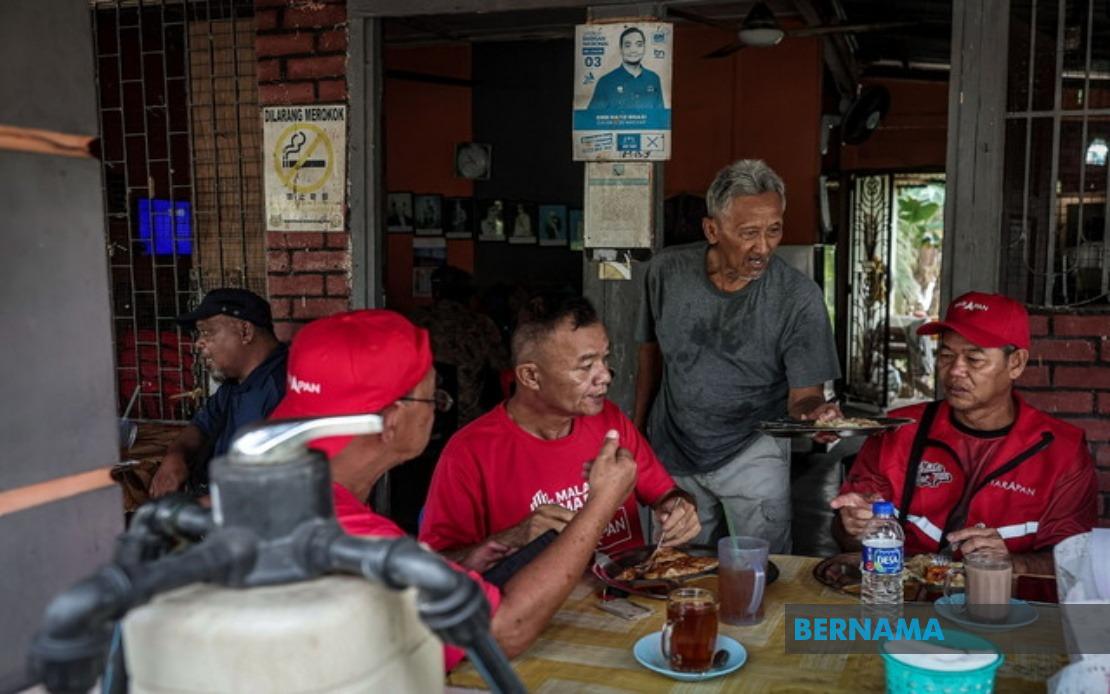
Beneath the political drama unfolding across Johor lies a quieter but equally significant story for the state's informal economy. The campaign season for the 16th Johor state election has unexpectedly transformed into a lucrative period for small-scale traders and hawkers, particularly in areas like Layang-Layang and Simpang Renggam, where the influx of campaign workers, party delegations, and election observers has created genuine commercial opportunity for everyday business operators who typically struggle with modest margins and inconsistent traffic.
For Noorma Zafmeeden, a 70-year-old stall proprietor in Felda Layang-Layang, the contrast between ordinary trading days and the campaign period is stark and unmistakable. Her warung, which has become a fixture in the settlement community, specialises in serving roti canai and nasi lemak, two breakfast staples deeply embedded in Malaysian food culture. Under normal circumstances, her morning takings rarely exceed RM400, a figure that reflects the economic realities facing many rural traders operating on thin profit margins within established agricultural settlements.
The arrival of the election campaign has fundamentally altered this baseline. Since the electoral process commenced, Noorma's daily revenue has climbed significantly beyond her previous expectations, a shift that she attributes directly to the heightened activity and foot traffic accompanying the political season. This phenomenon reveals an understudied dimension of Malaysian elections: the way democratic processes, with their attendant infrastructure of campaigning, voter engagement, and movement of political personnel, create economic multiplier effects in communities far removed from policy discussions or electoral analysis.
Noorma and her husband Bahari Madiran, 76, have operated their warung since settling in the Felda community in 1987—a tenure spanning over three and a half decades. Their daily rhythm begins well before dawn, with preparations for the breakfast service, followed by evening operations offering a variety of fried dishes tailored to local preferences. Beyond the purely commercial dimensions, Bahari reflects on their warung's deeper social significance, viewing it as a space where individuals from different ethnic and religious backgrounds converge in genuine harmony and mutual respect. The election campaign has intensified this role, as political delegations, campaign workers, and visitors from across Malaysia have patronised the establishment, creating opportunities for cross-community dialogue that extends beyond the immediate transaction.
Barahi, a father of five, derives considerable satisfaction from the expanded interaction his warung now facilitates. The temporary visitors flowing through during the campaign period represent a microcosm of Malaysia's diversity, and their presence at his modest establishment underscores how elections, for all their contentious nature, can create unexpected bridges between previously disconnected communities. This human dimension sits alongside the purely economic benefits, suggesting that the campaign's value to rural traders encompasses both immediate financial gain and the intangible benefits of expanded social networks and community visibility.
The phenomenon extends beyond Layang-Layang into other campaign hotspots. Ahmad Ridzuan Awang, a 45-year-old nasi campur vendor operating in Simpang Renggam, has witnessed an even more dramatic transformation in his business operations. His customary pattern involved gradually moving through his daily inventory, with the complete depletion of his prepared dishes typically occurring only as evening approached. Since the state election campaign intensified, this timeline has compressed dramatically—trays of carefully prepared dishes now sell out by mid-afternoon, around 1.30 pm, driven by bulk orders from various political parties and campaign groups operating throughout the constituency.
Ahmad Ridzuan's characterisation of the election influx as "political tourists" captures an important dynamic often overlooked in electoral discourse. These visitors represent not merely floating voters or demographic targets but genuine consumers whose presence animates local commercial ecosystems. The compression of his sales cycle by several hours daily translates into tangible additional revenue, yet it also requires operational adjustments and inventory planning that demands flexibility and responsiveness from vendors accustomed to more predictable, if modest, demand patterns.
The economic benefits flowing from the election campaign demonstrate a characteristic spillover effect across multiple tiers of the local economy. Food vendors such as Ahmad Ridzuan acknowledge that their increased sales directly stimulate demand among their suppliers and supporting businesses—transport operators, produce wholesalers, and ingredients merchants all benefit from the elevation in consumption. This multiplier mechanism, though temporary, highlights how electoral processes can inject demand shocks into communities operating in economic conditions that frequently preclude such expansions through conventional commercial channels.
The 16th Johor state election encompasses 172 candidates competing for 56 seats across the state, with voting scheduled for July 11 and early voting already underway on July 7. The scale of this electoral exercise—involving candidates, campaign teams, observers, and ancillary personnel numbering in the thousands—creates the logistical foundation for the economic stimulus experienced by petty traders. The concentration of human movement and commercial activity around campaign venues and transit routes naturally gravitates toward established food and beverage providers, transforming routine warung operations into temporary nodes within larger political infrastructure.
This economic windfall, while genuine and appreciated by vendors who often operate with minimal safety margins, remains fundamentally temporary and contingent upon the election cycle. The same traders who now report doubled or tripled sales will likely revert to previous income levels once the campaign concludes and normal community traffic patterns resume. This cyclical quality—where democratic processes provide periodic but temporary relief for economically marginal operators—reflects broader structural challenges facing Malaysia's informal economy, where hawkers and petty traders persistently struggle with thin margins, limited access to capital, and vulnerability to external demand shocks.
The Johor election campaign thus offers a lens through which to examine the intersections between political processes and grassroots economic activity. While mainstream electoral coverage focuses on campaign strategies, voter preferences, and political manoeuvers, the experiences of traders like Noorma, Bahari, and Ahmad Ridzuan illuminate a parallel reality where elections function as temporary economic stimuli for communities ordinarily relegated to the periphery of Malaysia's formal economy. Their warung and stalls become inadvertent beneficiaries of democratic participation, gaining visibility and revenue during the compressed timeframe of electoral competition, before returning to their customary rhythms once voters have cast their ballots and political attention moves elsewhere.

