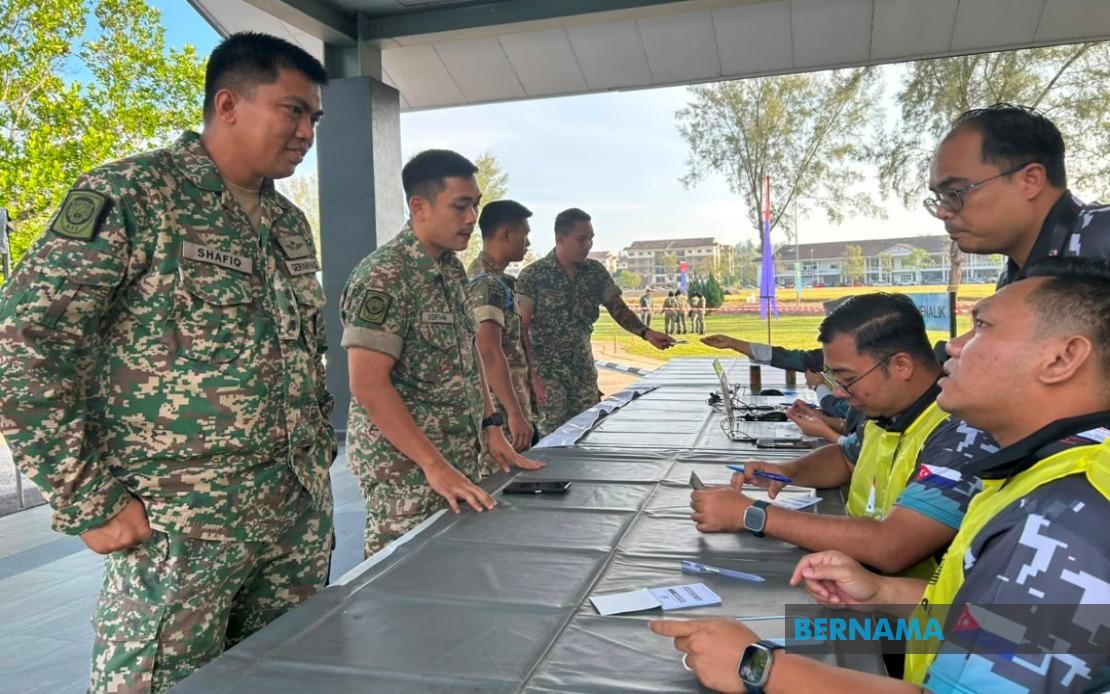
Early voting in the Johor state election commenced on July 7 under pleasant weather conditions, with security and law enforcement personnel beginning to exercise their electoral rights from the opening of polling centres at 8 am. The benign morning conditions facilitated smooth operations across the 64 designated early voting locations, allowing Election Commission staff and the security contingents they were serving to move about freely and process votes without hindrance. However, forecasters cautioned that the favourable conditions would not persist throughout the day, with the Malaysian Meteorological Department issuing alerts for potentially severe thunderstorms to develop across various parts of the state during the afternoon hours.
The early voting framework accommodated a substantial bloc of the electorate whose operational commitments required them to cast ballots before the scheduled election day. A total of 24,751 early voters participated across the network of centres, comprising 12,041 personnel from the Malaysian Armed Forces and their spouses, alongside 12,710 officers from the Royal Malaysia Police and General Operations Force, together with their family members. This arrangement, standard practice in Malaysian electoral cycles, ensures that security personnel maintaining operational readiness throughout the election period retain their democratic participation rights without compromising their institutional duties.
Election Commission personnel had conducted comprehensive preparatory work ahead of the early voting day, conducting final inspections and technical verifications to ensure each polling station was properly equipped and organised. Bernama observers who visited several facilities—including the 5th Battalion GOF Camp in Simpang Renggam, the Johor Contingent Police Headquarters, and Mahkota Kluang Camp—reported that voting procedures advanced without incident or notable delays. The orderly progression across multiple locations suggested effective coordination between election administrators and the security establishment, a critical prerequisite for maintaining public confidence in the electoral process.
The staggered closure schedule for early voting centres reflected operational flexibility built into the electoral design. Rather than closing simultaneously at a fixed hour, the 64 centres would wind down their operations between noon and 6 pm, with precise timings varying based on each location's voter population and logistical circumstances. This approach aimed to accommodate the varying shift patterns and deployment schedules of military and police units, recognising that security personnel operate according to institutional timetables that do not necessarily align with standard civilian voting hours.
The broader context of the Johor state election involved a considerably larger voting population than those participating in the early phase. The state registered 2,727,926 eligible voters distributed across 1,140 polling centres positioned throughout all 56 state assembly constituencies. The scale of the electoral machinery required to accommodate this population underscored the administrative complexity inherent in managing democratic processes across a major Malaysian state. The Election Commission's deployment of resources across such an extensive network, whilst maintaining standards of impartiality and procedural integrity, represented a significant operational undertaking.
Contention for the state legislature centred on 56 seats, with 172 candidates vying for representation across these constituencies. This candidate-to-seat ratio indicated a moderately competitive electoral environment, with multiple contestants in numerous races potentially creating complex three-way or multi-way contests that could fragment voter preferences and produce unexpected outcomes in tightly balanced divisions. The distribution of candidates across constituencies would likely reveal patterns regarding which political formations retained strong organisational capacity and popular appeal across different regions of the state.
Voters across Johor were scheduled to visit polling centres on the following Saturday to cast their ballots in the 16th state election under the state's electoral cycle. The sequence of events—with early voting for security personnel on Wednesday followed by the main polling day on Saturday—had become the established routine for Johor elections, creating a predictable pattern that allowed political campaigns to calibrate their final messaging and voter mobilisation efforts accordingly. The two-stage process also generated early indicators regarding voter sentiment, as analysts typically scrutinise early voting patterns and unofficial preliminary results to discern emerging electoral trends.
The meteorological warnings regarding afternoon thunderstorms highlighted how weather conditions, though often overlooked in electoral analysis, could meaningfully influence voter turnout and the practical functioning of polling operations. Heavy rainfall, lightning strikes, or strong winds could deter some voters from attending polling centres, potentially skewing the demographic composition of those who ultimately cast ballots. For election administrators, severe weather could also create logistical challenges in transporting ballot materials, securing facilities, and managing crowds at polling locations, adding an extra layer of complexity to an already intricate operational scenario.
For Malaysian observers tracking political developments in this major state, the Johor election carried significance beyond the immediate question of which parties would control state legislative seats. Johor's political complexion had shifted markedly in recent years, with changing voter preferences reflecting broader currents affecting Malaysian politics nationally. The 2023 general election had seen substantial realignment across the peninsula, and the state-level contest offered an opportunity to assess whether those shifts had stabilised or continued to evolve. Strong performances by particular coalitions in Johor could signal momentum heading into future national contests, whilst surprising results might suggest that voter sentiment remained unsettled or that certain political narratives retained persuasive power in specific regions.

